About Communication Receiver Demonstration Unit
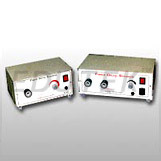
Communication Receiver Demonstration Unit
- Specifications of Communication Receiver Demonstration Unit.
- Communication Receiver Demonstration Unit.
- Principle : AC Position control system. AC Synchro Differential Generator.
- Displacement : Angular displacement ; Clockwise & Anti clockwise.
- Control Transformer : Specially designed reversible five terminal component with high impedance stator winding.
- Mounting : It is mounted with calibrated dial on front panel.
- Controls : Control Transformer knob mounted on its shaft.
- Test Points : Multi colored test points are provided at various stages in the circuit to observe waveforms and voltages.
- Power Requirements : It will derive its required power from AC Synchro Transmitter & Receiver.
- Standard Accessories : 1. Set of required number of patch cords. 2. Detailed Instruction Manual.
Designed for Practical LearningThis demonstration unit serves as an essential tool for teaching the principles of communication receivers. The manual control interface allows users to experiment with frequency tuning, signal reception, and audio output, making theoretical concepts tangible. Its analog dial and indicator LEDs enhance understanding during hands-on training.
Robust and Safe for Educational EnvironmentsBuilt with a durable metal cabinet and standard laboratory equipment thickness, this receiver prioritizes safety. Features such as fuse protection and fully insulated wiring safeguard learners during use. The compact, fixed bench-top design ensures stability during classroom or lab demonstrations.
Complete Setup for Immediate UseEvery receiver comes with essential accessories: a user manual for guidance, an external antenna for signal reception, and a power cord. Its 230 V AC mains power requirement aligns with institutional infrastructure, ensuring straightforward integration into educational setups.
FAQs of Communication Receiver Demonstration Unit:
Q: How does the superheterodyne tuner improve reception clarity in the demonstration unit?
A: The superheterodyne tuner enhances reception by converting incoming radio frequencies to a fixed intermediate frequency, which reduces interference and allows for clearer audio output. This makes it ideal for educational demonstrations of real-world radio communication.
Q: What teaching benefits does this receiver unit provide in a classroom or laboratory setting?
A: This unit enables learners to observe and understand key receiver functions, such as frequency tuning, audio amplification, and signal isolation. It offers hands-on experience that bridges theory and practice in wireless and radio communication training.
Q: When and where is this demonstration unit most effectively used?
A: The receiver is best utilized in educational institutions, vocational training centers, and laboratories during radio communication or electronics labs. Its design supports both individual instruction and classroom demonstrations.
Q: What is included with the Communication Receiver Demonstration Unit upon purchase?
A: The package includes the receiver unit, an external antenna, a user manual for guidance, and a power cord. These components ensure users are equipped for immediate setup and operation.
Q: How do the safety features of the unit protect users during operation?
A: The receiver is equipped with fuse protection and insulated internal wiring, minimizing risks of electrical faults and ensuring a safe environment for practical demonstrations and usage.
Q: What is the process for setting up the unit in a laboratory or classroom?
A: Setting up involves placing the compact receiver on a secure bench-top, connecting the external antenna and power cord, and following the user manual to explore functions like tuning and volume adjustment via the manual control panel.
Q: What practical skills can users develop with this demonstration unit?
A: By interacting with tuning dials, frequency selectors, and switches, users gain hands-on expertise in operating communication receivers, interpreting analog displays, and understanding RF signal processingvaluable skills for wireless and radio technology fields.