About Audiometer
Audiometer
Our Audiometer Equipment Calibration Complies with - ANSI S 3.6 1989, ISO 389 1991, IEC 645, Standards for electromedical equipment.
Technical Specification
- Input
- Tone, speech-built in & Ext. Mike
- Output
- Left, Right, Bone
- Freq.
- Air (-20 db to 120 db) 250 Hz to 8 Khz - 5 db Step. Bone (-20 db to 80db) 250 Hz to 6 Khz- 5 db Step.
- Masking
- Wide Band-10db Step., 100 db Max.
- Tests
- Pure Tone, Speech, Tone Decay (counter)
- Tone
- Continuous & Pulse
- Screen
- L.C.D.(with contrast control)
- Head Phone
- DR 59, TDH 39/49/Optional
- Bone
- B-71 Radioear
- Indication
- V.U. Meter for Speech
- Voltage
- AC 230 / 50 Hz, DC 12V (IA) Operation
- Weight
- 3.5Kg. (With Shoulder Bag)
- Dimension
- 25 x 21 x 7.5 cm
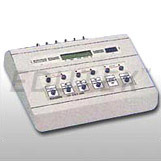
Offering both manual and automatic operating modes, this audiometer covers a wide range of diagnostic needs. Its compact design, lightweight build (2.2 kg), and optional three-hour battery operation enhance mobility within clinics and hospitals. The interface is intuitive, supporting efficient workflows for audiology professionals.
Robust Connectivity and Data ManagementEquipped with USB and RS232 ports, this device ensures seamless integration with hospital information systems and facilitates efficient storage of up to 100 patient records. The audiometer supports accurate measurement with 2 dB precision, contributing to reliable patient diagnostics and streamlined data handling.
Comprehensive Accessory Kit and Reliable BuildIncluded accessories such as standard headphones, bone vibrator, and patient response switch provide everything needed for immediate use. The device is built from durable ABS plastic and metal, featuring ISO-standard calibration and user-calibration options. Its clean white-blue aesthetic and rectangular design are well suited for modern clinical environments.
FAQs of Audiometer:
Q: How does this audiometer assist in the detection and assessment of hearing loss?
A: The audiometer evaluates hearing sensitivity by delivering precise sound stimuli via air, bone, and free-field conduction. Clinicians use different frequencies, masking types, and patient response mechanisms to accurately detect and assess hearing loss in both adults and children.
Q: What types of hearing tests can be performed using this device?
A: This audiometer supports pure tone audiometry, speech audiometry, and tests involving narrow band, speech, and white noise masking. It enables both manual and automatic operation (including Bekesy mode) to tailor the assessment process to patient needs.
Q: When should calibration be performed and can users calibrate the device themselves?
A: Calibration should be performed according to IS standards or whenever accuracy needs verification, such as after relocation or extended use. The audiometer features user-calibration capability, allowing audiologists to maintain precision without external service calls.
Q: Where is this audiometer best suited for use?
A: Designed for medical facilities, this audiometer is ideally suited for use in hospital audiology departments and clinics. Its robust build and user-friendly interface make it suitable for both stationary and mobile hearing testing across varied healthcare settings.
Q: What is the process for storing and retrieving patient test records?
A: The audiometer can store up to 100 patient records internally. Data can be easily saved and retrieved using the digital LCD interface, and information is quickly transferred to external systems via USB or RS232 ports for enhanced case management.
Q: Why is battery backup an important feature for this device?
A: The optional battery backup provides up to three hours of operation without mains power, ensuring uninterrupted testing during power outages or in settings where reliable electricity is not guaranteed. This supports continuous workflow and protects patient data integrity.




 Send Inquiry
 Send Inquiry

