About VAN DE GRAAFF ELECTRIC
Specification:
VAN DE GRAAFF ELECTRIC
Construction:
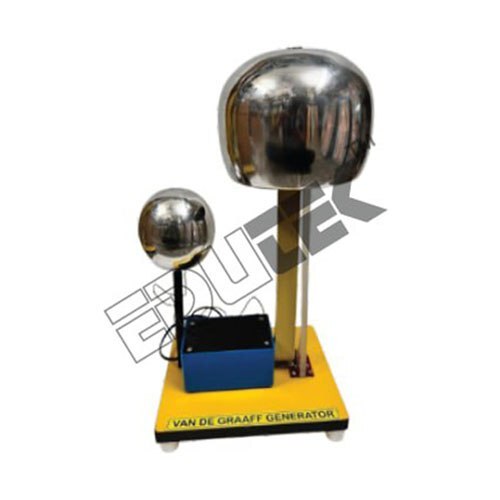
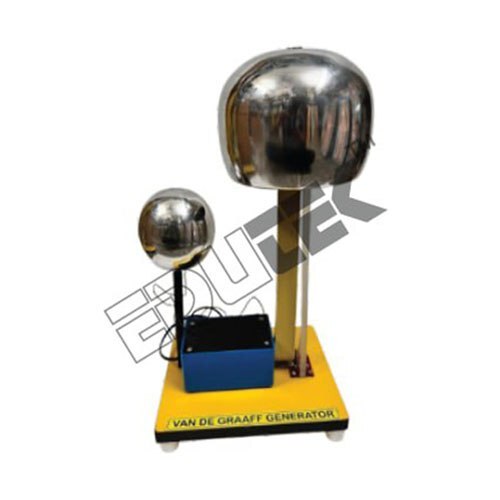
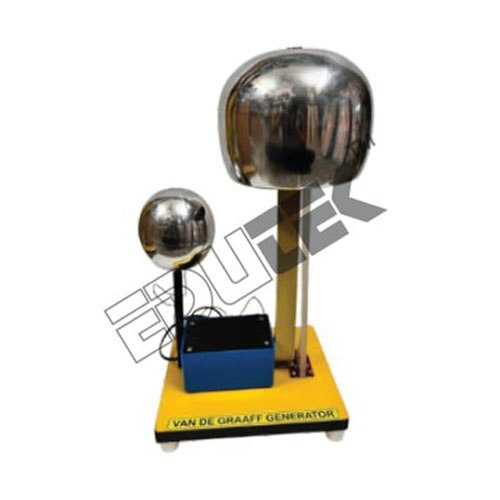
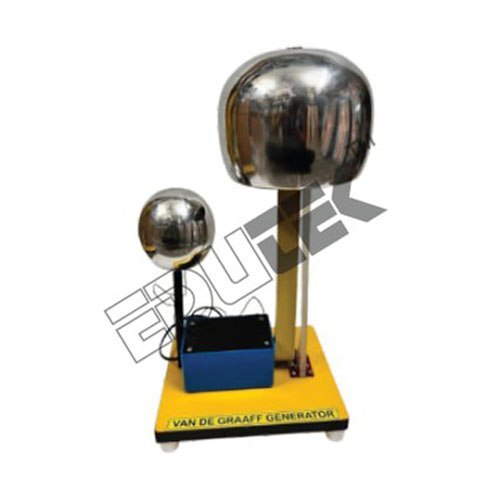
A Van de Graaff generator consists of a rubber belt that moves over a pair of rollers, with a hollow metal sphere placed on an insulated stand around one of the rollers. The generator also has an electron emitter comb near the lower roller and a receiver comb near the upper roller.
Principle:
The electrons repel each other and spread out on the surface of the sphere. When the potential of the sphere exceeds the breakdown value of air
Robust Design and ConstructionThis Van de Graaff generator boasts a resilient build with a sturdy plastic or coated steel base and a metal dome measuring approximately 220 mm in diameter. Its construction ensures long-term durability and dependability for continual laboratory use.
Efficient Static Electricity GenerationEquipped with a powerful 1/8 HP motor and a high-quality belt system, the device generates up to 500,000 volts of static electricity. The immediate response time upon activation makes it ideal for experiments requiring quick and reliable results.
Safe Operation for LaboratoriesSafety features include insulated supports and a discharge rod, providing secure operation even at high voltages. These ensure that educators and engineers can use the device confidently in academic and professional electronics laboratories.
FAQs of VAN DE GRAAFF ELECTRIC:
Q: How does the VAN DE GRAAFF ELECTRIC generator produce high voltage static electricity?
A: The generator uses a motor-driven belt made of high quality rubber or fabric that moves between two rollers. As the belt travels, it transfers electric charge to the dome through a process called triboelectric charging, resulting in the accumulation of static electricity up to 500,000 volts.
Q: What are the main components included in this Van de Graaff generator model?
A: The unit is comprised of a 1/8 HP motor, an insulating column, a metal dome, a driven belt mechanism, sturdy plastic or coated steel base, insulated supports, and an integrated discharge rod for safe operation.
Q: Where is this Van de Graaff generator typically used?
A: This instrument is predominantly utilized in engineering electronics laboratories, educational science experiments, and research facilities. It is designed for table-top mounting, making it suitable for classroom and workshop settings.
Q: What safety features are integrated into the Van de Graaff generator?
A: The generator is equipped with insulated supports and a discharge rod. These features prevent inadvertent electric shock by safely dissipating excess voltage after experiments, ensuring user protection even at high output levels.
Q: When should you use the discharge rod during operation?
A: The discharge rod should be used immediately after static electricity generation and before touching the dome or disconnecting the power supply. This removes residual charge and ensures safe handling by neutralizing potential electric buildup.
Q: How is the generator powered and controlled?
A: The device operates with a supply voltage of 220V AC mains (input), and features a manual ON/OFF switch for easy operation. Its portable design and straightforward assembly allow quick setup and activation in laboratory environments.
Q: What are the main benefits of using this Van de Graaff generator for engineering and educational applications?
A: Benefits include reliable high voltage output, low noise operation, immediate response on activation, robust construction for durability, and enhanced safety for users, making it highly suitable for demonstrations and educational experiments in electronics engineering.






 Send Inquiry
 Send Inquiry

