About Interacting And Non Interacting system
Interacting And Non Interacting system
Descriptions
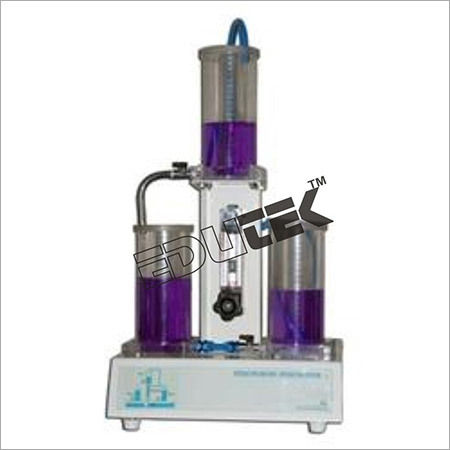
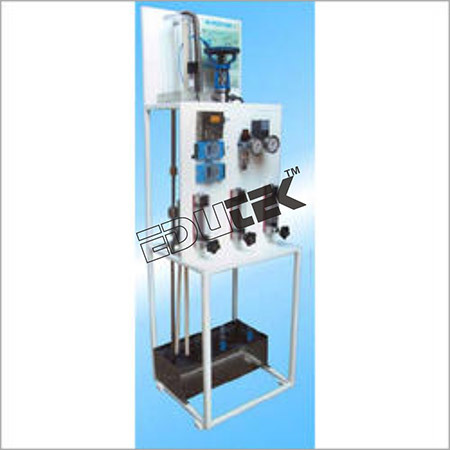
The observed step response of the tank level in different mode can be compared with mathematically predicted response. Setup consists of supply tank, pump for water circulation, rotameter for flow measurement, transparent tanks with graduated scales, which can be connected, in interacting and non-interacting mode. The components are assembled on frame to form tabletop mounting. The set up is designed to study dynamic response of single and multi capacity processes when connected in interacting and non-interacting mode. It is combined to study.
Single capacity process, Non-interacting process and Interacting process.
Experimentation
- Dynamics study for Step response.
- Single capacity Tank, Interacting mode Non Interacting mode.
- Step response of single capacity system.
- Step response of first order systems arranged in
- non-interacting mode.
- Impulse response of first order systems arranged.
- in non-interacting mode.
- Step response of first order systems arranged in
- interacting mode.
- Impulse response of first order systems arranged.
- in non-interacting mode.
Features
- Non corrosive wetted parts.
- Closed loop water circulation.
- Compact, self contained.
Cutting-Edge Process Control TrainingDesigned specifically for training purposes, this systems digital display and advanced PID algorithms enable users to explore both interacting and non-interacting liquid level dynamics. The equipment simulates real-world process scenarios, allowing learners to adjust variables and observe system responses in real time, enhancing understanding of industrial process control. With a user-friendly interface, trainees can seamlessly switch between manual and automatic operation modes.
Robust and Reliable EngineeringManufactured from high-quality stainless steel, the system ensures longevity, hygiene, and leak-proof operation in demanding laboratory settings. Safety is built-in with overload protection, providing peace of mind during experiments. Its digital instrumentation and motorized control valves guarantee accurate and repeatable results, making it an essential tool for both student learning and process analysis.
Versatile and Accurate MeasurementThe system is equipped with a level transmitter for accurate level detection and USB interface for comprehensive data logging. Capable of handling a wide range of capacities200 ml to 10 litersand measuring 0100% flow, it adapts to various experimental needs. The versatility makes it suitable for chemical, process, and instrumentation laboratories focused on automation and process efficiency.
FAQs of Interacting And Non Interacting system:
Q: How does the interacting and non-interacting two-tank system simulate different process behaviors?
A: This system features separate interacting and non-interacting tanks, allowing users to observe distinct liquid level dynamics. By adjusting inflow and outflow via the motorized valves and monitoring responses using level transmitters, users can visualize how tank interactions impact process control, flow rates, and system stability.
Q: What advantages does the PID control algorithm provide in this system?
A: The built-in PID (Proportional-Integral-Derivative) control algorithm delivers precise and stable level regulation by continuously adjusting valve positions based on real-time sensor data. This ensures accurate target level maintenance in both manual and automatic modes, making it ideal for hands-on learning about industrial process control.
Q: When should manual and automatic operation modes be utilized?
A: Manual mode is recommended for initial setup, calibration, or when users want to directly manipulate system variables for educational purposes. Automatic mode leverages the PID controller to maintain preset levels independently, offering a realistic demonstration of industrial automation and closed-loop control principles.
Q: Where can this process control trainer be effectively implemented?
A: This equipment is primarily designed for laboratory settings, such as universities, technical institutes, and research facilities. Its robust design also makes it suitable for industry training centers seeking hands-on demonstration of process control strategies and system responses using real hardware.
Q: What safety features help protect the system and users during operation?
A: The system is equipped with overload protection and a leak-proof design, minimizing risks associated with overfilling or accidental spillage. Stainless steel construction also ensures the equipments durability and safety during extended use in various laboratory environments.
Q: How does data logging function, and what are its benefits?
A: Data logging is managed via a USB interface, enabling users to record experimental measurements such as level, flow rate, and valve position. This aids in result documentation, analysis, and reporting, making training sessions more insightful and promoting data-driven learning experiences.
Q: What is the process for maintaining the equipment to ensure long-term efficiency?
A: Routine maintenance involves cleaning the tanks, periodically checking valve and sensor integrity, and ensuring electrical components (controller, actuators) function correctly. Stainless steel surfaces should be wiped down after use; regular inspection of seals and connectors maintains the leak-proof and efficient operation of the system.




 Send Inquiry
 Send Inquiry

