About Cavitation Demonstration
- Compact bench top unit.
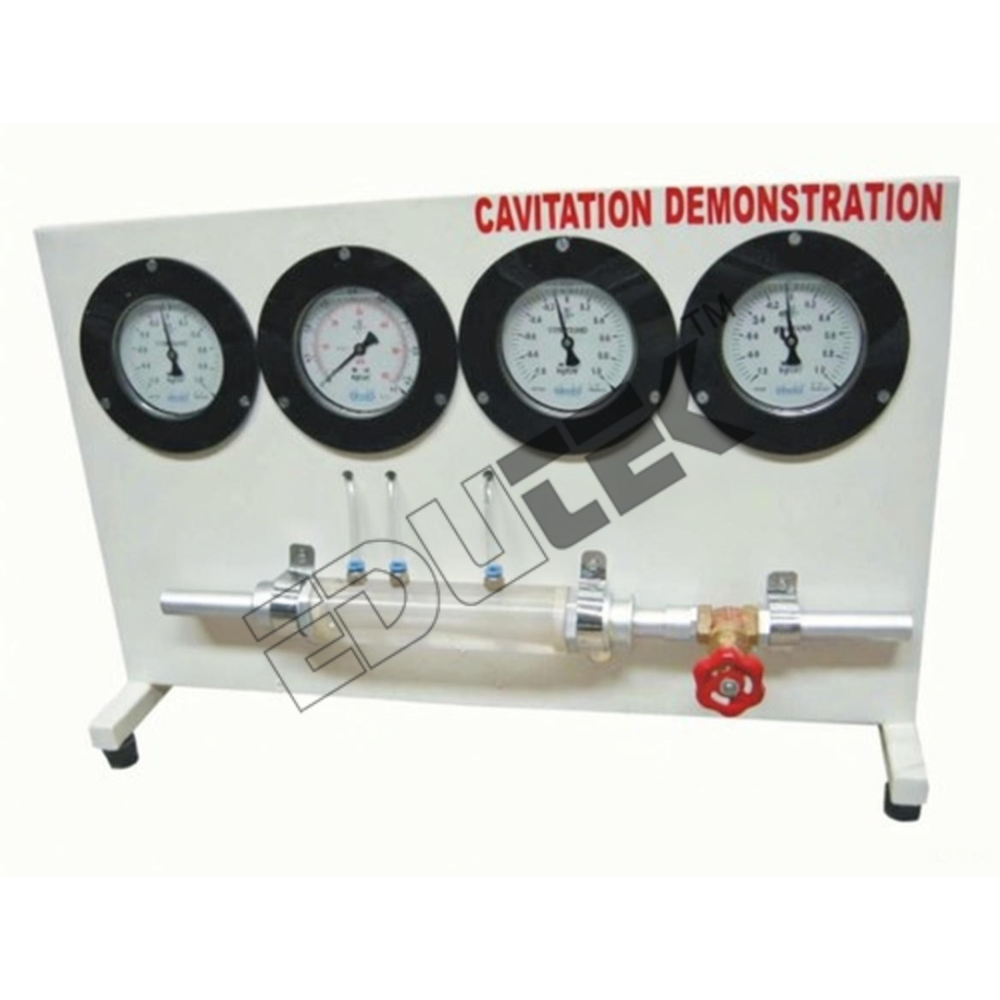
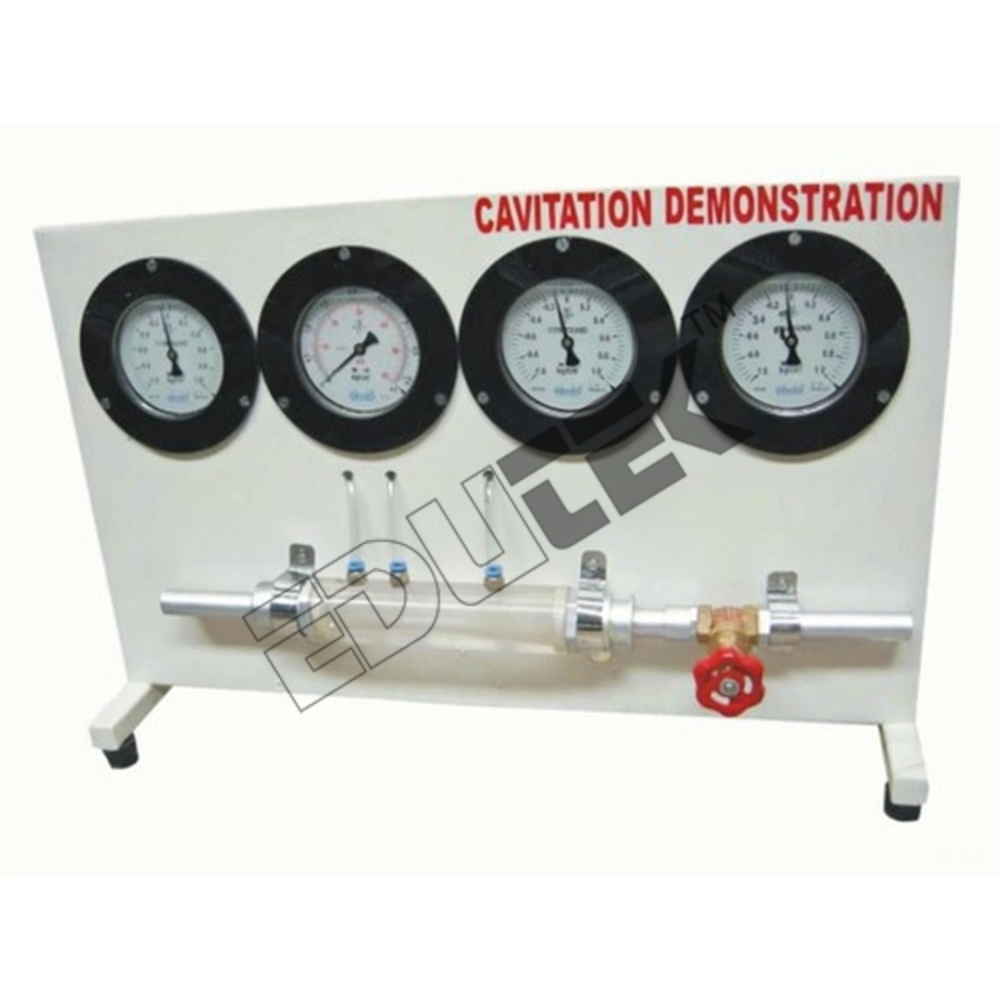
- Designed to visualize and study the cavitation phenomenon in water flow.
- The apparatus is consist of a venture shaped test section made of clear acrylic to enable visualization of formation of bubbles and subsequent collapse of bubbles in the flow.
- The upstream section of the venturi connected to the hydraulic bench or to any suitable source of water.
- Cavitation obtained by reducing pressure at the throat according to Bernoulli equation by varying the flow rate.
- Flow control valves at the upstream and downstream ends of the test section should allow control of flow.
Specifications:
- Piping system and quick release fittings, 15mm nominal bore, and stainless steel.
- Turbine flow meter, 2 liters/s max. flow rate.
- Instrument mounting panel.
- Computer based learning software.
Clear, Visual Demonstration of CavitationThe acrylic test section and well-designed flow system enable immediate visual observation of cavitation, making fluid dynamics concepts easier to understand. Students can witness the process as it unfolds, enhancing their comprehension of pressure-related phenomena.
Robust and Safe for Repeated UseConstructed with durable borosilicate glass, stainless steel, and flexible PVC tubing, this apparatus is built for routine laboratory use. Safety is ensured with overload protection for the pump and temperature handling up to 60C, suitable for typical educational environments.
User-Friendly and Reliable ControlsThe included control panel features an intuitive On/Off switch and easy-to-use control valves, allowing smooth operation and adjustment of system flow. Analog Bourdon type gauge provides accurate, real-time pressure readings within a range of 01 kg/cm.
FAQs of Cavitation Demonstration:
Q: How does the Cavitation Demonstration Apparatus help in understanding cavitation?
A: This apparatus features a transparent acrylic test section, allowing students and instructors to observe cavitation visually as it occurs in real time. By manipulating the flow using control valves, users see the formation and collapse of vapor bubbles, demonstrating pressure effects in liquids.
Q: What type of fluid and temperature range can be used for demonstrations?
A: The device is intended for use with water as the working fluid, operating efficiently from ambient temperature up to 60C. This range is adequate for most educational and research demonstrations without compromising safety or performance.
Q: When is this apparatus typically used in an educational setting?
A: The Cavitation Demonstration Apparatus is commonly used during fluid mechanics, thermodynamics, and engineering laboratory courses. It is ideal for hands-on demonstrations for students or practical experiments as part of curriculum activities.
Q: Where can the apparatus be installed in a laboratory?
A: With its compact, freestanding table-top design (dimensions: 550 mm x 270 mm x 500 mm), the equipment fits comfortably on standard laboratory benches and does not require wall mounting or dedicated infrastructure, making it versatile for various setups.
Q: What safety features are included to protect users and equipment?
A: The apparatus is equipped with overload protection for the pump to prevent damage during operation. Additionally, the transparent acrylic section is designed for strength and visibility, further safeguarding users during demonstrations.
Q: How should the system be maintained for reliable operation?
A: Routine maintenance is minimal and accessible to users. It typically involves checking the water level, inspecting pump operation, and cleaning the transparent sections if needed. All parts are designed for straightforward access and care.
Q: What are the main benefits of using this cavitation demonstration model?
A: By providing direct, visual insight into cavitation, the apparatus enhances conceptual understanding, supports interactive learning, and reinforces theoretical knowledge. Its ease of use, low maintenance, and robust design ensure it is a valuable asset in any engineering or science laboratory.




 Send Inquiry
 Send Inquiry

