About Demonstration Induction Coils
Demonstration Induction Coils
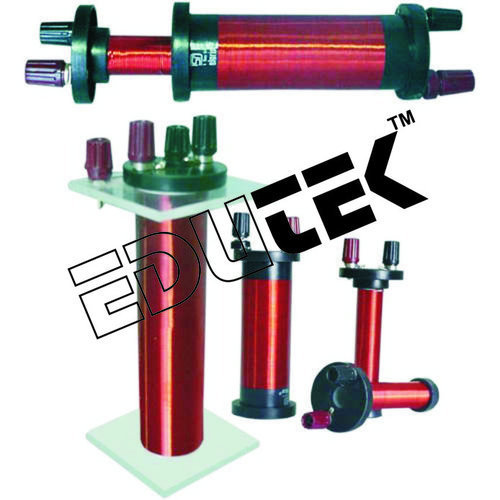
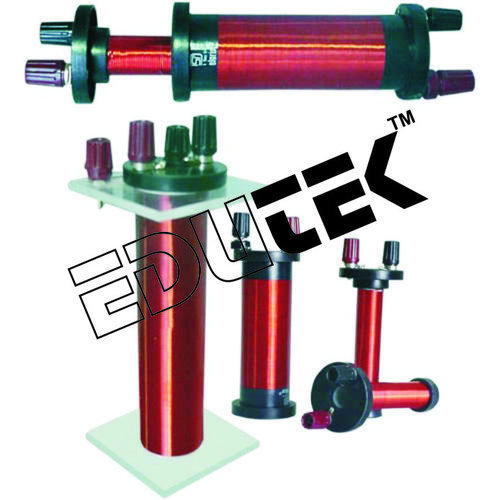
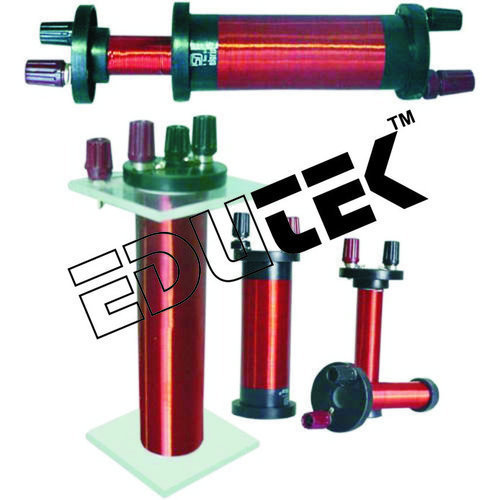
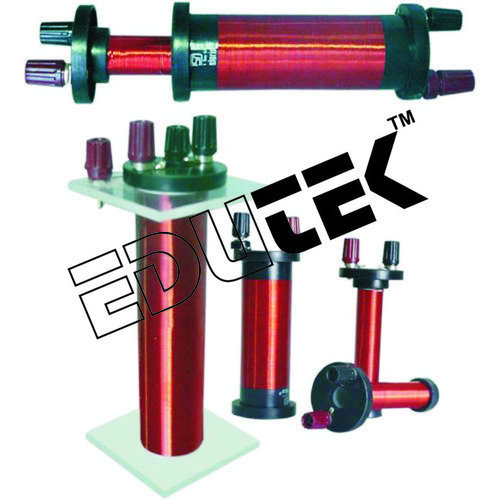
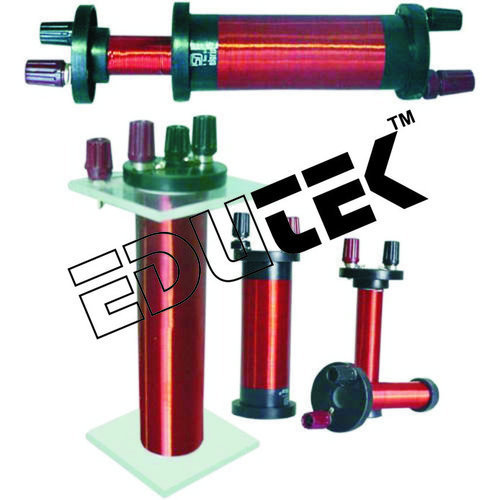
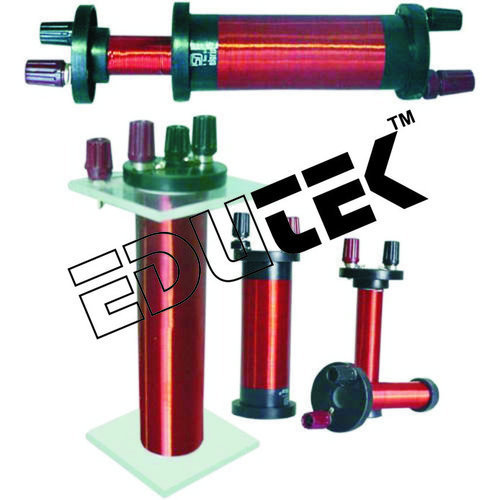
Demonstration Induction Coils consists of two coils wound on separate bobbins, one having many turns of fine wire & the other with few turns of heavy wire. It demonstrates that induced potentials are produced either by movement of a permanent or electromagnet or by a change of current in one coil, fitted with insulated 4 mm socket terminals & supplied with a soft iron core, outer coil is 12.5 cm long & is of 5 cm diameter.
Principles of OperationWith separate bobbins for each coil, the device demonstrates electromagnetic induction by showing how changing current or magnetic field induces voltage in the secondary coil. Visual experiments are easily performed, helping students grasp core scientific principles.
Robust and Educational DesignConstructed using fine and heavy wire, insulated bobbins, and a soft iron core, the induction coil is built for frequent classroom use. The clearly marked, 4 mm socket terminals make connecting external power sources and measurement equipment straightforward for instructors and learners alike.
Ideal for Physics DemonstrationsThis induction coil serves as a fundamental educational tool, perfectly suited for teaching electromagnetic induction. Its design encourages hands-on learning, making theoretical concepts tangible and understandable through physical demonstration.
FAQs of Demonstration Induction Coils:
Q: How does the Demonstration Induction Coil illustrate electromagnetic induction?
A: The coil demonstrates electromagnetic induction by having a primary coil with many turns of fine wire and a secondary coil with fewer turns of heavy wire, each on separate bobbins. When a magnet is moved or the current in the primary coil is changed, a voltage is induced in the secondary coil, making the underlying physical principle observable.
Q: What methods can be used to demonstrate induction with this coil set?
A: Induction can be demonstrated either by moving a permanent or electromagnet near the coils or by altering the current flowing through the primary coil. Both methods visibly induce voltages in the secondary coil, helping students observe the effects of changing magnetic fields.
Q: When is it appropriate to use this induction coil in the classroom?
A: This device is best used during physics lessons on electromagnetism or electricity, especially when introducing the concept of electromagnetic induction. It is suitable for laboratory sessions, classroom demonstrations, or science exhibitions.
Q: Where should the Demonstration Induction Coil be set up for experiments?
A: The coil should be set up on a stable lab table or demonstration surface, with enough space to safely move magnets and connect external power or measurement equipment. Its insulated terminals accommodate standard laboratory connectors.
Q: What is the process for operating the Demonstration Induction Coil?
A: Connect the primary coil terminals to an external power source (not included), and optionally attach measuring instruments to the secondary coil. Use a magnet or change the current in the primary coil to induce voltage in the secondary coil, which can then be observed or measured.
Q: How does using this induction coil benefit students?
A: By providing a tangible way to observe electromagnetic induction, the coil bridges theory and practice. Students gain a deeper understanding through hands-on involvement, which reinforces learning and promotes scientific curiosity.
Q: What materials are used in constructing the Demonstration Induction Coils?
A: The coils feature fine and heavy wire for primary and secondary windings, respectively, mounted on insulated bobbins. A soft iron core enhances magnetic effects, while 4 mm insulated socket terminals ensure safe and convenient connections.





 Send Inquiry
 Send Inquiry

