About Test Sieve
Sieve
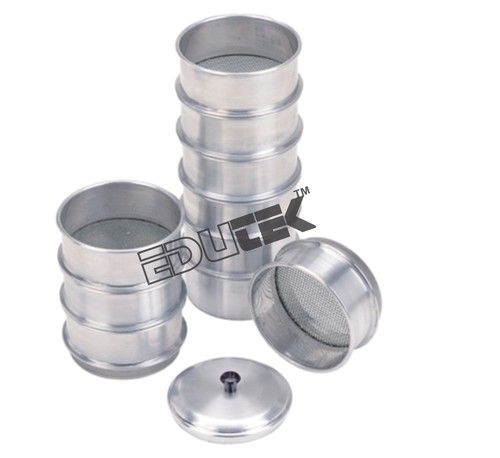
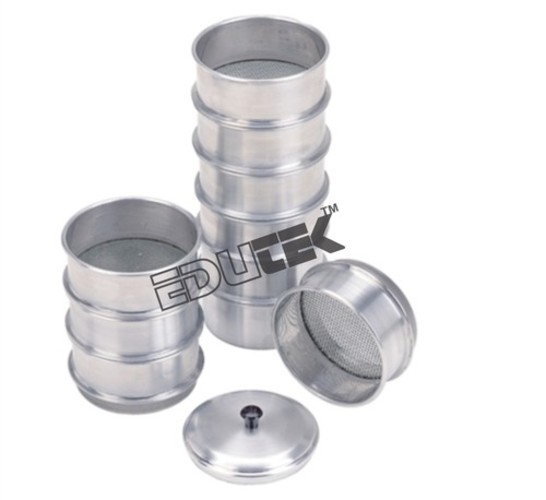
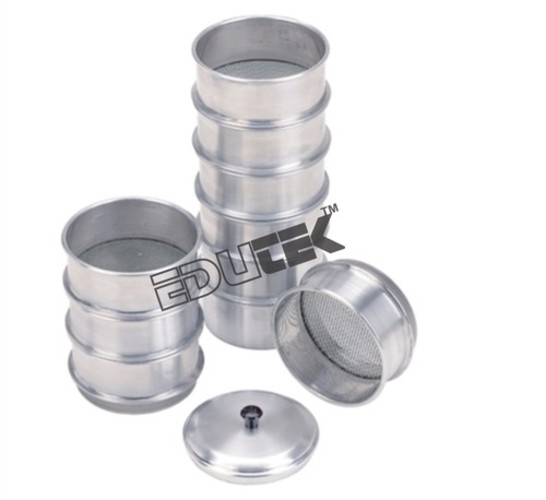
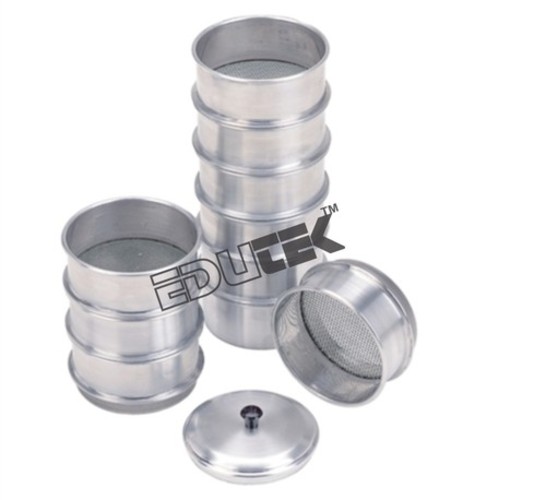
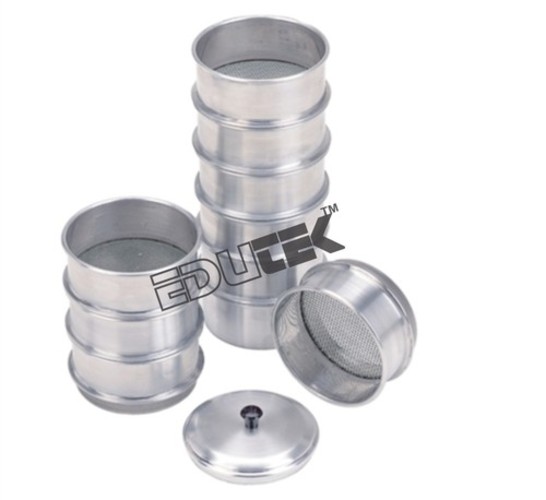
- Lid and receiver dia 203 mm,
- 203 mm dia ASTM sieve No 4 (4.75 mm),
- 203 mm dia ASTM sieve No 10 (2.00 mm),
- 203 mm dia ASTM sieve No 20 (0.850 mm),
- 203mm dia ASTM sieve op. 425 mic No. 40,
- 203 mm dia ASTM sieve No 60 (0.250 mm),
- 203 mm dia ASTM sieve No 140 (0.106 mm),
- 203 mm dia ASTM sieve No 200 (0.075 mm).
SIEVE AND RECEIVER (EDT-11718SR)
- Metal frame
- Diam-18cmX5cm
- Small 25cmX6cm big
Customizable Mesh Options and Robust ConstructionSelect from mesh sizes ranging from 5 microns to 125 mm, with frame finishes in polished or matte to meet specific analytical needs. Manufactured using premium stainless steel, brass, or mild steel, our sieves maintain structural integrity with rimmed, seamless joints, offering durability and precision in a variety of environmental conditions.
Versatile Applications Across IndustriesEngineered for particle size analysis, test sieving, and laboratory sieve analysis, these test sieves serve a key role in industries such as pharmaceuticals, food, chemical, mining, and construction. The uniform aperture and corrosion-resistant features ensure high accuracy and reliability, no matter the particle type or testing environment.
FAQs of Test Sieve:
Q: How is the mesh size selected for different materials during testing?
A: The appropriate mesh size depends on the particle size distribution of your sample material. For fine powders, select finer meshes (as low as 5 microns), while coarser particles require larger meshes, up to 125 mm. Use guidance from analytical protocols or industry standards to determine the optimal size for accurate separation and gradation.
Q: What standards do these test sieves comply with, and why is this important?
A: These sieves are manufactured to comply with ASTM E11 and ISO 3310 standards. Compliance ensures consistent mesh uniformity, precise aperture dimensions, and reliable test results, which are vital for laboratory and quality control processes across industries.
Q: When should the frame finish be selected as polished versus matte?
A: Choose a polished finish for easy cleaning, minimal sample retention, and environments requiring high hygiene, such as pharmaceuticals or food. A matte finish is suitable for standard laboratory use, where glare reduction or aesthetics are preferred. The choice depends on your operational requirements.
Q: Where are these test sieves typically used?
A: These sieves are extensively used in analytical laboratories, quality control departments, and production facilities within the pharmaceutical, food, chemical, mining, and construction industries. Their versatility and stringent compliance make them ideal for both research and industrial workflows.
Q: What is the process for using these test sieves in particle size analysis?
A: Place the material on the top sieve of a stack arranged from largest to smallest apertures. Manually shake or use a mechanical sieve shaker to facilitate particle passage. Particles are separated into fractions according to size, supporting accurate analysis and gradation.
Q: How do the design and material choices benefit users?
A: Options for material (stainless steel, brass, mild steel) and frame finish allow selection based on chemical compatibility and durability needs. Rimmed, seamless joints enhance structural strength, while corrosion resistance and uniform apertures ensure longevity and reliable test outcomes even under frequent or high-temperature use.




 Send Inquiry
 Send Inquiry