About DIGITAL OSCILLOSCOPES
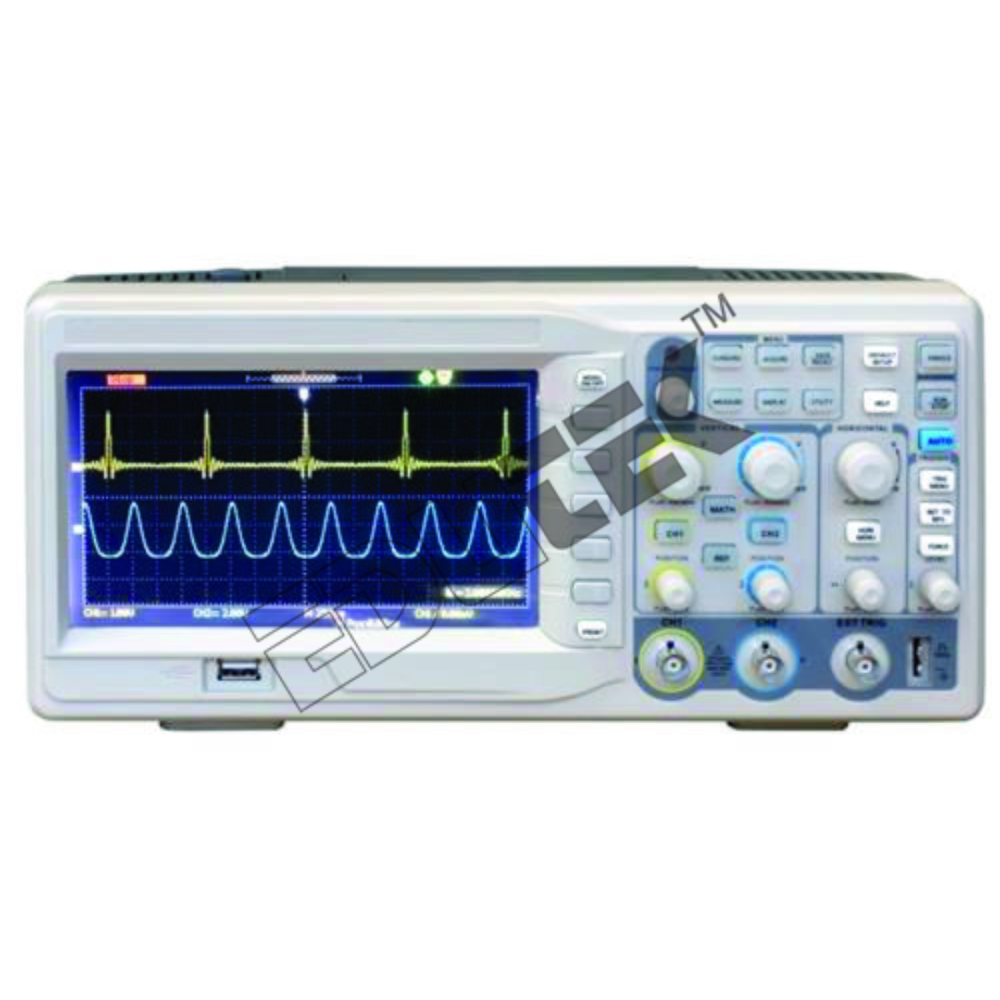
DIGITAL OSCILLOSCOPES
- Bandwidth 200 MHz
- Channel 2
- Real Time Sample 1 Gsa/S
- Equivalent Sampling Rate : 50GSa/s.
- Memory Depth 40 k
- Rise time 1.7ns
- Time base accuracy 50ppm, Volts/DIV
- Range 2mv/ div-5v/div
- Input Impendence 1m
- For Voltage measurement, Temperature, Impedance, electric Power, frequency etc.
High-Performance Signal AnalysisWith a sampling rate of 1 GSa/s and a bandwidth of 50 MHz, this oscilloscope delivers precise waveform measurement and rapid data acquisition. The time base can be adjusted from 5 ns/div to 50 s/div, enabling detailed analysis of both fast and slow signals. The 40 kpts record length ensures no detail is overlooked during signal capture.
User-Friendly Features for Versatile UseEquipped with a 7-inch color LCD, simple front panel controls, auto set, and multi-language menus, this oscilloscope is designed for ease of use in demanding environments. The compact size allows for easy portability, making it suitable for use in laboratories, educational settings, field repairs, and R&D departments.
FAQs of DIGITAL OSCILLOSCOPES:
Q: How do I use the math functions on this digital oscilloscope?
A: You can access math functions such as Add, Subtract, Multiply, and Fast Fourier Transform (FFT) via the front panel buttons or menu system. These functions allow for advanced signal analysis by combining two channels, extracting frequency components, or performing comparative waveform inspection.
Q: What benefits does the auto set function provide?
A: The auto set function streamlines the setup process by automatically optimizing vertical, horizontal, and trigger parameters. This helps users quickly capture stable waveforms without manual adjustment, making it especially useful for beginners or for quick diagnostics.
Q: When should I use the different trigger modes available?
A: Edge trigger is ideal for capturing signal transitions, Video trigger is used for analyzing video signals, Pulse trigger isolates specific pulse widths, and Alternate trigger allows you to view both channels simultaneously. Selecting the appropriate trigger mode enhances precision in signal capture based on your testing requirements.
Q: Where can this oscilloscope be ideally utilized?
A: This model is well-suited for electronics laboratories, industrial testing floors, service centers, and educational institutions, thanks to its robust construction, portable size, and versatile function set. It supports research, training, diagnostics, and repair tasks effectively.
Q: What is the process to store and export waveform data?
A: Captured waveforms can be stored internally and exported via the USB interface. After saving your waveform, connect the oscilloscope to a computer using the USB port to transfer data for documentation, analysis, or sharing.
Q: How do probe attenuation settings affect measurements?
A: Probe attenuation (selectable between 1X and 10X) allows you to adjust the probes input scaling. Using 10X increases the voltage measurement range, helpful for capturing higher amplitude signals without distortion, while 1X is suited for lower voltage, higher sensitivity measurements.
Q: What advantages does this oscilloscope offer over analog models?
A: Compared to analog oscilloscopes, this digital model provides higher sampling accuracy, waveform storage, advanced math functions, instant response, and multiple language support, making measurement and analysis more flexible, intuitive, and suitable for modern electronic applications.





 Send Inquiry
 Send Inquiry

