About Venturimeter .
Venturimeter
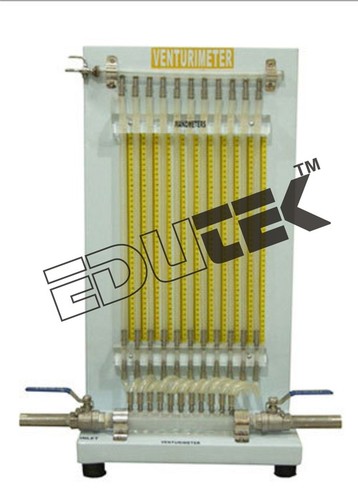
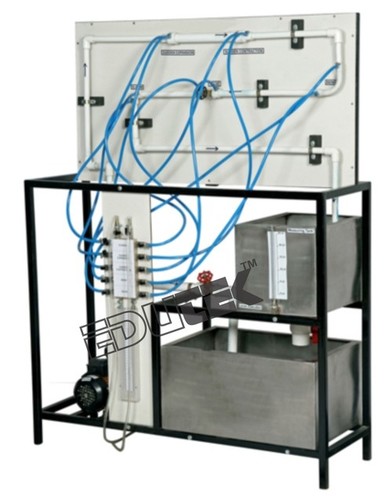
- An educational Venturi tube that allows students to study the Venturi meter and Bernoulli's Theorem and to make direct comparisons between the results obtained by experimentation and those predicted by theory.
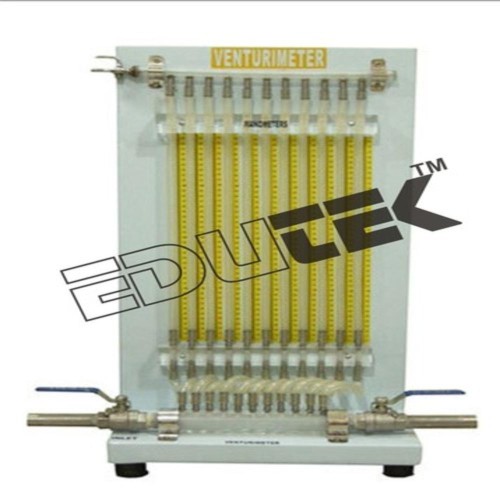
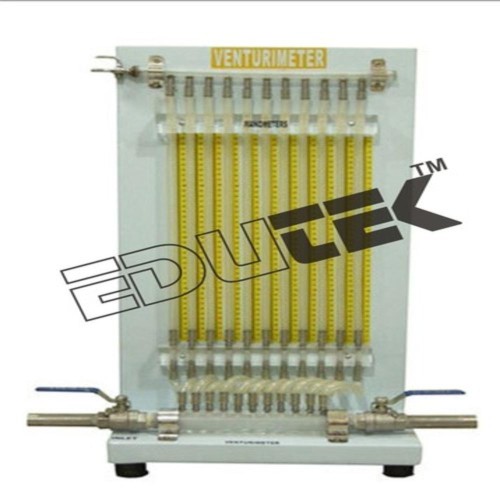
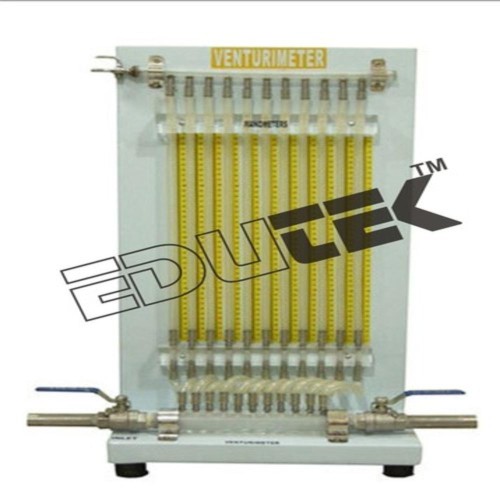
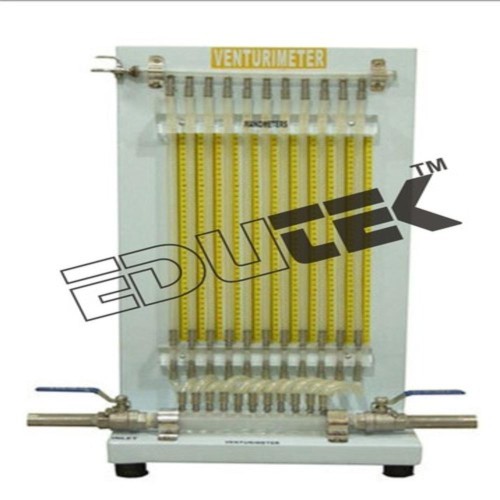
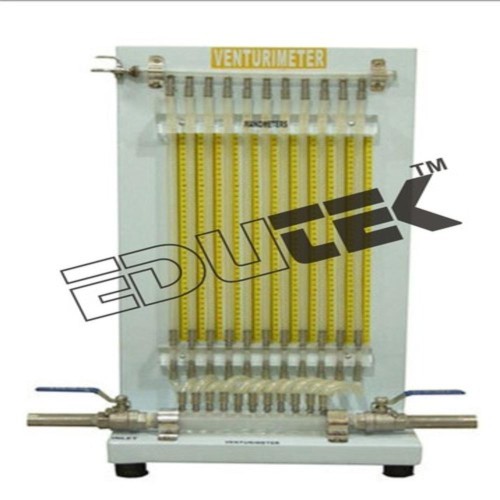
- A Venturi meter is used to determine the flow rate of fluid in a pipe. Venturi Meter is comprised of a horizontal Venturi tube, a downstream flow-control valve and eleven pressure tappings connected to water manometers (piezometers). A common manifold above the piezometers includes an air pressure control valve.
- The inclusion of eleven piezometers allows study of the pressure distribution along the convergent-divergent passage within the Venture tube.
- The is designed for use with the Gravimetric or Volumetric Hydraulics Benches (available separately). These benches measure absolute flow rate which can be used by students to find the Venturi meter coefficients over a range of flow conditions.
- The Venturi meter is a device used to measure the flow rate. As shown, it consists of a tapering contraction section, along which the fluid accelerates towards a short cylindrical throat, followed by a section which diverges back to its original diameter.
- As velocity increases from the inlet section to the throat, there is a fall in pressure, the magnitude of which depends on the rate of flow. The flow rate may therefore be inferred from the difference in pressure, as measured by pizometers placed upstream and at the throat.
- The device is used to determine the discharge coefficient or the Venturi meter coefficient (C).
- This value lies between 0.92-0.99 and varies from one meter to another.
Educational Excellence in Fluid MechanicsThis Venturimeter is tailored for experimental training, empowering users to visualize and analyze Bernoullis Principle and fluid flow characteristics. It offers students a clear, hands-on experience for measuring velocity, pressure differences, and discharge coefficients, providing a comprehensive understanding of core fluid mechanics concepts essential for academic and practical advancement in engineering disciplines.
Robust Design and Ease of InstallationThe unit is built with a powder-coated steel frame, borosilicate glass, and leak-proof joints for enhanced operational safety and longevity. Designed for the laboratory environment, installation is straightforwardsimply clamp or bolt to any standard workbench. Its bench-top anti-slip feet provide stability, and the shatter-resistant construction ensures reliable use throughout repeated experiments.
Accurate Measurement and Reliable CalibrationThe VM-EDU2024 is factory calibrated to an accuracy of 1% of full scale, with certification included. The equipment enables analog manometer readings at the inlet, throat, and outlet positions, supporting flow velocity measurements from 0 to 2 m/s. These reliable readings make it a valuable tool for researchers, students, and educators striving for consistent, trustworthy experimental data.
FAQs of Venturimeter .:
Q: How does the VM-EDU2024 Venturimeter demonstrate Bernoullis Principle in laboratory experiments?
A: By measuring pressure at the inlet, throat, and outlet of a constricted Venturi tube, the VM-EDU2024 illustrates how fluid velocity increases where the tube narrows (throat), causing a decrease in pressurean application of Bernoullis Principle. Students can visually interpret these changes using manometer readings with water or mercury.
Q: What is the process for installing this Venturimeter on a laboratory workbench?
A: Installation is straightforward, requiring either a simple clamp or bolts to secure the unit to the experimental workbench. The anti-slip feet ensure stability during practical sessions, and all necessary mounting components are included for quick setup.
Q: Where are the pressure measurement points located on this equipment?
A: The Venturimeter has designated measurement points at the inlet, throat, and outlet of the Venturi tube. Manometer connections at each point allow users to compare pressure differences along the flow path to analyze fluid behavior.
Q: What are the core benefits of using this Venturimeter for educational purposes?
A: This equipment provides hands-on experience in applying fluid mechanics principles, allowing for direct observation and calculation of flow rates, discharge coefficients, and pressure differences. Its robust and leak-proof design ensures safe, repeatable experiments suitable for continuous laboratory use.
Q: Which fluids can be used in the manometer, and how do they affect readings?
A: The manometer supports either mercury or water as the indicating fluid. Mercury provides higher resolution for pressure differences due to its density, while water is a safer, more accessible option for general lab use. The selection may influence the sensitivity and scale of measurements.
Q: What is the recommended operating water supply for this Venturimeter?
A: For optimal performance, use a steady water supply of 23 liters per minute at a pressure between 1 and 2 bar. This ensures consistent flow through the Venturi tube and accurate experimental results.
Q: When can users expect to receive calibration certification with the equipment?
A: Each VM-EDU2024 Venturimeter is supplied fully factory-calibrated and comes with an official calibration certificate. This documentation is provided at the time of delivery, ensuring readiness for immediate laboratory use.





 Send Inquiry
 Send Inquiry

