About UJT AS RELAXATION OSCILLATOR
Specification:
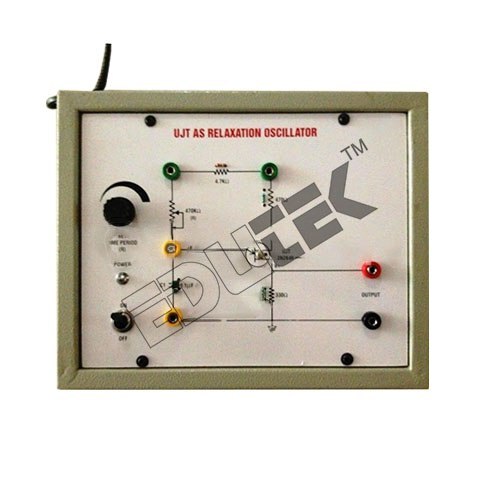
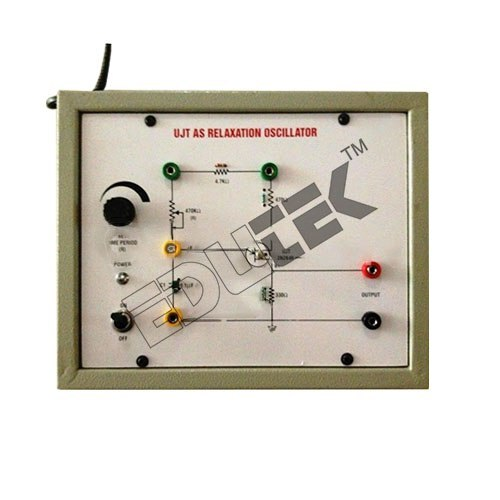
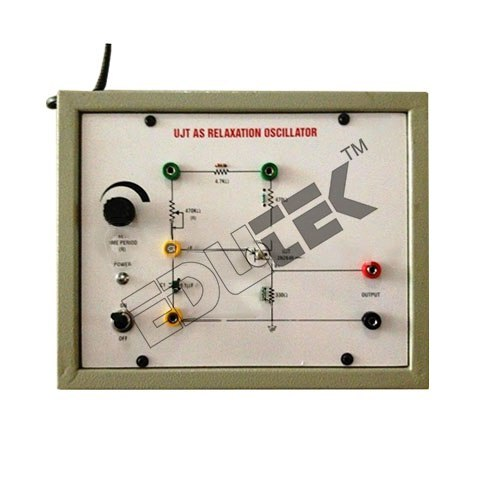
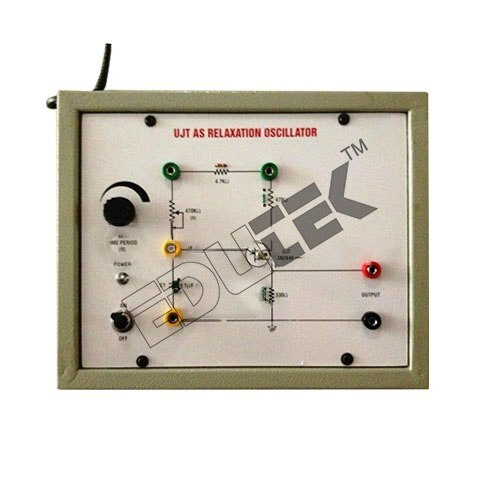
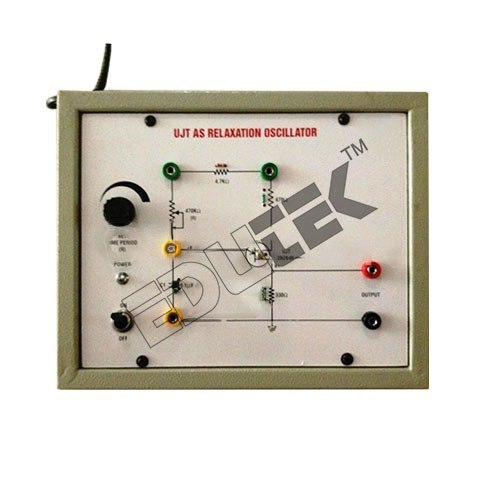
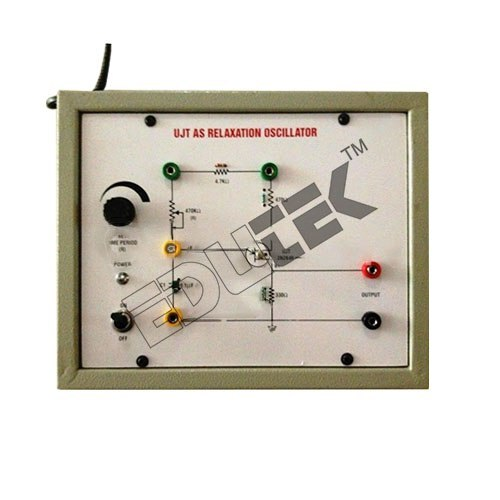
UJT AS RELAXATION OSCILLATOR
To study the Frequency and Wave shape generated by Relaxation Oscillator.
Features:
Instrument comprises of 30V DC Regulated Power Supply, Circuit diagram printed & components mounted on front panel
Adjustable Sawtooth Waveform DemonstrationUtilize the UJT as Relaxation Oscillator module to produce and study sawtooth waveforms. The built-in trimmer potentiometer and easy-to-change component sockets enable comprehensive exploration of how resistor and capacitor values influence output frequency. Demonstration points are clearly labelled for straightforward connection to a CRO or oscilloscope.
Engineered for Academic ExcellenceSpecifically tailored for engineering electronics instruction, the module boasts robust laboratory-grade construction. Its component layout and labelling simplify learning, while safety is prioritized through a low voltage 12V DC supply. The external DC power input and colour-coded leads enhance practical use and instructional clarity.
Simple Setup and ExperimentationDesigned for convenience, the module features 4mm banana terminals for connections and a bench-top mounting structure. With a thickness of 4-5 mm and dimensions optimized for classroom benches, users can quickly set up experiments and focus on exploring relaxation oscillator principles without complex assembly.
FAQ's of UJT AS RELAXATION OSCILLATOR:
Q: How can I adjust the output frequency of the UJT relaxation oscillator?
A: You can modify the output frequency by using the onboard trimmer potentiometer or by swapping out resistors and capacitors in the accessible sockets. The frequency typically ranges from about 1 Hz to 1 kHz, depending on your component choices.
Q: What is the waveform produced by this UJT oscillator, and how can I observe it?
A: The module generates a sawtooth waveform at its outputs. You can observe this waveform by connecting the clearly labelled emitter, base1, or base2 test points to a CRO or oscilloscope using the provided leads.
Q: When should I use this UJT oscillator module in my electronics studies?
A: This module is ideal for classroom demonstrations and laboratory experiments in engineering electronics courses that cover oscillators. It helps visualize and analyze the principles of UJT operation and relaxation oscillation.
Q: Where should I set up and operate this oscillator module?
A: The bench-top design is suitable for academic laboratories or classroom tables. Ensure a stable, dry, and clean surface within the module's operating temperature range (0~50C) and supply power via an external 12V DC source.
Q: What accessories are included with the module for conducting experiments?
A: The kit comes with an experiment manual to guide your studies, as well as connection leads for linking the module outputs to oscilloscopes or other test equipment.
Q: How does the safety design of this module benefit its use in educational settings?
A: Engineered for low voltage operation (12V DC) and featuring safe circuit mounting on a sturdy fiberboard base, the module minimizes electrical risk and is appropriate for supervised educational use. No fuse is necessary due to its inherently safe design.
Q: What are the main benefits of using this UJT oscillator module for students and teachers?
A: The module provides a practical, hands-on approach to understanding relaxation oscillators, offers flexibility with adjustable frequency, and ensures safety and reliability. Its academic-grade build and clear labelling facilitate both teaching and learning in electronics experimentation.




 Send Inquiry
 Send Inquiry

