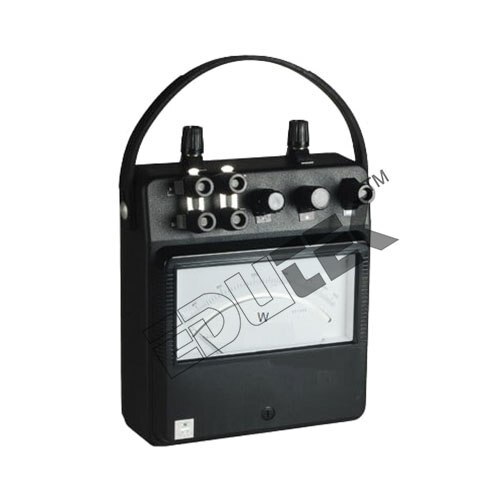
About TWO CURRENT AND THREE VOLTAGE RANGE SINGLE PHASE DYNAMOMETER TYPE PORTABLE WATTMETER (L.P.F TYPE)
Specification:
TWO CURRENT ANDTHREE VOLTAGE RANGE SINGLE PHASE DYNAMOMETER TYPE PORTABLE WATTMETER (L.P.FTYPE)
Select any onerange:
CurrentCoil/Potential Coil: 1/2A x75/150/300V OR 2.5/5Ax150/300/600V OR 5/10Ax150/300/600V
Exceptional Accuracy and Multiple Range SelectionThis wattmeter features both two current and three voltage ranges for versatile usage in diverse electrical measurement scenarios. Its Class 0.5 low power factor accuracy and long wide scale guarantee precise power readings, even under challenging conditions. Every user can benefit from its clear, color-coded dial markings that simplify range identification, enhancing overall usability during critical electrical tests.
Built for Safety and DurabilityWith overload protection for both current and voltage inputs, an internal safety fuse, and insulation resistance exceeding 20 M at 500V DC, this instrument emphasizes user safety. The enclosure is constructed from sturdy metal, providing both environmental protection and robust portability, aided by its convenient carrying handle. Designed for challenging laboratory or field environments, it ensures reliable performance and extended service life.
User-Friendly Features and ComplianceThe wattmeters knife-edge pointer, mechanical zero adjuster, and wide dial ensure parallax-free, instantly readable measurements, minimizing user error. The instrument is built with high-quality detachable test leads and offers clear multi-range scale markings. Compliance with IS standards underlines its commitment to professional engineering requirements, making it a dependable choice for measurement and export.
FAQs of TWO CURRENT AND THREE VOLTAGE RANGE SINGLE PHASE DYNAMOMETER TYPE PORTABLE WATTMETER (L.P.F TYPE):
Q: How does the dual current and triple voltage range function on this wattmeter?
A: This wattmeter allows users to select between two current ranges (1A and 5A) and three voltage ranges (150V, 300V, and 600V AC), enabling accurate power measurements across various types of single-phase circuits. The selection is easy and enhances the flexibility of usage in different testing scenarios.
Q: What are the primary benefits of using this dynamometer type wattmeter in engineering laboratories?
A: Key advantages include high measurement accuracy (Class 0.5) at low power factors, robust overload protection, a clear analog scale for precise readings, and compliance with IS standards. Its portability and durable construction make it suitable for regular use in educational, research, and quality control environments.
Q: When should the wattmeters zero adjustment be used?
A: The front accessible mechanical zero adjuster should be used before starting any measurement to ensure the pointer rests exactly on zero. This practice guarantees accurate readings and compensates for any drift that may occur during transportation or storage.
Q: Where is this wattmeter ideally mounted or used?
A: Designed as a portable bench or desk-top instrument, its commonly deployed in electrical engineering laboratories, industrial testing areas, and educational institutions where precise, portable measurement is required.
Q: What safety features are integrated into this wattmeter?
A: Safety is prioritized with an internal protective fuse, overload protection for both the current and voltage circuits, and a high insulation resistance (>20 M at 500V DC), reducing risk during high-voltage testing and enhancing user protection.
Q: How is the wattmeter powered during operation?
A: The wattmeter is self-powered from the measurement circuit, requiring no external power supply. It draws operating energy directly from the voltage and current present in the circuit being tested.
Q: What type of display and indication does this instrument offer?
A: A wide, clear analog dial with a knife-edge pointer ensures parallax-free, high-resolution readings. Color-coded, multi-range scale markings help quickly identify the selected range, facilitating accurate and efficient measurements.




 Send Inquiry
 Send Inquiry

