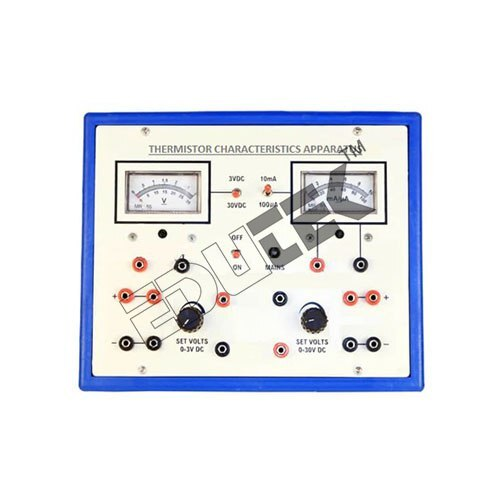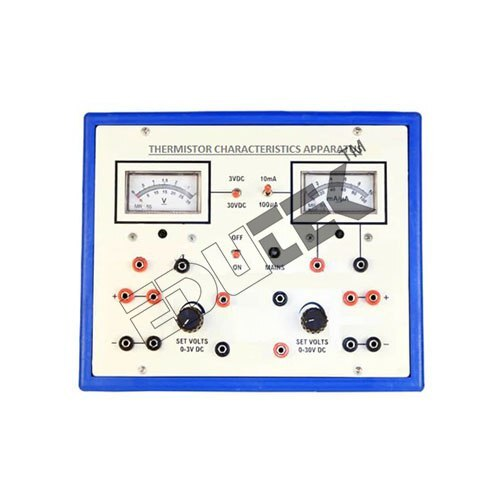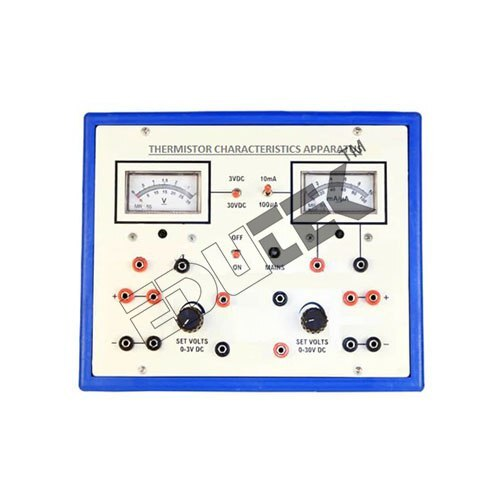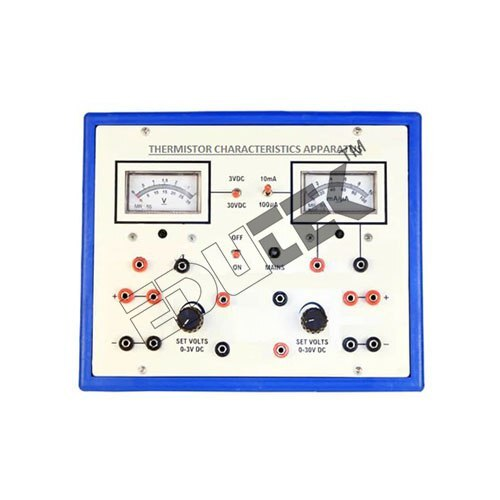
About THERMISTOR CHARACTERISTICS APPARATUS WITH ALUMINUM PANEL & SQUARE METERS
Specification:
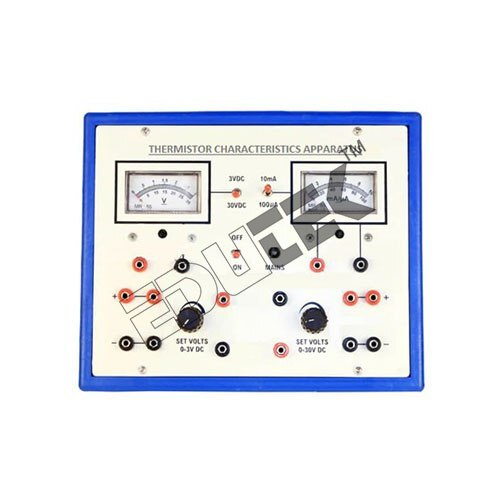
THERMISTOR CHARACTERISTICS APPARATUS WITH ALUMINUM PANEL & SQUARE METERS
Objective: To plot negative Resistance co-efficient Characteristics of a Thermistor.
Features: Instrument comprises of DC Regulated Power Supply 0-5 VDC/150mA in steps.
Two Digital meter for Voltage & Current measurement
Connections of Supplies, Meter & Thermistor brought out at 4 mm Sockets, also provided with Oven with temperature on /off Switch.
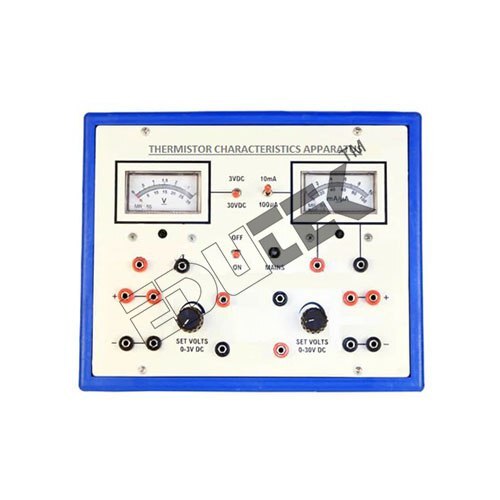
Robust Construction and User-Friendly DesignCrafted with a high-quality brushed aluminum panel approximately 2 mm thick, this apparatus boasts durability and ruggedness. Its compact bench-top design, non-slip feet, and clear digital displays ensure ease of use and stable operation, ideal for single-user or group experiments in educational labs.
Comprehensive Thermistor StudyThe instrument is tailored for exploring both negative and positive temperature coefficient thermistors (NTC/PTC). Students and professionals can investigate resistance variation with temperature using the built-in digital indicator, enabling a thorough understanding of thermistor properties vital to engineering applications.
FAQs of THERMISTOR CHARACTERISTICS APPARATUS WITH ALUMINUM PANEL & SQUARE METERS:
Q: How do I use the Thermistor Characteristics Apparatus to study thermistor properties?
A: To use the apparatus, connect the thermistor module as instructed, apply power via the mains cord, and set the desired voltage/current from the front-panel controls. Monitor the digital temperature display and record resistance values to analyze how resistance changes with temperature.
Q: What makes the aluminum panel of this apparatus beneficial in laboratory environments?
A: The brushed aluminum panel provides durability, resistance to corrosion, and good thermal conductivity, ensuring stable experiments. Its rugged design also protects internal components, making it suitable for repeated educational use.
Q: When should this apparatus be used in laboratory settings?
A: This apparatus is recommended for experimental studies of thermistor behavior during electrical engineering lab sessions, thermal characterization demonstrations, and research projects that require accurate resistance and temperature measurements indoors.
Q: Where is this instrument best installed for operation?
A: It is intended for bench-top use within indoor laboratory environments, thanks to its moderate dimensions (300 mm x 200 mm x 100 mm) and safety features. Avoid outdoor or damp locations, as it is not IP-rated for ingress protection.
Q: What process does the apparatus follow to measure thermistor resistance variations?
A: The strip heater gently controls the test temperature while the digital indicator monitors temperature changes. As the thermistor experiences varying temperatures, its resistance is measured precisely through the integrated arrangement, with results recorded in real-time.
Q: What are the main usage scenarios for this apparatus?
A: It is primarily used by engineering students, researchers, and instructors for practical demonstrations, resistance-temperature documentation, and evaluation of NTC/PTC thermistor devices in laboratory courses.
Q: What are the key benefits of using this thermistor characteristics apparatus?
A: Benefits include precise digital readings, quick response times (under 2 seconds), a safe fused power input, instructional aids for easy setup, and versatility in analyzing various thermistor types, all contributing to effective and reliable laboratory learning.