About Pump Characteristics For Parallel And Series Configuration
PUMP CHARACTERISTICS FOR PARALLEL AND SERIES CONFIGURATION
Several pumps are often installed either in parallel or in series configuration for economic reasons. In in parallel configuration the pumps operate in a common pipe. This requires that the pumps used in each case can achieve the same head. Parallel configurations offer the advantage that when demand is low only one pump works and other pumps are switched on as the flow rate increases. In series configuration pumps with equal flow rates are arranged in a row. This arrangement allows the bridging of large heads and is often more cost-effective than the use of a single pump with large head.
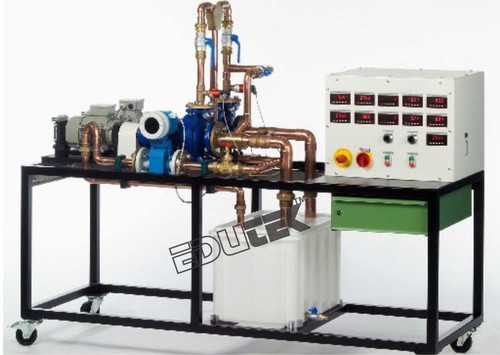
The trainer studies the cooperation of two centrifugal pumps and illustrates the differences in parallel and series configuration. The metrology components used are common in industry and therefore closely related to practice.
The trainer has a closed water circuit and is equipped with two identical pumps that are driven by speed-controlled motors. The rotational speed of the motors for the centrifugal pumps can be adjusted via frequency converters. All motors are mounted on swivel bearings so that the drive torque can be measured via a force sensor, allowing the mechanical drive power to be determined. Sensors detect the pressures at inlet and outlet of the pumps. The flow rate is measured by an electromagnetic flow meter. Relevant measured values are read from digital displays and can be transmitted simultaneously via USB directly to a PC where they can be analysed using the software included. The performance data of the pump and losses in the pipe are calculated in the software and shown in the form of characteristics. Characteristic parameters of pumps are determined from the measured values. Furthermore, students are familiarised with the operating behaviour of centrifugal pumps and can practise the correct way to start up and shut down such a pump system. The well-structured instructional material sets out the fundamentals and provides a step-bystep guide through the experiments.
The unit perform the following experiments and investigations:
Learning Objectives / Experiments
Investigate behaviour of centrifugal pumps in operation
Recording pump characteristics
Recording system characteristics
Determining efficiency
Investigation of series and parallel configuration of pumps
Starting up and shutting down pump systems
Specification:
Trainer with 2 centrifugal pumps which are operated in series or parallel configuration
Closed water circuit
Drive motors with adjustable speed
Motor with pendulum bearing, torque measurement via lever arm and force sensor
Inductive speed sensor on the motor
Electromagnetic flow meter
Digital displays for power consumption, torque, speed, pressure and flow rate
Software for data acquisition via USB under Windows Vista or Windows 7
Technical Data:
2 pumps
Max. flow rate: 21m3/h
Max. head: 16,9m 2 drive motors
Power output: 1,1kW
Speed range: 0...3000min-1
Supply tank: 96L
Measuring ranges:
Pressure
Inlet pump 1: -1...0,6bar
Outlet pump 1: 0...2,5bar
Inlet pump 2: -1...3bar
Outlet pump 2: 0...6bar
Flow rate: 0...480L/min
Speed: 2x 0...3000min-1
Torque: 2x 0...10Nm
Power: 2x 2,2kW
Dimensions and Weight
LxWxH: 2150 x 815 x 1765mm
Weight: approx. 325kg
Tell us about your requirement
Price:
Quantity
Select Unit
50
100
200
250
500
1000+
Additional detail
Mobile number
Email
Name
Comapny Name
Phone Number
Email Id
City / State
Confirm Your Requirement
Verification Code
Did not receive yet?
Resend OTP
Youre Done!
We have received your requirements and will reply shortly with the best price.
Products You May Like
More Products in Fluid Mechanics Lab Equipment Category




 Send Inquiry
 Send Inquiry

