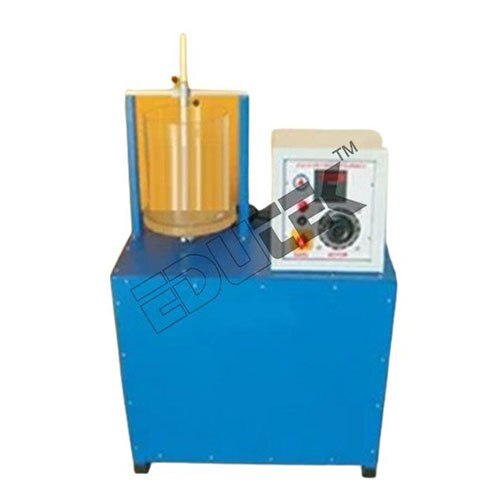
About Potential Flow
POTENTIAL FLOW
The laminar, two-dimensional flow is a good approximation of the flow of ideal fluids: the potential flow. All physical systems described with the Laplace equation can be demonstrated with potential flow. This includes current and thermal flows as well as magnetic flux.
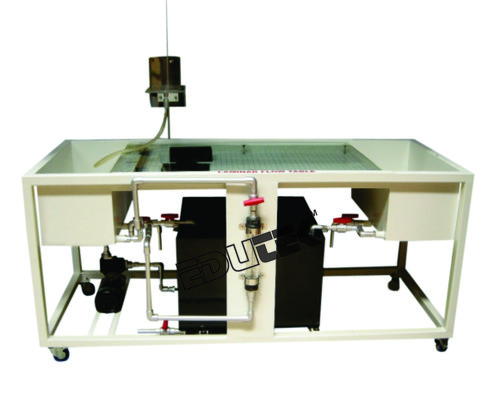
The laminar, two-dimensional flow is achieved by water flowing at low velocity in a narrow gap between two parallel glass plates. The parallel flow generated in this way is non-vortical and can be regarded as potential flow. Sources and sinks are generated via eight water connections in the bottom glass plate. The streamlines are displayed on the glass plate by injecting a contrast medium (ink).
In experiments the flow around bodies is demonstrated by inserting models into the parallel flow. Interchangeable models such as a cylinder, guide vane profile or nozzle contour are included.
To model the flow without models, it is possible to overlay parallel flow, sources, sinks and dipoles as required. This allows the demonstration of the formation of Rankine half-bodies.
The water flow rate and the quantity of contrast medium injected can be adjusted by using valves. The water connections are also activated by valves and can be combined as required.
The well-structured instructional material sets out the fundamentals and provides a step-by-step guide through the experiments.
Learning Objectives / Experiments
- Visualisation of streamlines in
- Flow around drag bodies: cylinder, guide vane profile, square, rectangle
- Flow through models: nozzle contour, sudden contraction or enlargement
- Flow separation, flow with 90 deflection
- Modelling the flow around bodies by overlaying parallel flow and sources and/or sinks
- Formation of Rankine half-bodies
- Demonstration of a dipole
- Analogy between potential flow and other physical systems which are described by the Laplace equation
Specification:
- Demonstration of potential flow in a Hele-Shaw cell for visualising streamlines
- Flow around supplied models: cylinder, square, rectangle, guide vane profile, various models for changes in cross-section
- Modelling the flow around contours without models by overlaying parallel flow with sources or sinks
- Water as flowing medium and ink as contrast medium
- Hele-Shaw cell made of two glass plates arranged in parallel with narrow gap
- Upper glass plate, hinged for swapping models
- Bottom glass plate with cross-shaped water connections for generating sources/sinks, can be combined as required
- Grid in the bottom glass panel for optimal observation of the streamlines
- Flow velocity, water inlet and water outlet in sources/sinks as well as dosage of the contrast medium can be adjusted by using valves
Technical Data:
- 2 glass plates, LxW: 910x585mm
- Distance between the plates: 5mm
- Bottom glass plate with eight water connections for
- Sources/sinks
Models:
- 6 drag bodies
- 2 changes in cross-section
- Material: rubber
- Thickness: 5mm
Injection of the contrast medium (ink):
- 19 nozzles
- Tank for contrast medium: 200mL
Dimensions and Weight:
- LxWxH: 1550x720x1410mm
- Weight: approx. 125kg
This apparatus makes it possible to demonstrate and analyze both laminar and turbulent flow regimes within a single system. The integrated water supply, adjustable controls, and clear flow channel enable students and researchers to study key fluid mechanics principles under controlled conditions.
Robust Design and Safe OperationWith components constructed from stainless steel and glass, and safety features like overtemperature protection, the PF-01 guarantees reliability and longevity. Its bench-top setup and digital display ensure convenient use, while the low-maintenance design reduces operational overhead.
Precision and CustomizationFactory calibration ensures highly accurate measurements, critical for laboratory research and demonstration. With customizable volume capacity, precise flow measurement (0.1 to 10 L/min), and adaptable temperature range, this versatile device is suitable for a wide spectrum of experimental needs.
FAQs of Potential Flow:
Q: How do I operate the Potential Flow Apparatus for fluid mechanics demonstrations?
A: To operate the apparatus, fill the integrated water tank, select the desired flow type (laminar or turbulent) via manual or digital controls, and activate the water circulation system. The digital display assists with real-time monitoring, making setup and operation straightforward for laboratory environments.
Q: What are the benefits of using a factory-calibrated, 100% accurate flow apparatus like the PF-01?
A: Factory calibration ensures measurement reliability, eliminating the need for frequent recalibration. With 100% accuracy, users can trust the data for precise analysis in fluid mechanics studies, enhancing both educational demonstrations and research outcomes.
Q: When should the overtemperature protection feature be utilized?
A: Overtemperature protection automatically engages whenever water temperatures approach the devices safety threshold, providing peace of mind and protecting equipment integrity during extended or intensive experiments.
Q: Where is the ideal location for installing this potential flow apparatus?
A: Designed specifically for indoor, bench-top use, the apparatus fits standard laboratory environments. Its compact footprint (600 mm x 350 mm x 550 mm) allows for easy installation on laboratory benches or demonstration tables.
Q: What is the typical maintenance process for this laboratory equipment?
A: Routine maintenance involves inspecting and cleaning the flow channel and integrated tank, ensuring manometers and the display system function properly, and verifying the safety features. The robust construction and low-maintenance design simplify upkeep.
Q: How can instructors and students benefit from the digital display and semi-automatic controls?
A: The digital display provides precise, real-time readings of flow rates and temperatures, while semi-automatic controls enable quick adjustments between experiments. This efficiency streamlines laboratory exercises and improves the learning experience.




 Send Inquiry
 Send Inquiry