About FEEDBACK AMPLIFIER (POSITIVE & NEGATIVE)
Specification:
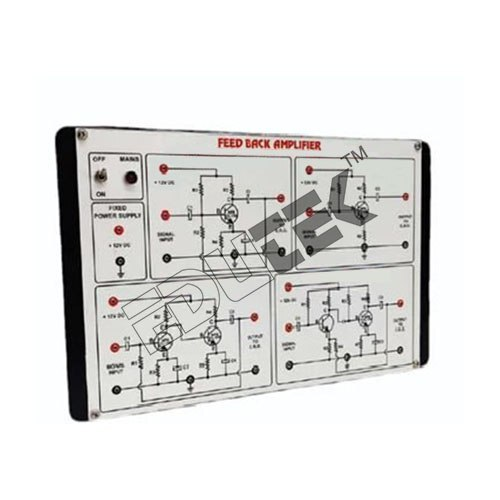
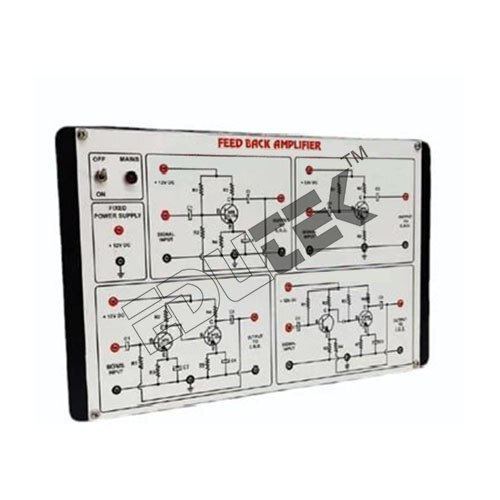
FEEDBACK AMPLIFIER (POSITIVE & NEGATIVE)
Features:
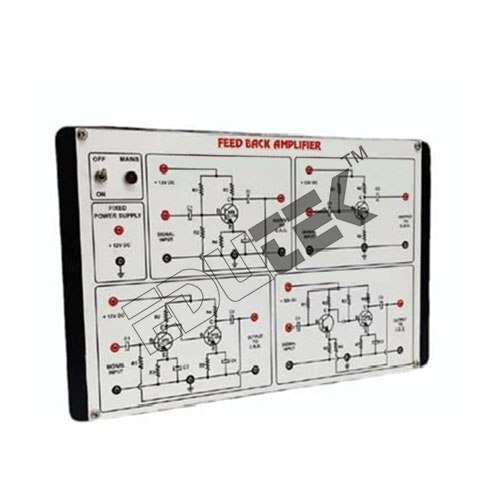
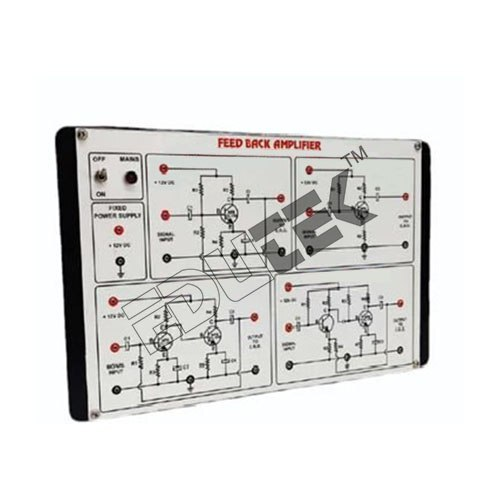
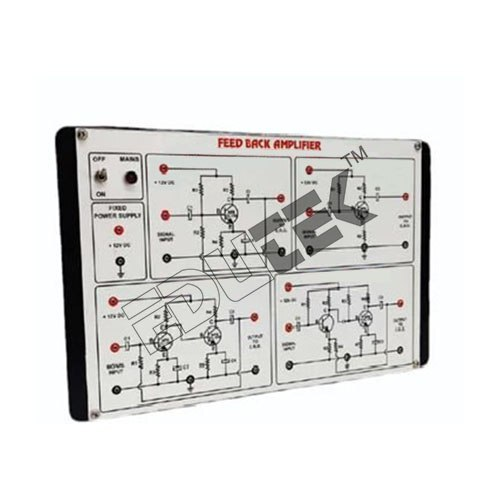
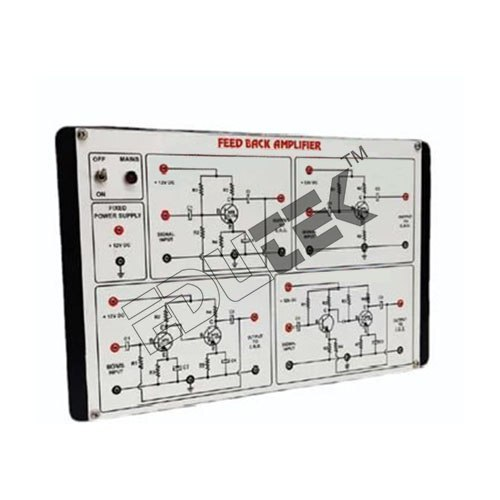
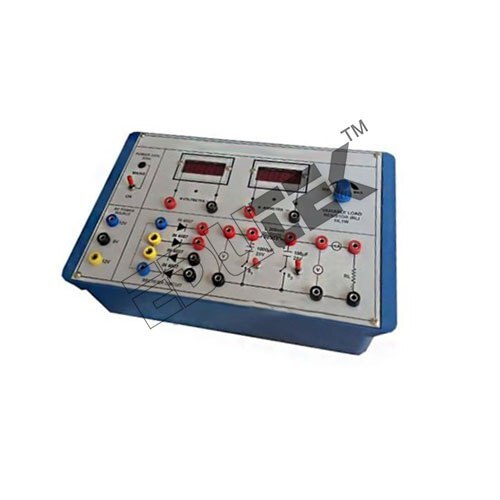
Front panel built with high class insulated Printed Circuit Board sheet with well printed circuits and symbols.
Fuse for Short Circuit protection Instruction manual. Connections are brought out through 2mm Colored Sockets.
Patch Cords 2mm.
The trainer is housed in ABS Plastic cabinet.
Versatility in Feedback DemonstrationThis amplifier allows users to explore and configure both positive and negative feedback scenarios within one compact unit. The included schematic diagram and clearly marked panel simplify understanding and reconfiguration, making it an excellent educational tool for demonstrating feedback principles.
Lab-Ready and Safe OperationConstructed with a fused, overload-protected power supply and rugged MS powder-coated panel, this device is ideal for repeated classroom or lab use. Its portable, bench-top design meets standard laboratory size requirements, ensuring convenience without compromising safety.
Comprehensive Monitoring and ExperimentationMultiple test points and easy-to-use 4 mm safety terminals enable thorough voltage and current monitoring at several circuit locations. The included manual guides users through a range of experiments, supporting self-learning and guided instruction alike.
FAQ's of FEEDBACK AMPLIFIER (POSITIVE & NEGATIVE):
Q: How does the amplifier demonstrate both positive and negative feedback?
A: The amplifier can be easily configured to illustrate both positive and negative feedback by adjusting the circuit connections as indicated in the included schematic diagram and manual. This versatility is central to understanding feedback effects in electronic circuits.
Q: What academic or practical benefit does this device offer?
A: This instrument provides a hands-on platform for students and professionals to explore theoretical concepts through experimentation. It reinforces learning about feedback in amplifiers, a key topic in electronics engineering, and aids in practical skill development.
Q: When should I use the test points for voltage and current monitoring?
A: Test points should be used during experimentation to observe and measure critical voltages and currents at different stages of the amplifier circuit. This real-time monitoring facilitates better comprehension of circuit behavior under varying feedback conditions.
Q: Where can I set up and use this feedback amplifier?
A: The feedback amplifier is designed for bench-top use in laboratories, classrooms, or any educational workspace with access to a 230V AC mains supply. Its portable design makes it easy to relocate as needed.
Q: What is the process for switching between positive and negative feedback?
A: Switching between positive and negative feedback involves following the wiring changes detailed in the experiment manual and schematic diagram. Patch cords are provided for secure and clear connections during each configuration.
Q: Which accessories and safety features are included with the product?
A: The unit comes with patch cords for convenient circuit connections and a fused power supply for overload protection. Inbuilt signal source and safety terminals ensure safe and flexible operation in an academic environment.




 Send Inquiry
 Send Inquiry

