About Secondary Controllers In Refrigeration Systems
SECONDARY CONTROLLERS IN REFRIGERATION SYSTEMS
Secondary controllers are used to ensure the optimum operation of large, complex refrigeration systems. They control the evaporation pressure (KVP), the intake pressure of the compressor (KVL), the delivery capacity of the compressor (KVC), the condensation pressure (WVFX, KVR) and the receiver pressure (KVD, NRD).
With this trainer the student can try out the operation of the different secondary controllers. The secondary controllers can be
disabled as required by bypassing or blocking. This option can be used for fault finding. By adjusting the secondary controllers the effect on the overall system can be studied.
Manometers at all important locations and a manual thermometer enable the monitoring of the system state. The two evaporators for the cooling and freezing stage can be selected via solenoid valves. With an adjustable electrical heater in the refrigeration chamber the effect of a changing cooling load on the secondary controllers can be examined.
The well-structured instructional material sets out the fundamentals and provides a step-by-step guide through the experiments.
The unit shall perform the following experiments and investigations:
Learning Objectives / Experiments
- Properties and application options of different
- Secondary controllers
- Evaporation pressure controller (KVP)
- Start-up controller (compressor intake control; KVL)
- Capacity controller (control of the compressor
- Delivery capacity; KVC)
- Condensation pressure controller (WVFX, KVR)
- Receiver pressure controller (KVD with NRD)
- Adjustment of optimum operating points
- Fault finding in secondary controllers
Specification
- Trainer from the practical series for the training of mechatronics engineers for refrigeration
- Refrigeration system with different secondary controllers: evaporation pressure controller KVP, capacity controller KVC, condensation pressure controller KVR, pressure-controlled water valve WVFX as condensation pressure controller, receiver pressure controller KVD, start-up controller KVL
- 2 refrigeration chambers: refrigeration and freezing stage
- Evaporator selectable via solenoid valves
- Adjustable electric heater in the refrigeration chambers as cooling load
- Water-cooled coaxial condenser
- Pressure measurement at all relevant points in the system
- Refrigerant R134a, CFC-free
Technical Data
- Compressor according to CECOMAF
- Refrigeration capacity: 990W at -5/55C
- Power consumption: 685W
- Cooling load: 0...500W
- Receiver: 1,3L
Measuring ranges
- Pressure: 5x -1...9bar / 3x -1...24bar
- Flow rate water: 20...250L/h
- Flow rate refrigerant: 1x 1...11,5L/h; 1x 2...27L/h
- Temperature: -50...300C
Dimensions and Weight
- LxWxH: 2.500x790x1.900mm
- Weight: approx. 280kg
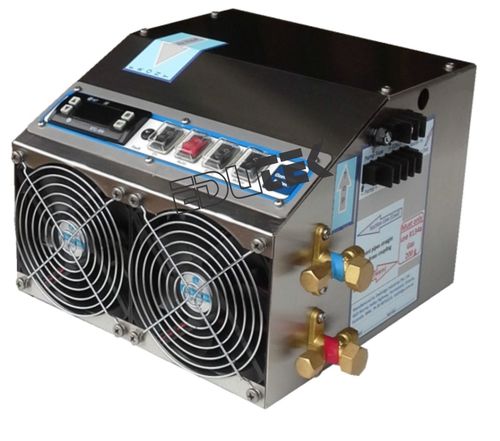
The SC-RS480 offers highly accurate and programmable temperature control for multi-circuit refrigeration systems found in laboratories. With an operational range from -50C to +150C and support for both NTC and PT100 sensors, this controller ensures optimal sample preservation, research consistency, and system efficiency.
Robust Monitoring and Data LoggingEquipped with a digital LED display and multi-color LED status indicators, the SC-RS480 delivers real-time feedback. Buzzer and visual alarms, along with on-board memory for 2,000 events, allow for comprehensive monitoring. Optional Modbus RTU enables remote communication, essential for labs emphasizing data traceability and security.
Easy Installation and Flexible OperationThe panel mount design and IP54 enclosure ensure straightforward installation and resilience against challenging laboratory conditions. With automatic operation, integrated relay outputs, and swift response times under one second, the controller is engineered for demanding laboratory workflows where reliability and speed are paramount.
FAQs of Secondary Controllers In Refrigeration Systems:
Q: How can I program multiple set points on the SC-RS480 secondary controller?
A: Programming multiple set points (4-8) is accomplished using the digital LED interface. Navigation buttons allow you to set specific temperature thresholds based on your application requirements, supporting tailored cooling and defrost cycles for up to eight circuits.
Q: What sensors are compatible with this controller and how do I select the right one?
A: The SC-RS480 supports both NTC and PT100 sensors. Selection depends on your desired measurement range, required accuracy, and installation compatibility. NTC sensors are often used for general applications while PT100s are preferred for higher accuracy and stability in laboratory settings.
Q: When and where is it best to use the SC-RS480 in a laboratory environment?
A: The controller is ideal for laboratory refrigeration and climate control systems that demand precise temperature management across multiple zones. It performs optimally at ambient temperatures between 0C and +60C and is suitable for panel-mounted installations, especially where data logging and alarm monitoring are essential.
Q: What is the process for integrating the SC-RS480 with existing lab systems?
A: Integration involves panel mounting the unit, connecting compatible sensors, and wiring relay outputs to your refrigeration equipment. For advanced communication, Modbus RTU can be connected for remote monitoring or control. Its microprocessor-driven design ensures quick set-up, with all connections detailed in the supplied documentation.
Q: How does the data logging function benefit laboratory operations?
A: With on-board memory capable of recording up to 2,000 events, the SC-RS480 enables detailed traceability of system status, alarms, and temperature changes. This facilitates compliance reporting, troubleshooting, and system optimization in laboratory environments requiring documentation and quality assurance.
Q: What visual and remote alarm functions does the controller provide?
A: Alarms are delivered both audibly (buzzer) and visually via multi-color LEDs and digital display indicators. For remote notifications, optional Modbus RTU protocol enables alerts to be sent to facility management systems or remote devices, enhancing response times and system awareness.
Q: What are the primary benefits of choosing the SC-RS480 from an Indian exporter, manufacturer, or supplier?
A: Selecting the SC-RS480 from an Indian exporter or manufacturer ensures local technical support, competitive pricing, and shorter lead times. The robust design, automation features, and compliance with laboratory standards make it a cost-effective and efficient choice for advanced refrigeration control.



 Send Inquiry
 Send Inquiry

