About SAWTOOTH GENERATOR USING OP-AMP
Specification:
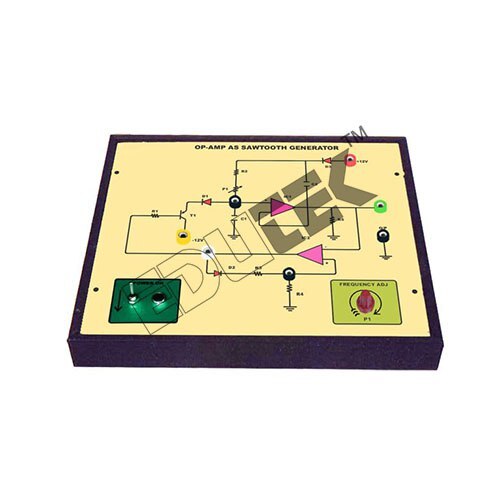
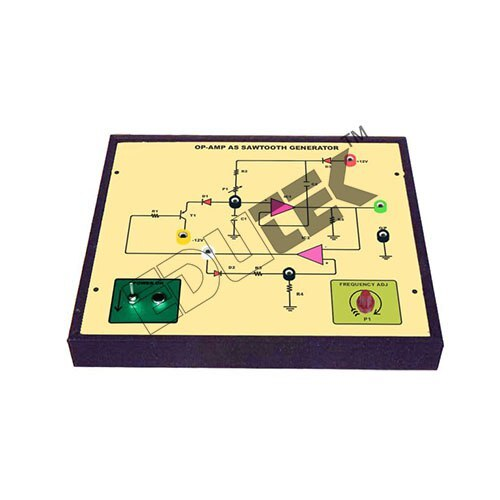
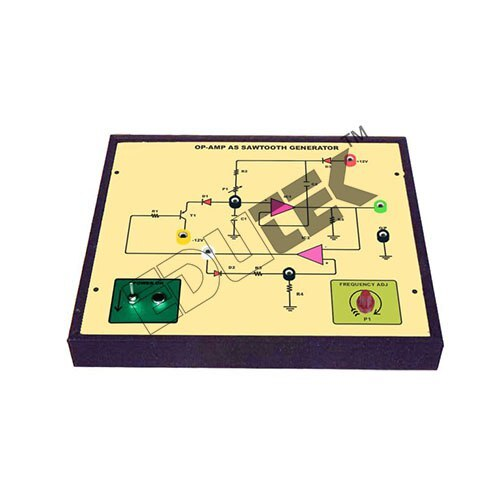
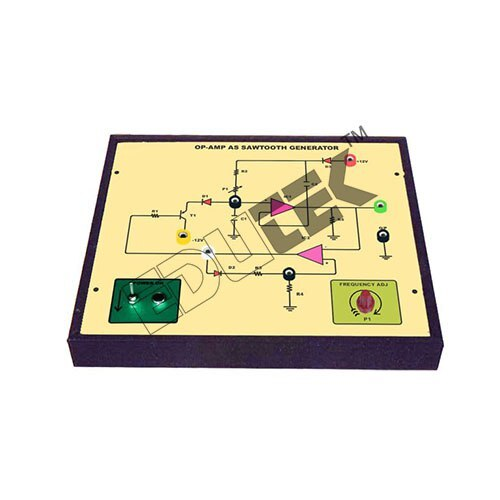
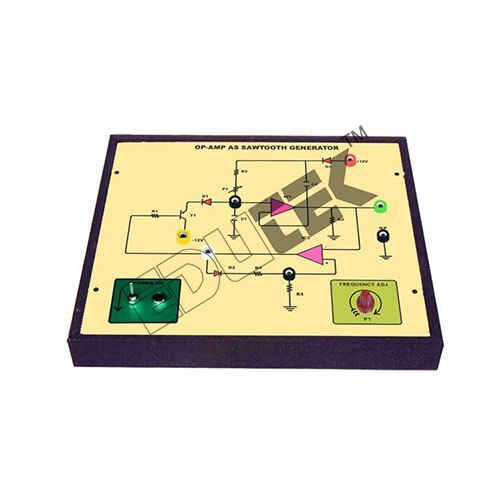
SAWTOOTH GENERATOR USING OP-AMP
Dedicated trainer board for each circuit.
Completely self-contained stand-alone unit.
Construction and study of Op amp as saw tooth wave generator.
Study the working and observe the output saw tooth wave.
Reliable Sawtooth Signal GenerationThis generator delivers a clean, adjustable sawtooth waveform-an essential signal for simulating, analyzing, and testing electronic circuits. Its frequency can be tuned using an onboard potentiometer, supporting experiments across a typical 100 Hz to 5 kHz range. With durable PCB construction and standard-grade components, it's ideal for engineering labs and instructional settings.
Precision Engineering for Classroom and FieldDesigned with FR4 high-grade glass epoxy PCB and a HASL finish, the module ensures excellent durability and thermal handling during routine usage. The visible blue and white assembly, along with supplied test points, simplifies interfacing and measurements, making it a highly practical educational instrument.
Simple Integration and OperationMounting and connecting is straightforward using through-hole components and standard connectors. The module runs on a typical +12V DC input and can be powered by any compatible external regulated supply. Sawtooth waveform output can be observed and measured directly using an oscilloscope without requiring a display on the module itself.
FAQ's of SAWTOOTH GENERATOR USING OP-AMP:
Q: How do I adjust the output frequency of the sawtooth generator?
A: You can set the output frequency by turning the onboard potentiometer. The typical adjustable frequency range is between 100 Hz and 5 kHz, which is determined by the RC network values in the circuit.
Q: What is the recommended power supply for this module?
A: It is recommended to use a regulated DC power supply within the 5V to 15V range, with +12V DC being typical. Ensure the supply is properly regulated, as there is no built-in over-voltage or reverse-polarity protection.
Q: Where should I connect my measuring instruments?
A: Test points are provided for both the output and power connections. Connect your oscilloscope probes to the output test points to observe the waveform. Power is connected via a 2-pin DC terminal.
Q: What type of load is suitable for this generator?
A: For optimal performance, use a load resistance greater than 10 k. This avoids excessive loading on the op-amp's output and maintains waveform integrity.
Q: How can I modify the duty cycle of the sawtooth waveform?
A: The duty cycle can be adjusted by changing the values of the timing resistors and capacitors (RC network) according to your application needs.
Q: When is this module typically used?
A: This generator is commonly used in engineering electronics laboratories, educational environments, and in development or testing scenarios where a continuous sawtooth waveform is required.
Q: What are the main benefits of using this sawtooth generator?
A: Benefits include reliable, precise sawtooth waveform generation; robust PCB construction; compact form factor; and straightforward setup, making it suitable for both educational and laboratory instrumentation.




 Send Inquiry
 Send Inquiry

