About Refrigeration Components For Basic Experiments
REFRIGERATION COMPONENTS FOR BASIC EXPERIMENTS
Enables in conjunction with, and the accessory set the design and performance of various basic experiments related to refrigeration.
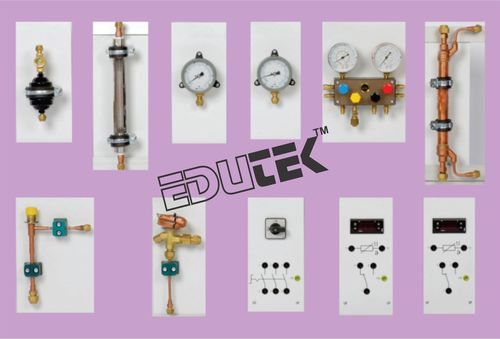
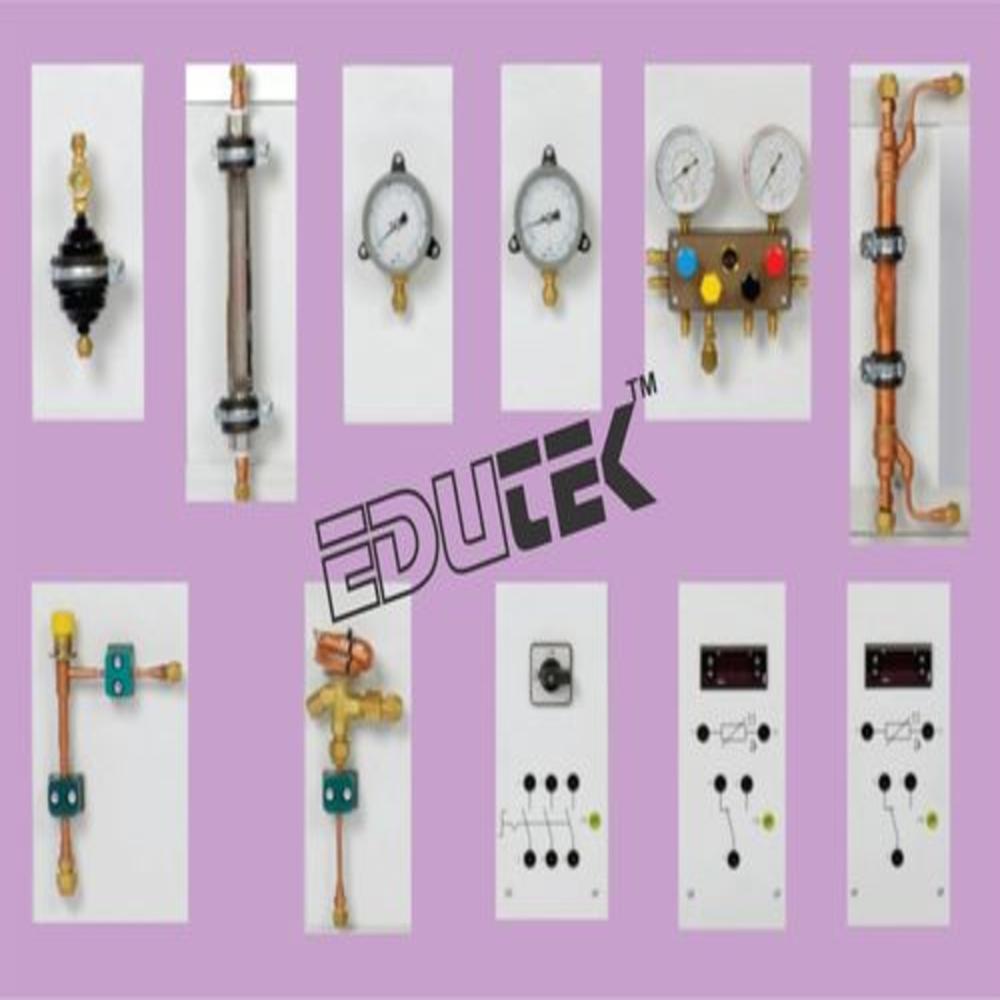
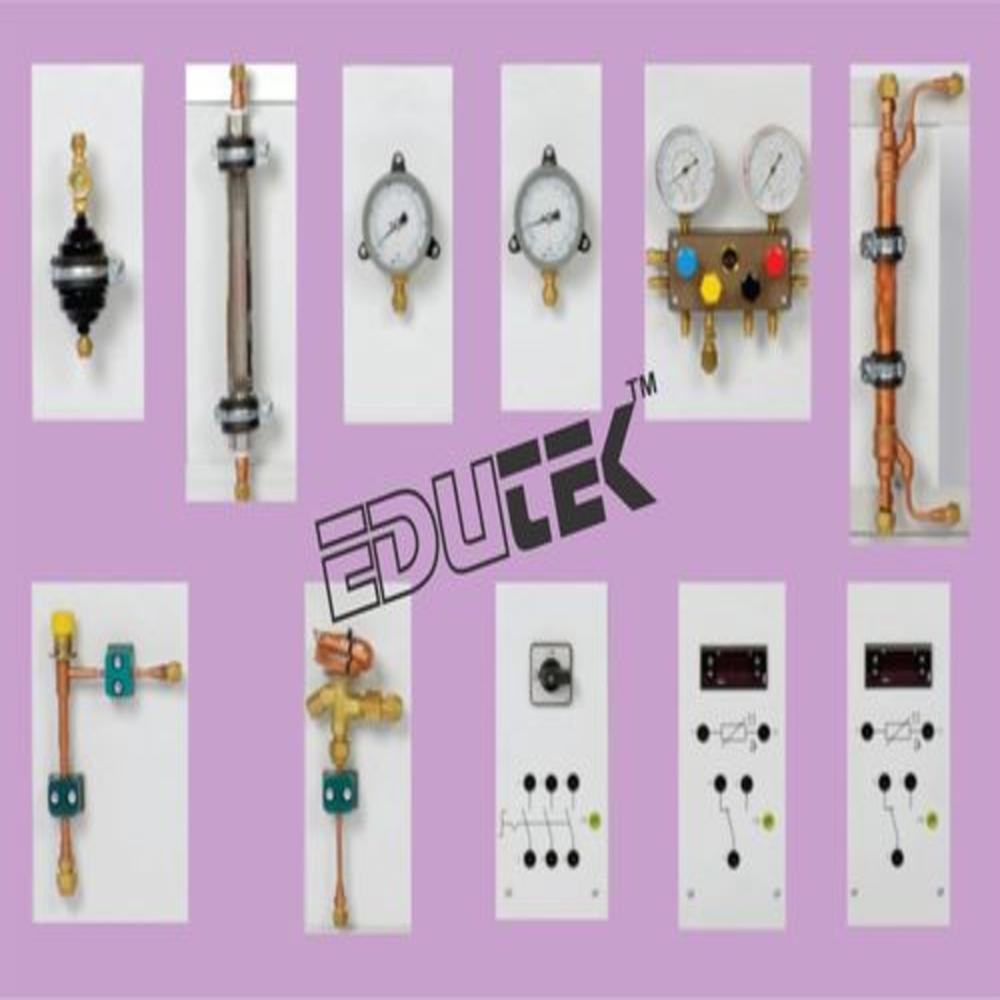
Commercial components are used in practical experiments. These components are mounted on plates ready to be connected and are arranged clearly in the frame of.
The set includes simple refrigeration components, such as expansion elements and filters, as well as electrical components, e.g. switches and thermostat. The super heater included in the set is a heat exchanger ensuring the complete evaporation of the refrigerant before entering the compressor whilst the liquid refrigerant is supercooled upstream of the expansion element. The control behaviour of the expansion element is monitored at the flow meter. Manometers provide an insight to the pressure ratios in the refrigeration circuit. Via pressure and temperature measurements the change of state of the refrigerant can be tracked and entered into the log p-h diagram. The temperature is measured by inter laboratory thermometers.
The well-structured instructional material sets out the fundamentals and provides a step-by-step guide through the
experiments.
The unit shall perform the following experiments and investigations:
Learning Objectives / Experiments
- Design of different simple refrigeration circuits
- Design, operation and adjustment of components
- Sight glass with filter/drier
- Flow meter
- Delivery and intake manometer
- Assembly aid
- Superheater
- Pressure-controlled expansion valve
- Thermostatic expansion valve
- 3-pin circuit breaker
- Electric two-point thermostat with
- Switch hysteresis
- Suction line receiver
- Read and understand technical drawings and
- Operating instructions
- Fault finding
Specification
- Components for the setup of simple refrigeration circuits in conjunction with Refrigeration Training System Unit
- Heat exchanger as superheater
- 3-pin circuit breaker
- Assembly aid: 4-port directional valve with sight glass
- Sight glass with humidity indicator
- Pressure-controlled expansion valve
- Thermostatic expansion valve
- 2 thermostats with different temperature ranges
- Components mounted on plates ready to connect
- Abrasion-proof symbols and labels on plates
Technical Data
- Pressure-controlled expansion valve
- Pressure range: 1...7bar
- Thermostatic expansion valve
- Evaporation temperature: -45...20C
- Valve insert rated capacity: 0,3kW
- Circuit breaker, 3-pin: 3kW
- 2 electric thermostats
- -5...25C
- -25...5C
- Heat exchanger
- Capacity: approx. 2.5kW at -10C evaporation
- Temperature
Measuring ranges
- Pressure, high pressure side: -1...24bar
- Pressure, low pressure side: -1...9bar
- Flow rate: 3...41kg/h
Dimensions and Weight
- Plate height: 297mm
- Weight: approx. 20kg
These refrigeration components are designed to provide consistent and accurate results in laboratory environments. Their 100% accuracy ensures dependable measurements and outcomes, making them indispensable for basic refrigeration experiments in educational and research settings.
Built for Efficiency and DurabilityFeaturing advanced engineering and quality materials, our refrigeration components offer highly efficient performance while withstanding the rigors of frequent laboratory usage. Their robust design ensures longevity and operational stability, optimizing the learning and experimentation process.
FAQs of Refrigeration Components For Basic Experiments:
Q: How should the refrigeration components for basic experiments be set up in a laboratory?
A: To ensure proper functionality, position the components on a stable work surface and connect according to the supplied guide. Follow all recommended safety protocols and verify connections before starting any experiment.
Q: What are the main applications of these refrigeration components in laboratory settings?
A: These components are primarily used in educational laboratories to demonstrate basic refrigeration principles, allowing students to conduct thermodynamics and cooling cycle experiments.
Q: When is it ideal to use these refrigeration components for teaching or research purposes?
A: They are best utilized during introductory and intermediate laboratory courses on refrigeration, or when conducting controlled research studies related to cooling mechanisms and thermal management in educational institutions.
Q: Where are these refrigeration components manufactured and supplied from?
A: Our components are manufactured in India and distributed globally as we serve as a leading exporter, manufacturer, and supplier for quality laboratory equipment.
Q: What is the process for maintaining these refrigeration components?
A: Routine maintenance involves checking all connections, ensuring cleanliness of coils and housing, and verifying that no parts are obstructed or damaged. Periodic checks will maximize performance and longevity.
Q: How does the high efficiency of these refrigeration components benefit laboratory experiments?
A: High efficiency ensures energy savings and consistent temperature control, resulting in precise experimental conditions and improved accuracy of results for educational and research applications.




 Send Inquiry
 Send Inquiry

