About Permeability Apparatus
Permeability Apparatus
Permeability Apparatus (Single Cell Model)
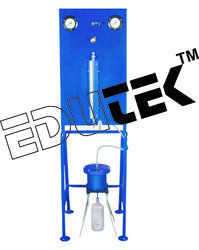
One of the durability test of concrete is to determine permeability of water through specimen. Permeability apparatus is used for determining the permeability of cement mortar and concrete specimens of 15cm cubes cast in the laboratory. Specification :The concrete permeability apparatus comprises of a brass / gunmetal cell of Square/Round cross-section mounted on a stand and a pressure chamber is connected to the cell through copper tubing and T-connector mounted on the stand with sleeve packed valve and rubber hose pipe with end connections. The cell assembly consists of one base plate, one metal funnel and one top plate. The pressure chamber is fitted with a pressure regulator which helps in regulating the pressure from 0-15kg/cm sq. Gauge is for indicating the pressure in the cell. A foot pump and a pressure tube is supplied to develop pressure in the chamber. The apparatus is supplied with a measuring cylinder 500cc to measure percolated quantity to water. Pressure can also be applied; by a pressure air line or by a compressor which can be supplied at an extra cost. Precision and Safety in Soil Permeability AnalysisThis apparatus is designed for highly accurate soil permeability measurement, offering 1% accuracy. The factory-calibrated analog gauge allows for confident, repeatable readings, while the overload protection ensures safe operation during extended tests. With its quick-release mechanism and corrosion-resistant components, users enjoy both convenience and safety.
Versatility for Multiple Testing MethodsCapable of both falling head and constant head tests, the equipment accommodates a range of research applications. Its transparent acrylic tubes and rigid PVC piping promote easy observation, while the borosilicate glass and stainless steel parts ensure resilience. The sample holder can accommodate up to 100 mm diameter samples, allowing flexibility for different soil types.
Built for Laboratory Efficiency and ReliabilityMeasured at 400 x 250 x 800 mm and weighing 18 kg, this apparatus is compact yet robust. The powder-coated finish, stainless steel construction, and electric operation support long-term, low-maintenance usage. An ambient temperature range of 10C to 45C and water tank capacity of 2 liters make it ideal for consistent lab performance.
FAQs of Permeability Apparatus:
Q: How is soil permeability measured using the Permeability Apparatus with Manometer Type?
A: Soil permeability is measured by observing water flow through a soil sample placed in the permeability cell. The apparatus allows testing via both falling head and constant head methods, using factory-calibrated analog gauges to record pressure and water movement, enabling precise determination of permeability according to IS: 2720 (Part XVII) standards.
Q: What types of samples and soils can be tested with this apparatus?
A: The device supports soil samples up to 100 mm in diameter, making it suitable for a wide range of soil typesincluding fine-grained and coarse-grained soilsensuring versatility in laboratory soil permeability research.
Q: When should I use the falling head method versus the constant head method with this equipment?
A: The falling head method is typically used for fine-grained, low-permeability soils, whereas the constant head method is preferable for coarse, more permeable soils. The apparatus enables both methods, so users can select the appropriate testing process based on the soil characteristics.
Q: Where is this permeability apparatus commonly used?
A: This apparatus is primarily utilized in geotechnical, civil engineering, and soil mechanics laboratories, including academic, industrial research, and quality control environments where precise soil permeability testing is essential.
Q: What is the process for setting up and operating the apparatus safely?
A: To set up, securely place the soil sample in the stainless steel holder and tighten using the quick-release clamp. Fill the water reservoir with up to 2 liters, connect to the 230V AC power source, and set the test parameters. The systems overload protection ensures operational safety during testing.
Q: How does the apparatus ensure accurate and reliable results?
A: Precision is achieved through factory calibration, an analog gauge with 1% accuracy, and corrosion-resistant materials that guarantee consistent performance over time. The transparent acrylic double tube allows for clear observation, while the robust construction enhances repeatability.
Q: What benefits does this permeability apparatus offer to users and laboratories?
A: Key benefits include its ability to perform multiple test methods within a compact design, quick sample handling via the release mechanism, minimal maintenance due to corrosion-resistant parts, and reliable results that align with industry standards. These features collectively improve laboratory efficiency and data integrity.





 Send Inquiry
 Send Inquiry

