About Open Wind Tunnel
Open Wind Tunnel
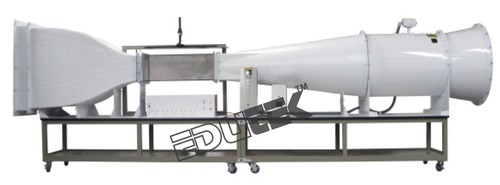
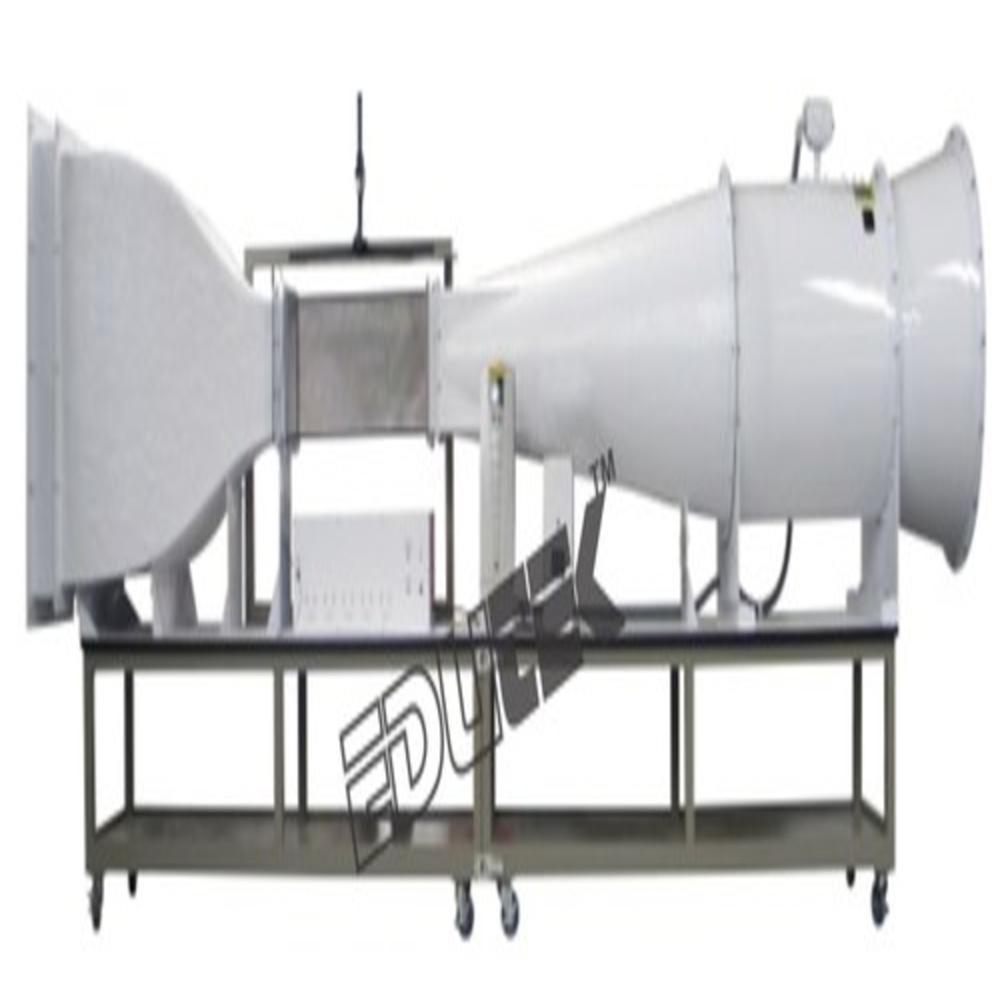
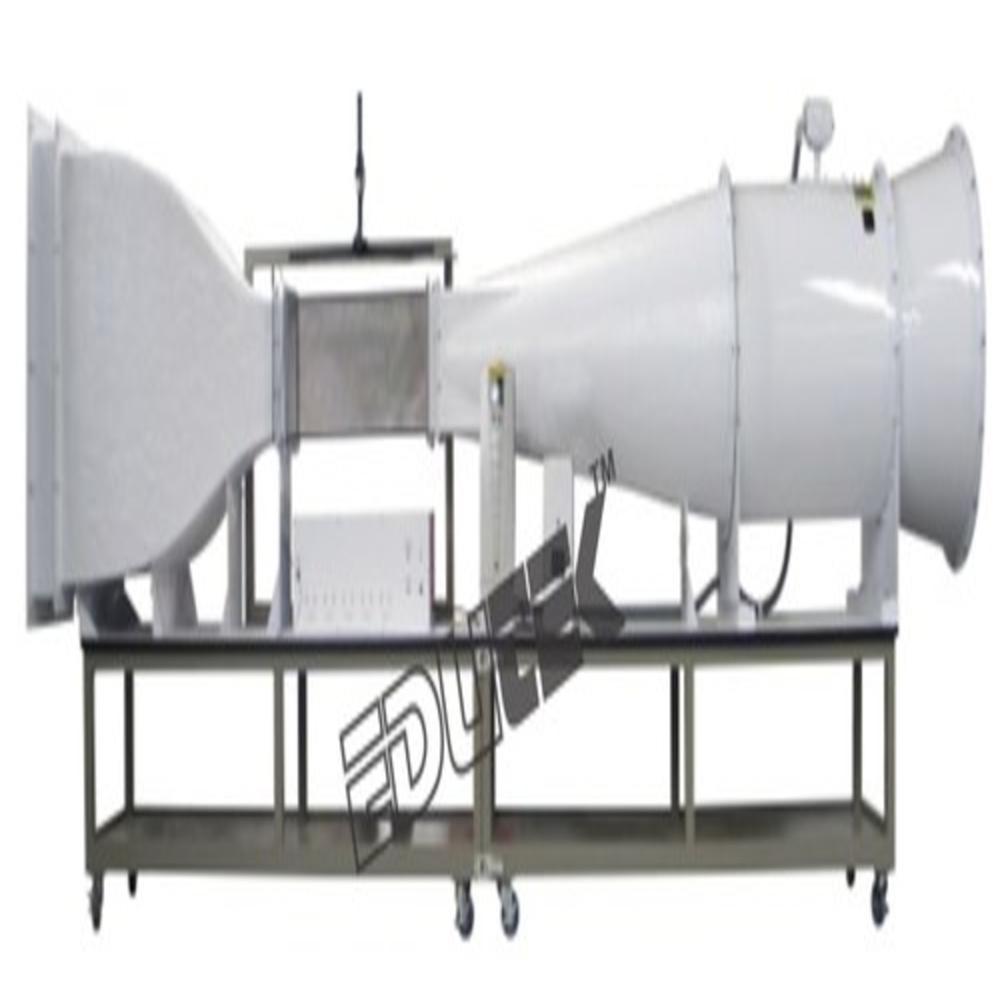
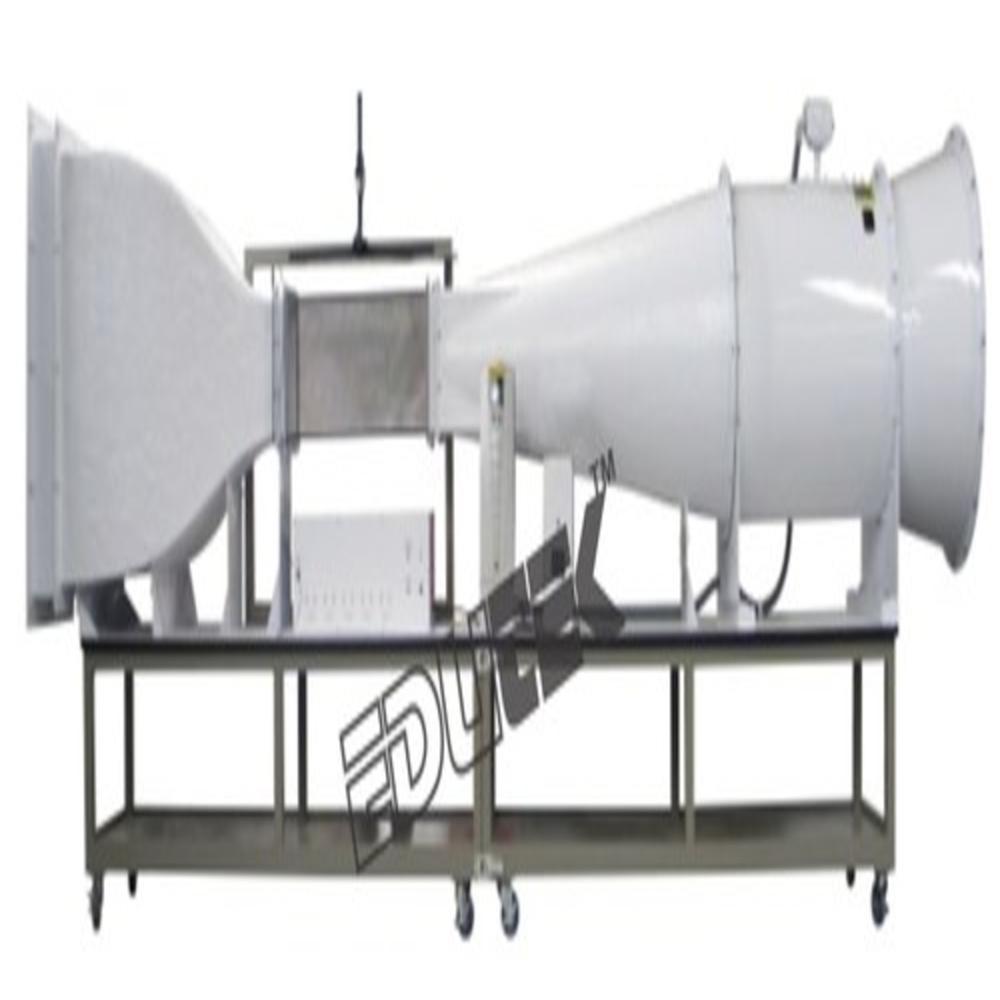
Wind Tunnel has been developed to perform various experiments of aerodynamics and fluid flow. This is a open circuit Wind Tunnel provides a region of controlled air flow into which models can be fitted at downstream of working section. The Tunnel consists of bell mouth shaped entry to guide the air smoothly into settling chamber and stabilizes the air flow this follows working section for test section where various models can be tested. Test section with acrylic sheet, will be provided for visual observation. Working section is followed by diffuser section which reduces the dynamic pressure at the exit. A fan coupled with motor is used to produce desired wind velocity.
Learning Objectives / Experiments:
- Experiments with accessories.
- Determine drag and lift coefficients for different models.
- Pressure distribution on drag bodies immersed in a flow.
- Boundary layer analysis.
- Investigation of flutter.
- Wake measurement.
- In conjunction with the fog generator.
- Visualisation of streamlines.
Specification:
- Experiments from the field of aerodynamics and fluid mechanics with an ''Eiffel" type wind tunnel.
- Wide range of accessories available.
- Transparent, closed measuring section.
- Inlet contour, nozzle and diffuser made of GRP.
- Variable-speed fan motor for energy-efficient operation.
- Flow straightener reduces turbulence.
- Electronic two-component force sensor for measuring the flow forces.
- Inclined tube manometer for displaying the air velocity.
- Digital display of drag and lift.
- Display of measured values for pressure.
- Displacement/angle, velocity and force using system for data acquisition.
Technical Data:
- Measuring section
- Flow cross-section W x H: 292 x 292 mm - length: 420 mm.
- Wind velocity: 3,1...28 m/s.
Axial fan- Power consumption: 2,55 kW.
Measuring ranges
- Force: 2x -5...5N.
- Pressure: 0...5 m bar.
Dimensions and Weight
- L x W x H: 2950 x 945 x 1645 mm.
- Weight: approx. 275 kg.
Engineered for laboratory environments, the Open Wind Tunnel guarantees high efficiency and delivers results with absolute accuracy. Precision in airflow control makes it suitable for diverse testing and research tasks, ensuring consistent data for every experiment. This wind tunnel is trusted by professionals for its reliability and accuracy in real-world applications.
Robust Construction with Warranty AssuranceWith dimensions of 2950 x 945 x 1645 mm and weighing 275 kg, this wind tunnel is both compact and durable. Crafted for longevity, it includes a 1-year warranty, supporting users with dependable after-sales service. Whether for educational or research applications, it offers long-term performance and peace of mind.
FAQs of Open Wind Tunnel:
Q: How is the Open Wind Tunnel typically used in laboratory settings?
A: The Open Wind Tunnel is primarily utilized for aerodynamic testing, flow visualization, and educational experiments. Its highly efficient and accurate airflow system allows users to study fluid dynamics, test models, and conduct various research projects within laboratory environments.
Q: What makes this Open Wind Tunnel stand out in terms of efficiency and accuracy?
A: This wind tunnel features advanced engineering that ensures maximum efficiency and 100% accuracy. Its precision-controlled airflow and robust build make it especially suitable for reliable data collection in experimental and research scenarios, minimizing results variability.
Q: When is routine maintenance recommended for the Open Wind Tunnel?
A: Routine maintenance is suggested at least twice a year, or according to the workload in the laboratory. Following the manufacturers maintenance guidelines will help maintain optimal performance and extend the equipments operational lifespan.
Q: Where is the Open Wind Tunnel manufactured and supplied from?
A: This Open Wind Tunnel is manufactured, supplied, and exported from India, catering to domestic as well as international laboratories, research centers, and educational institutions.
Q: What is the standard process for setting up the Open Wind Tunnel in a lab?
A: Setting up involves positioning the wind tunnel on a stable surface due to its 275 kg weight, connecting it to the required power source, and calibrating the controls as per the user manual. Professional installation is recommended for optimal safety and performance.
Q: What are the primary benefits of using this Open Wind Tunnel?
A: Key benefits include exceptionally high efficiency, precision in measurement, reliability, and the assurance of a 1-year warranty. Its versatility supports a wide range of experiments, enhancing the overall capabilities of any laboratory involved in fluid dynamics studies.




 Send Inquiry
 Send Inquiry

