About E/M BY MAGNETRON METHOD
Specification:
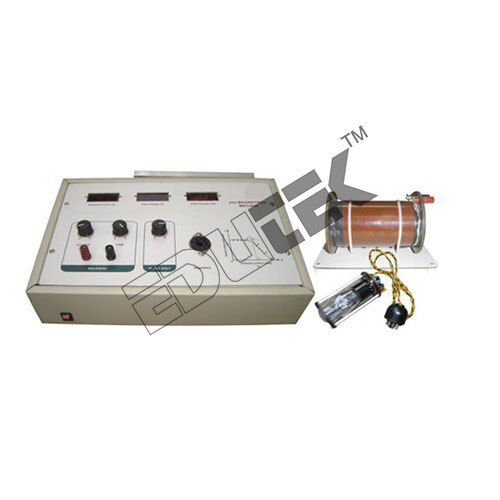
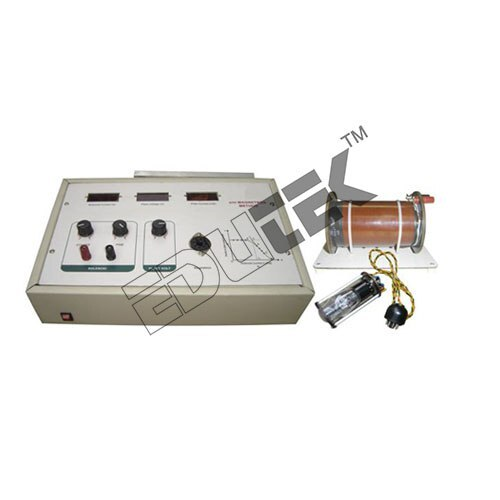
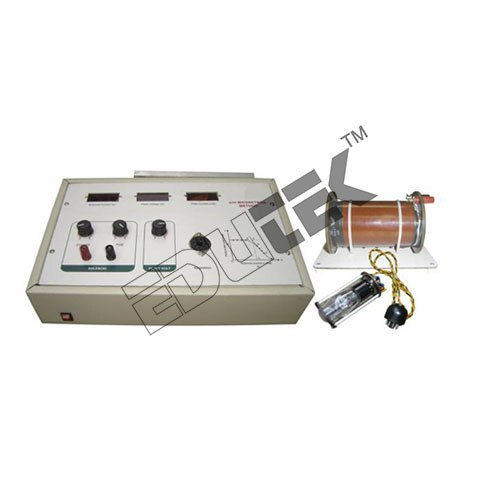
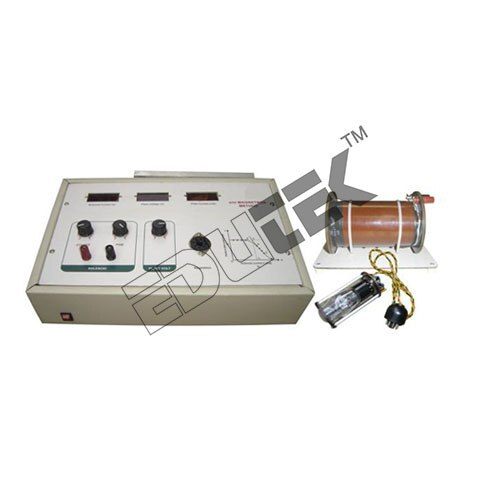
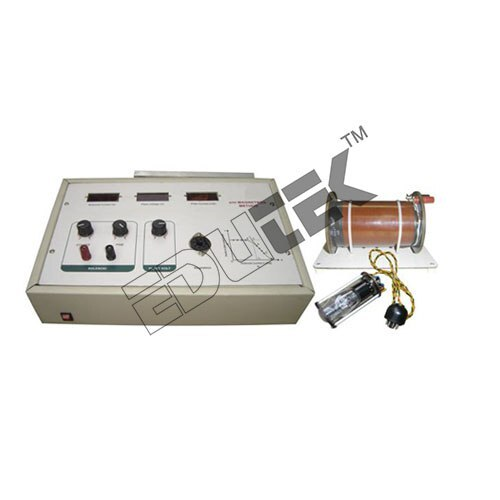
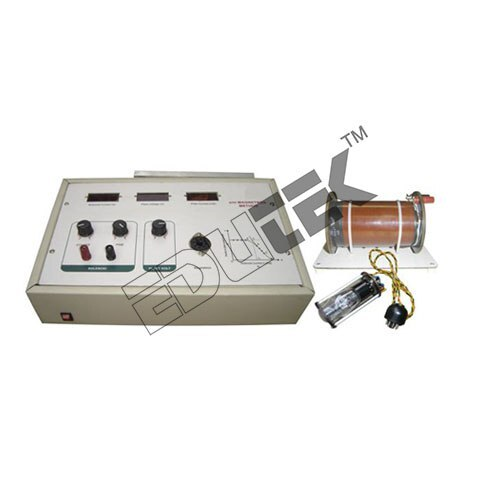
E/M BY MAGNETRON METHOD
Magneton Power Supply.
Input: 230 volts AC.
HT: 250 volts at 200 Micro Amps
LT: 6.3 volts at 2 Amp.
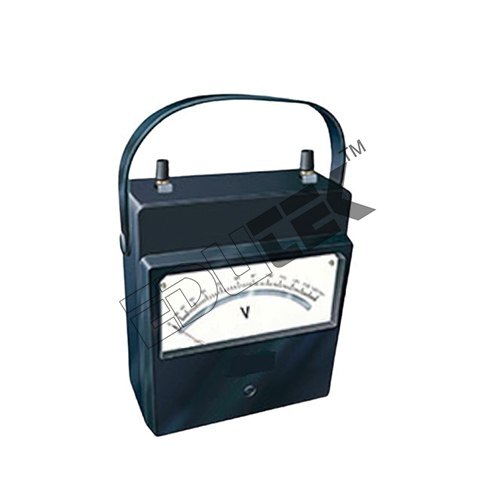
Provided with meters to read voltage and current.
Power Supply for Solenoid:
Input: 230 volts AC.
Output: 30 volts DC at 3Amp
Meter is provided to read current.
Accessories
Solenoid: Current carrying capacity 3Amp
Length: 45cm
Dia: 6.5 cm
Rheostat: Groove type special wound Rheostat is provided at 3A.
Advanced Magnetron Method for Accurate e/m MeasurementUtilizing crossed electric and magnetic fields, the EMM-101 enables highly accurate determination of the charge-to-mass ratio of the electron. Its integrated magnetron tube and Helmholtz coils ensure precise alignment and field uniformity, essential for dependable experimental outcomes.
User-Friendly and Comprehensive Laboratory SolutionThis setup comes complete with a digital voltmeter and ammeter for immediate measurement feedback, simple rotary controls for coil current adjustability, and all necessary accessories such as test leads, clamps, and a detailed manual. Its powder-coated case guarantees durability and safety for repeat laboratory usage.
Optimized for Educational and Research EnvironmentsDesigned for standard indoor laboratory conditions, the EMM-101 provides stable, non-slip mounting and a robust build to withstand daily academic or research activities. The compact, bench-sized form factor and intuitive digital interface make it suitable for engineering electronics courses and advanced study modules.
FAQ's of E/M BY MAGNETRON METHOD:
Q: How does the E/M BY MAGNETRON METHOD instrument measure the e/m ratio?
A: This instrument measures the charge-to-mass ratio (e/m) of the electron using the magnetron method, which involves placing electrons in crossed electric and magnetic fields. By analyzing the resulting deflection and using the precise readings from the digital voltmeter and ammeter, users can calculate the e/m ratio effectively.
Q: What components are included with the EMM-101 model?
A: The setup comes equipped with an enclosed glass magnetron tube with calibration markings, precisely wound Helmholtz coils, a digital voltmeter (0-30V), digital ammeter (0-2A), power supply module, connecting leads, instruction manual, fuse, and support clamps, providing a complete package for laboratory experiments.
Q: When and where should the E/M BY MAGNETRON METHOD apparatus be used?
A: This device is intended for use in indoor, non-condensing laboratory conditions, between 10C and 40C. It is ideally used in educational institutions, research laboratories, and engineering electronics courses to demonstrate and study the properties of electrons.
Q: What is the process for using the instrument to obtain measurements?
A: To operate, connect the device to a 230V AC mains supply, set up the glass tube and Helmholtz coils, and adjust the coil current using the rotary control. Digital meters display voltages and currents in real time, allowing for accurate assessment of the experimental data needed to calculate the e/m ratio.
Q: How does the digital interface benefit the user during experiments?
A: The digital voltmeter and ammeter provide highly precise measurements with microampere and millivolt resolution, reducing reading errors and ensuring reliable data. Immediate electrical response ensures that results can be viewed and recorded quickly during experimentation.
Q: What are the advantages of the powder-coated metal case and non-slip rubber feet?
A: The powder-coated metal case protects the instrument against wear and corrosion, while the non-slip rubber feet guarantee stable positioning on the laboratory bench, minimizing disruptions and enhancing safety during operation.




 Send Inquiry
 Send Inquiry

