About Plummet Balance
Plummet Balance
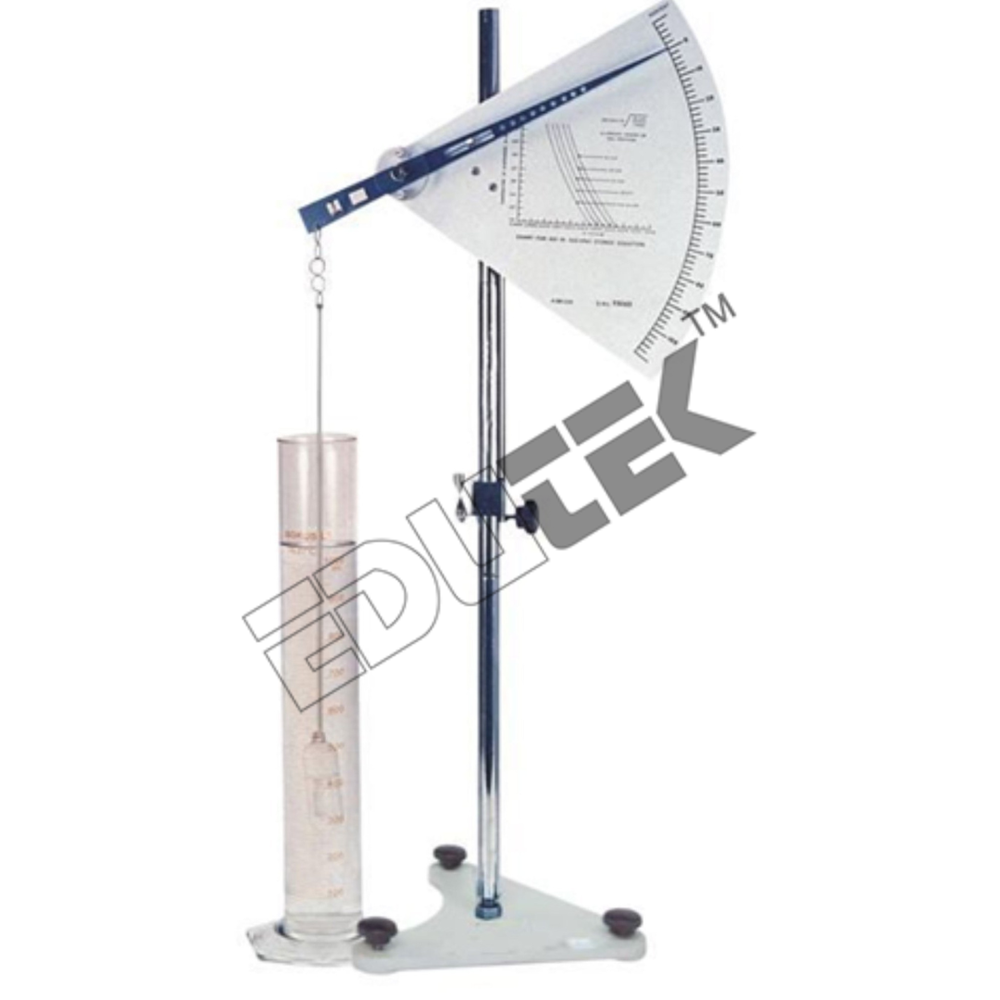
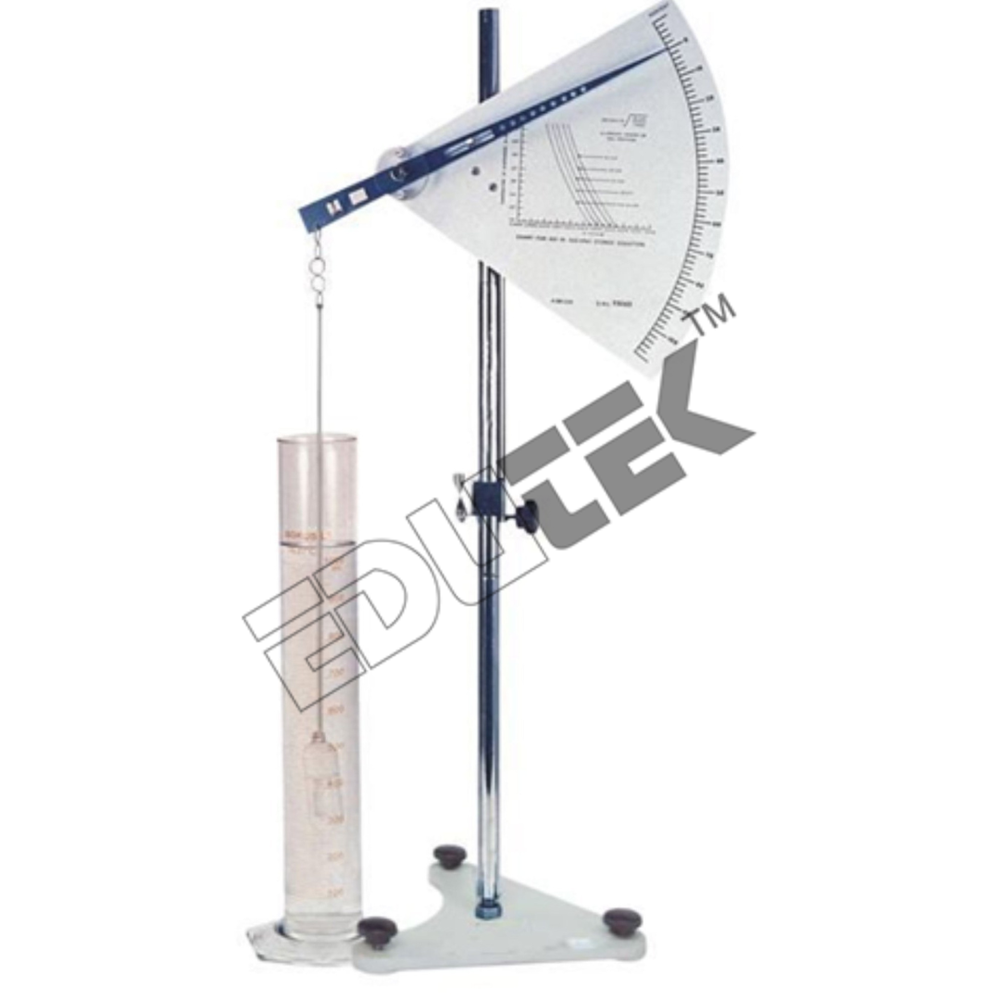
Conventionally particle size distribution analysis is carried out using pipette and hydrometer methods. Whereas in hydrometer method it is possible to determine particle sizes in the range 75 microns, the method involves computation and it is time consuming. The pipette method can be used for determining only the percentage of specific sizes less than 0.02, 0.006 and 0.002 mm as a percentage of total soil sample. The plummet balance method to determine sub sieve particle size for the entire range is very rapid and only manipulation of height of the balance, so that plummet sinks to the right depth is required. The percentage of soil in suspension is directly indicated by a pointer over a graduated scale. A vertical rod is mounted on a sturdy base having leveling screws. A pointer with steel pivots turns is jewel bearing an moves over a graduated scale. Scale graduations are market 0-100% x 2% To the other end of the pointer a plummet is hanged.
Rack and pinion arrangement is provided on the vertical rod for adjusting the height. Supplied with a chart showing relationship between K and temperature of suspension of soils of varying specific gravity from 2.4 to 2.8 to help in solving stroke's equation. Supplied complete with one Perspex plummet one measuring jar and one rider weight for zero adjustment and rider weight for adjusting the pointer to 100%.
Exceptional Build and AccuracyCrafted from brass with chrome plating for added durability, the Plummet Balance delivers high accuracy and corrosion resistance. The powder-coated mild steel stand provides stability, making it ideal for repetitive soil density and gravity testing in various laboratory environments.
User-Friendly Mechanical OperationOperation is entirely manual, employing a suspension system and lever mechanism for balance. No electrical source is required, ensuring portability and suitability for remote sites or teaching labs without advanced infrastructure. Analog displays allow straightforward measurement readings.
FAQs of Plummet Balance:
Q: How do you operate the Plummet Balance for soil density measurements?
A: To use it, suspend the cylindrical plummet from the lever mechanism attached to the powder-coated stand. Place the sample in accordance with standard procedures, then manually balance the lever arm until equilibrium is reached. Read the measurement on the analog display to determine soil density.
Q: What makes it suitable for civil engineering labs and educational use?
A: Its polished brass construction, corrosion resistance, manual operation, and high accuracy make it ideal for use in civil engineering labs, teaching environments, and industrial quality control settings. The analog readout and robust stand facilitate straightforward, dependable measurements.
Q: When should this mechanical balancing plummet be selected over electronic models?
A: Choose it when electricity is unavailable, portability is required, or maximum durability is preferred. Its manual mechanism is reliable in field research, educational demonstrations, and environments where electronic equipment might not be practical.
Q: Where is it typically used within laboratory or industrial settings?
A: This balance is commonly found in soil testing laboratories, geotechnical labs, educational institutions, and fieldwork locations. Its sturdy carton box packaging ensures safe transport and storage between workspaces.
Q: What is the benefit of using a mechanical suspension system with lever arm in this balance?
A: The suspension system with lever arm offers consistent and precise measurements, minimizing the effect of ambient vibrations and user error. This mechanical design enhances long-term reliability and supports the balances high accuracy rating.
Q: What is included in its package, and what are its main components?
A: The package includes the cylindrical plummet, powder-coated mild steel stand, hook, and lever mechanism. These core components provide all the necessary parts for conducting density and gravity measurements in soils and related materials.





 Send Inquiry
 Send Inquiry

