About PHOTO CELL CHARACTERISTICS APPARATUS
Specification:
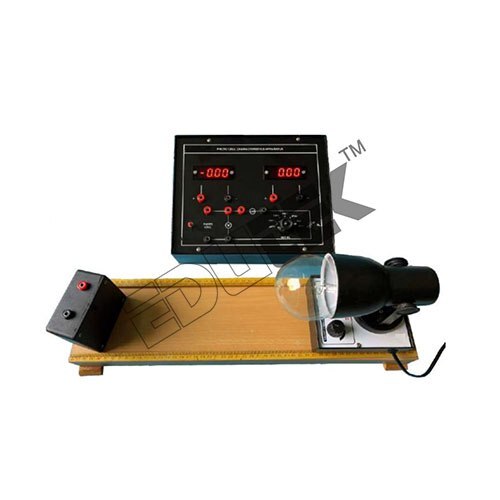
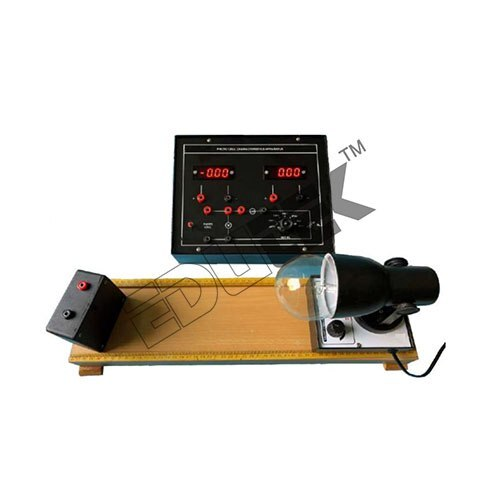
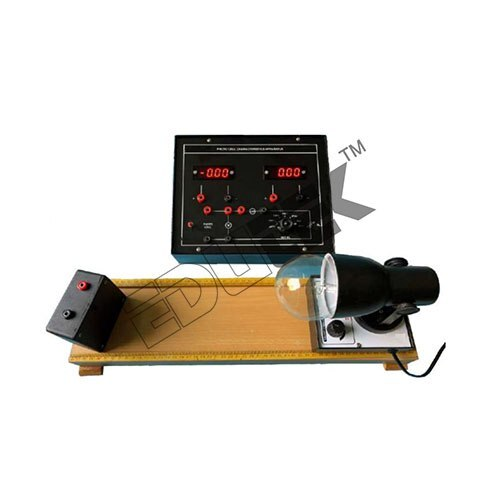
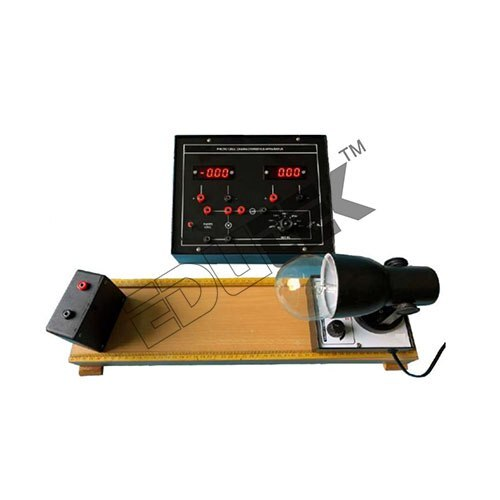
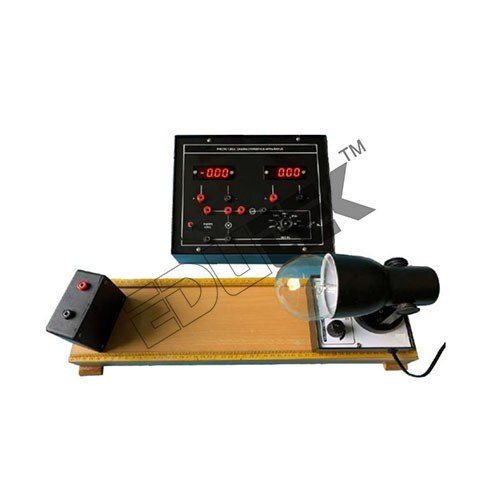
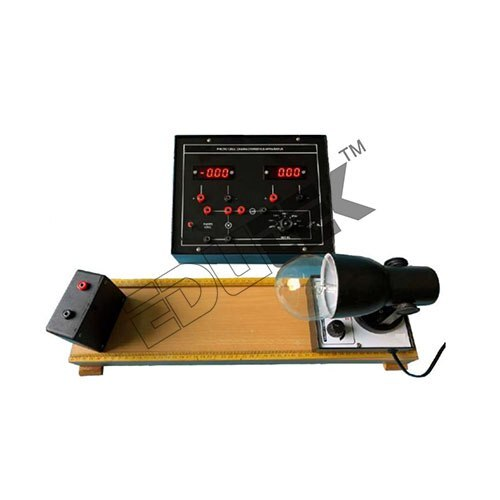
PHOTO CELL CHARACTERISTICS APPARATUS
Photo Cell: Fitted on a Box
Wooden Plank: 50 cm Long
Lamp House: 100W 220VAC
Ammeter: Digital
Range: 0 - 200 mA
Voltmeter: Digital
Range: 0-20 V
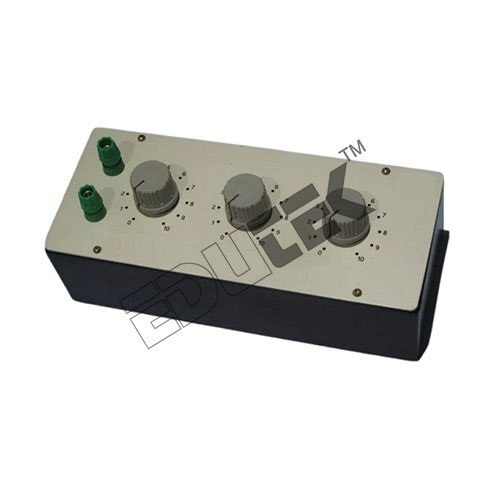
Variable Resistance: 100, 220, 330, 470,1K, 2K Ohms
Dimensions W X D X H: 315mm x 200mm x 75mm
Weight: 3 Kg approx.
Innovative Learning for Future EngineersThe Photo Cell Characteristics Apparatus offers hands-on experience in studying the principles of photoelectric effect and light-dependent circuit behaviour. It is tailored for students, researchers, and educators in electronics and engineering, providing accurate digital measurement tools and versatile resistance settings. Its intuitive design ensures that fundamental concepts of photocell operation can be effectively demonstrated in practical settings.
Reliable Construction and Functional DesignEngineered with dependable materials, including a sturdy wooden plank and a professionally housed photo cell, this apparatus ensures safe and repetitive use. The high-power 100W lamp facilitates experiments under controlled light conditions, while variable resistors and clear digital meters enhance precision and adaptability during laboratory exercises.
FAQ's of PHOTO CELL CHARACTERISTICS APPARATUS:
Q: How does the Photo Cell Characteristics Apparatus function in an electronics lab?
A: This apparatus measures the electrical response of a photo cell under controlled lighting conditions. By adjusting variables such as light intensity and resistance, users can observe changes in current and voltage, helping them understand the photoelectric effect and related electronic behaviors.
Q: What are the main applications of this apparatus in engineering education?
A: It is primarily used in academic environments to demonstrate and analyze the characteristics of photo cells. Engineering students use it to study current-voltage relationships and photoconductivity, making it highly valuable for laboratory experiments and electrical engineering research.
Q: When should variable resistance be adjusted during experiments?
A: Variable resistances should be adjusted to study how the circuit responds to different loads. By selecting different resistance values, users can analyze the effect on current and voltage readings, thereby enhancing their understanding of circuit behavior with photocells.
Q: Where is the phototube located within the apparatus?
A: The photo cell is securely fitted on a box attached to a wooden plank within the apparatus. This arrangement helps to maintain consistent measurement conditions and protects the cell during repeated experimental trials.
Q: What is the process for using the digital meters provided in the apparatus?
A: First, set up the circuit as directed in the experiment manual. Use the digital ammeter to measure current (up to 200 mA) and the digital voltmeter for voltage (up to 20 V). Adjusting the lamp and resistance values will yield different readings, which should be recorded for analysis.
Q: What are the benefits of using a photo cell characteristics apparatus with digital instruments?
A: Digital meters provide precise, easy-to-read measurements, improving accuracy and convenience in experiments. The apparatus's structure enhances safety, and its comprehensive measurement features make it an effective tool for learning and demonstrating photoelectric principles.





 Send Inquiry
 Send Inquiry

