About MULTIVIBRATORS (ASTABLE/MONOSTABLE)
Specification:
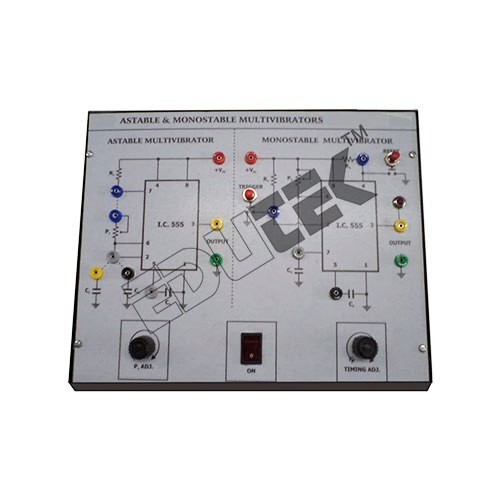
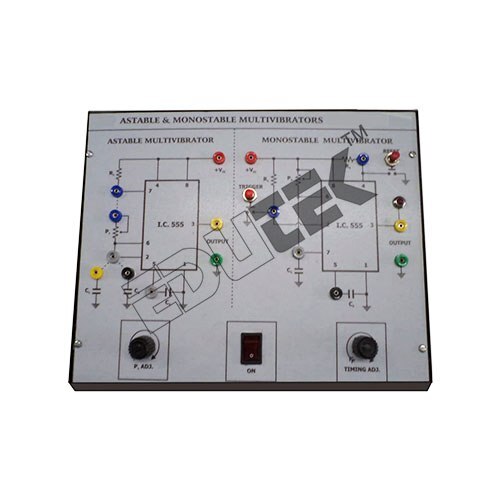
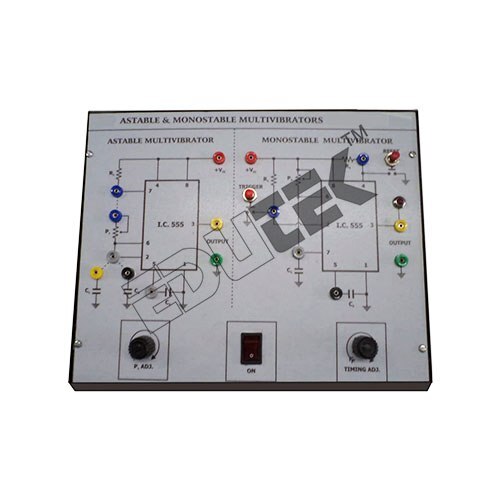
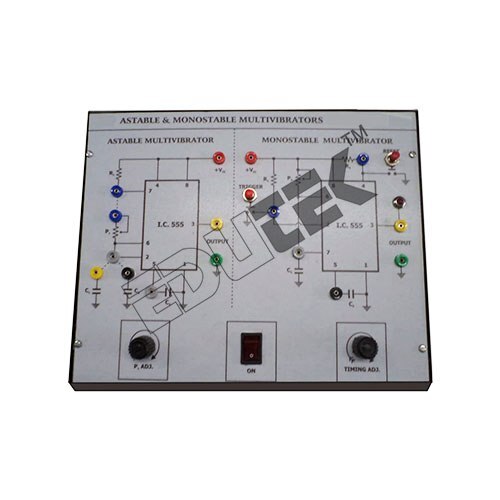
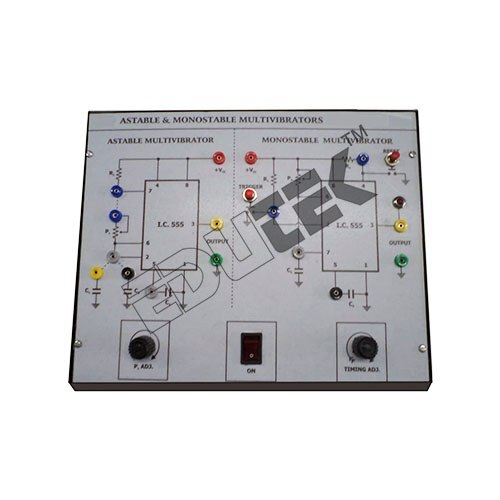
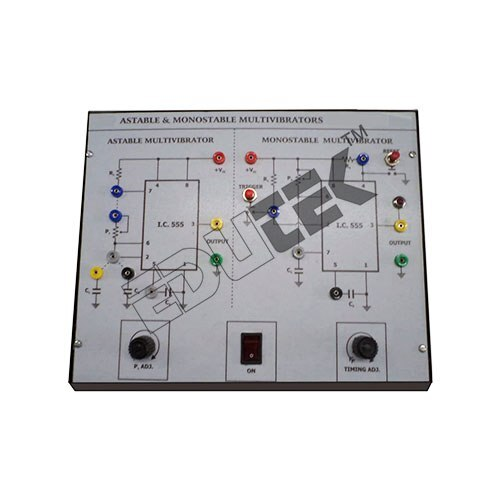
MULTIVIBRATORS (ASTABLE/MONOSTABLE)
Operation on + 5 to + 18 V supply voltage in both as table and monostable modes Adjustable duty cycle.
Timing from sec to hours.
High current output. Capacity to source or sink current of 200 mA Output can drive TIL.
Temperature stability of 50 parts per million (ppm) per C change in temperature or 0.005% per C "Reliable, easy to use, and low cost.
Mains Supply: 230V 10%, 50Hz DC
Bias Voltage: +5V
Frequency of Trigger: 1KHz
Pulse Generator Frequency Range: 600Hz 3.2KHz (approximate)of A stable Multivibrator
Frequency Range: 350Hz 1KHz (approximate) of Bitable Multivibrator
Output Voltage: 5V (approximate)
Versatile Timing SolutionsWith both astable and monostable configurations available, this multivibrator is ideal for creating square wave outputs for timing, pulse generation, and oscillator applications. The module supports quick configuration changes, making it suitable for a wide spectrum of electronics experiments and development tasks.
Reliable Design and SafetyConstructed on FR4 epoxy, the PCB ensures durability and reliable performance. Reverse polarity protection via onboard diode and RoHS compliance provide safety and environmental assurance. LED indicators convey output status, while stable ripple-free output is maintained with adequate decoupling.
Ease of Use and Flexible IntegrationThe module offers adjustable frequency and pulse width through onboard potentiometers and is equipped with screw terminals and test pins for straightforward electrical connections. It comes with mounting standoffs for bench-top use, making it easy to incorporate into lab setups and prototyping activities.
FAQs of MULTIVIBRATORS (ASTABLE/MONOSTABLE):
Q: How do I adjust the pulse width and frequency on this multivibrator module?
A: The pulse width and frequency can be adjusted using the onboard potentiometers. By changing the resistance, you alter the timing characteristics of the circuit, allowing you to set the required output parameters within the range of 1 Hz to 100 kHz.
Q: What applications is the multivibrator board best suited for?
A: This board is commonly used for oscillator circuits, timing pulse generation, laboratory experiments, and timing analysis where square wave or one-shot pulse signals are required. Its versatility makes it an excellent choice for engineering electronics instrumentation.
Q: When should I use astable versus monostable configuration?
A: Use the astable mode when you need a continuous square wave output, such as clock signals or repetitive timing. Monostable configuration is chosen when a single pulse is needed after a trigger event, making it ideal for applications like delay timers or pulse width modulation.
Q: Where can I safely install and operate this module?
A: Designed for bench-top setups and indoor use only, the module offers robust mounting via standoffs with an IP20 rating. It is best installed in laboratory environments or electronics workbenches within the 0C to 50C operating temperature range.
Q: What protection features are provided to safeguard the board and its components?
A: The multivibrator is equipped with reverse polarity protection via an onboard diode. This ensures that accidental polarity reversals do not damage the electronics, contributing to long-term reliability and device safety.
Q: What is included in the package and how do I connect the module for use?
A: The package includes the multivibrator board, user guide, and DC connector. Connect your DC power supply using the provided connector or battery, and utilize screw terminals and test pins for signal input/output as described in the user guide for quick setup.





 Send Inquiry
 Send Inquiry

