About Consolidation Apparatus
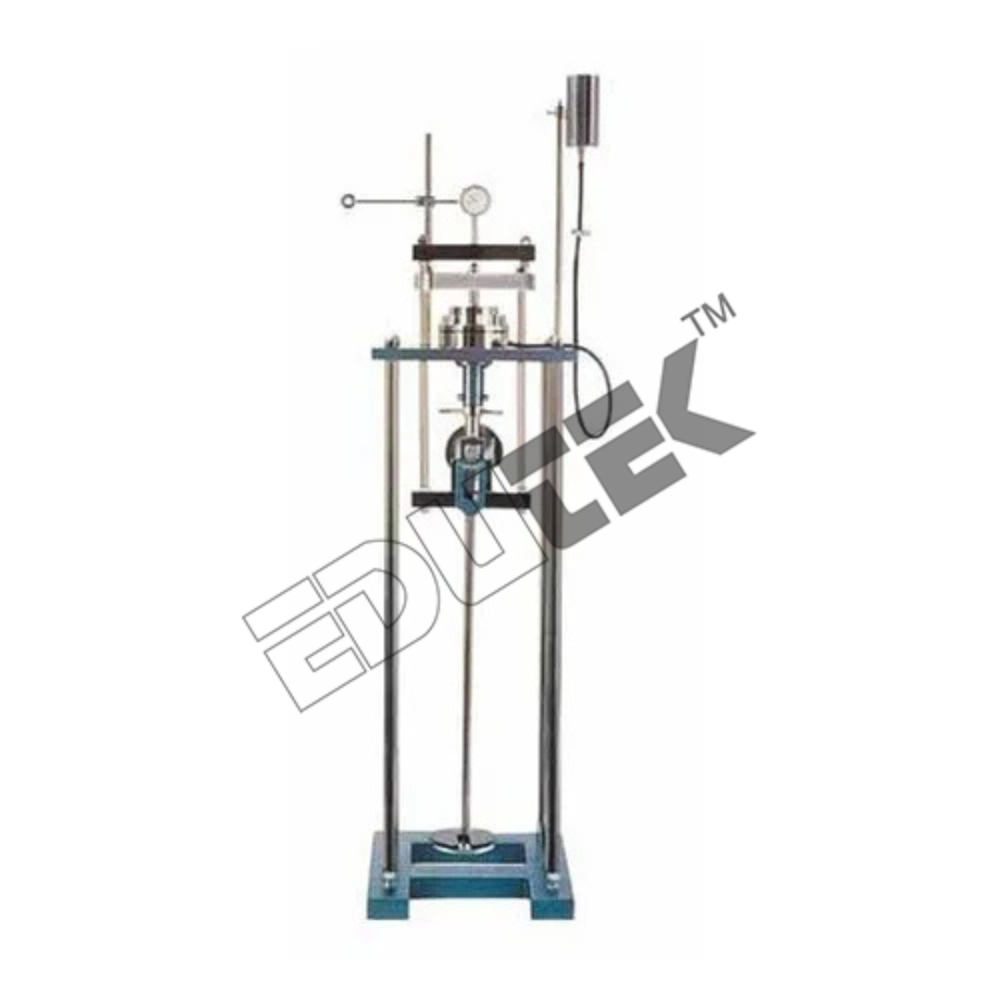
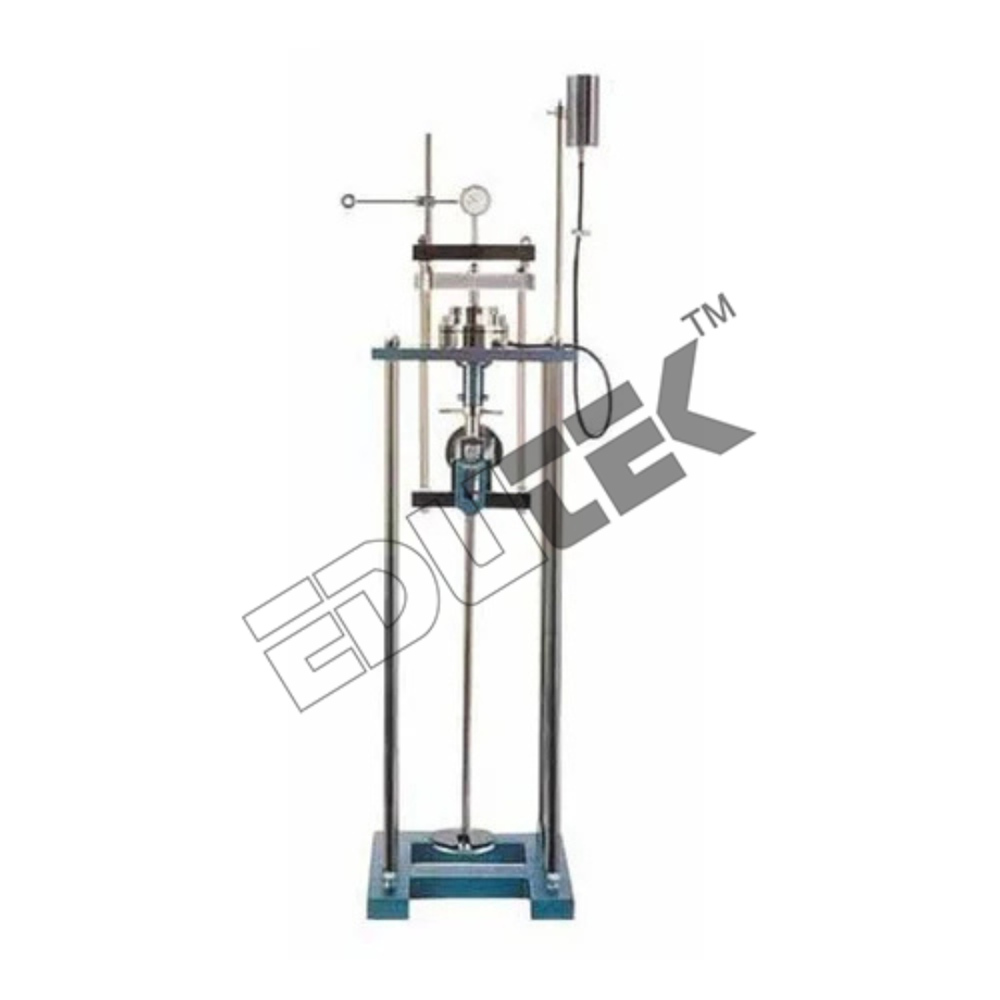
Consolidation Apparatus Single Gang
Consolidation test is un-dimentional test considered extremely important in soil mechanics. Sample taken from adjacent areas of a single site show differential settlement even when tested using same techniques. Soil of similar strength may show varying consolidation. Samples are very carefully prepared and vertical settlement of the specimen in saturated or drained conditions carefully recorded when known load is applied.
standard outfit comprises of the following items. Loading unit, maximum capacity 20kg/cm.sq.Having a loading yoke connected to a lever arm with a counter balancing adjustment and having a lever ratio of 1:1 the whole assembly being mounted on a sturdy steel frame stand. The loading unit is so designed that it can be used for consolidation cells of different diameters as well as different diameter floating ring type consolidation cells. Fixed ring type Consolidometer (Odeometer) cell assembly for testing 60 mm diameter x 20 mm thick specimen comprising:
Fixed ring type Consolidometer (Odeometer) cell assembly for testing 60mm diameter x 20mm thick specimen comprising: Fixed ring for specimens 60mm dia x 20mm thick with guide ring. Top and bottom porous stones for 60 mm dia specimen. Perforated pressure pad, Channeled base with water inlet and gasket Flanged water jacket, water reservoir with plastic tube and pinch cock. Set of weights to give a pressure of 10kg/cm.sq. On 60mm dia specimen, comprising : 7 nos. 0.05 kg/cm .sq., 5nos. 0.1 kg/sq.cm., 6nos. 0.5kg/sq. cm., and 5 nos. 1.0 kg/sq.cm. Supplied complete as above but without dial gauge.
Accessories :
- Dial gauge 0.002 mm x 10mm. Extension piece, 40 mm long, consolidation test forms pad of 50 for one dimensional consolidation.
Varying head stand pipe, 50cms. Long with mm. Scale. Fixed ring type of Consolidometer (Odeometer) cell assembly for 50mm. dia x 20mm thick specimens , complete with fixed ring guide ring. Pair of porous stones, perforated pressure pad, channeled base, gasket and flanged water jacket. Set of weights to give a pressure of 10kg/sq.cm. on 50cm. dia specimen. Fixed ring type of Consolidometer (Odeometer) cell assembly for 70mm dia x 20mm thick specimens, complete with accessories as above.Set of weights to give a pressure of 10 kg/sq.cm. on 70mm dia specimens. Fixed ring type of consolidometer (odeometer) cell assembly for 100mm diameter x 25mm thick specimens, complete with accessories as above. Set of weights to give a pressure of 10 kg/sq.cm. on 100mm. Diameter specimens.
Advanced Multi-Specimen TestingTest up to three specimens simultaneously with configurable consolidation cells, enabling flexible operations. Each cell supports typical specimen dimensions of 60 mm diameter and 20 mm thickness, with a maximum load capacity of approximately 10 kg per cell. The water reservoir tank facilitates consistent sample saturation, ensuring reliable consolidation measurements.
Durable and Accurate Laboratory EquipmentConstructed from high-grade stainless steel and brass, the apparatus offers exceptional corrosion resistance and minimal maintenance requirements. The analog dial gauge measures deformation with a resolution of 0.01 mm, delivering 100% accuracy. Designed for ambient laboratory environments, its compact dimensions and robust frame streamline testing procedures.
Standards-Compliant and User-FriendlyThe apparatus adheres to IS:2720 (Part XV) and ASTM D2435 specifications for consolidation testing, ensuring your results meet international benchmarks. Manual operation and mechanical components offer straightforward usage, making the equipment suitable for laboratory technicians, educators, and research professionals alike.
FAQs of Consolidation Apparatus:
Q: How is the number of consolidation cells configured on the apparatus?
A: The apparatus is designed with three consolidation cells by default, but the system can be easily reconfigured to accommodate one or two cells on request, allowing flexibility to meet different testing requirements.
Q: What process does the consolidation apparatus follow for soil testing?
A: Soil samples, typically 60 mm in diameter and 20 mm thick, are placed in the consolidation rings. Incremental loading is applied up to 10 kg per cell, while a water reservoir maintains sample saturation. Deformation is measured using a precision dial gauge to determine consolidation characteristics.
Q: When should laboratory technicians use this consolidation apparatus?
A: This apparatus should be used when accurate determination of soil consolidation properties is required, such as in geotechnical investigations, research projects, and compliance tests as per IS:2720 (Part XV) or ASTM D2435 standards.
Q: Where is this consolidation apparatus manufactured and supplied?
A: The apparatus is manufactured and supplied in India. Exporters, manufacturers, and laboratory equipment suppliers offer the product for domestic and international demand.
Q: What benefits does the highly efficient and corrosion-resistant design provide?
A: The use of high-grade stainless steel and brass components ensures long-lasting durability and minimal rusting, reducing maintenance and prolonging the apparatuss service life. Efficiency is enhanced by simultaneous multi-sample testing and straightforward manual operation.
Q: How does the dial gauge display measurements?
A: The analog/dial gauge provides precise deformation readings with a resolution of 0.01 mm, ensuring high measurement accuracy throughout the testing range of 010 mm.
Q: What is the typical weight and dimension of the apparatus?
A: Depending on the configuration, the apparatus weighs approximately 20-30 kg and measures about 550 x 380 x 500 mm (L*W*H), making it compact enough for most laboratory workspaces.





 Send Inquiry
 Send Inquiry

