About COMMON BASE AMPLIFIER
Specification:
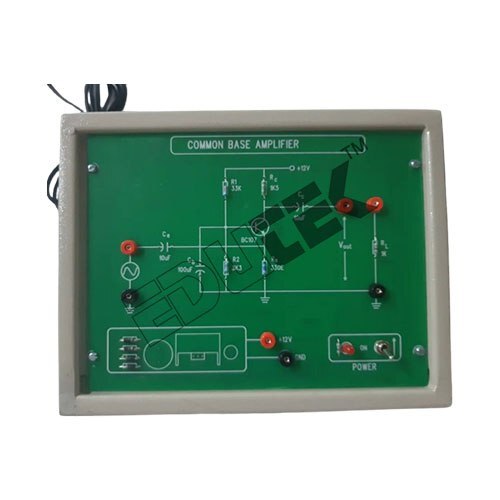
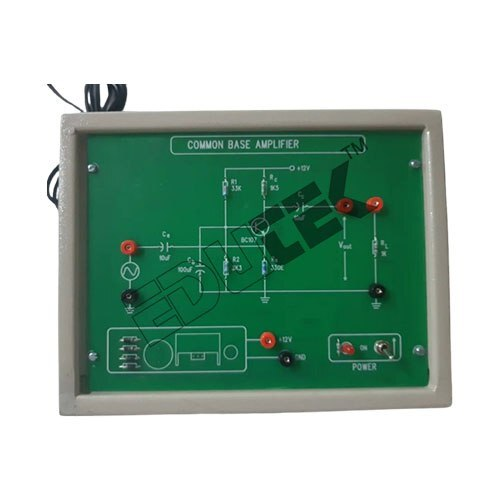
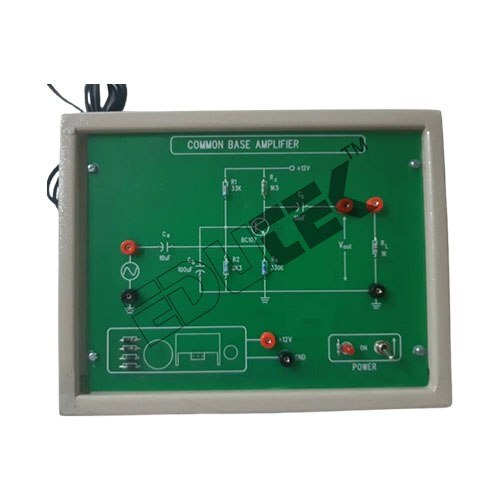
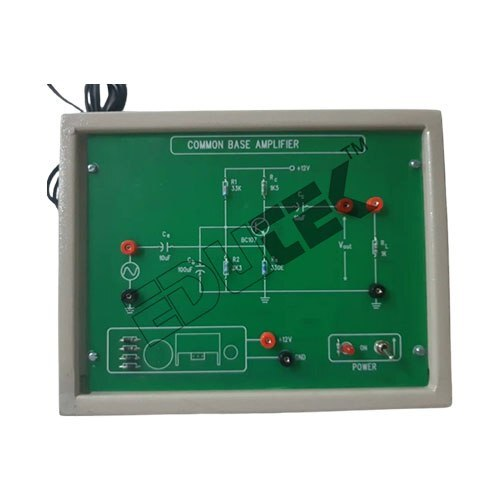
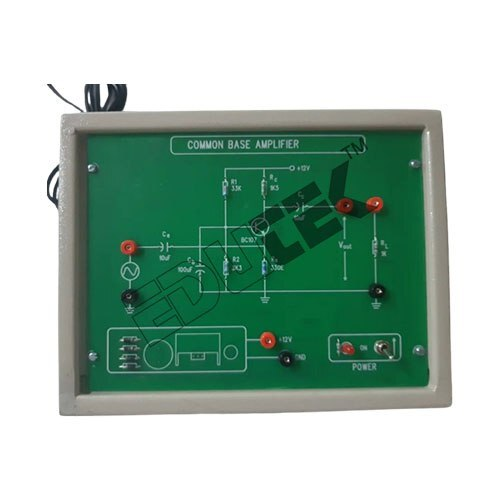
COMMON BASE AMPLIFIER
This unit consists of a power supply +15V,@300mA.
The circuit is constructed in common base mode to find the frequency response of the amplifier.
Efficient Signal AmplificationThis Common Base Amplifier leverages an NPN transistor to effectively amplify weak AC input signals. With its medium voltage gain, the amplifier is optimized for educational purposes, allowing users to witness practical signal strengthening operations. Its low input impedance and high output impedance characteristics make it a valuable tool for electronic circuit demonstrations.
Robust and User-Friendly DesignMounted on a high-quality FR4 PCB, the module ensures durability and reliability in lab environments. Screw terminals facilitate secure connections for power and signal interfaces, while included test points make signal analysis straightforward. The standardized dimensions and through-hole component layout enhance ease of use during experiments and demonstrations.
FAQ's of COMMON BASE AMPLIFIER:
Q: How do I use the Common Base Amplifier module in a lab setting?
A: To use the module, connect your low-level AC signal to the input terminals and supply 9-12V DC to the power terminals. The amplified signal can be accessed at the output terminals. Test points allow you to monitor and analyze circuit performance using standard lab equipment.
Q: What are the main benefits of a common base amplifier circuit for engineering students?
A: The common base amplifier helps students grasp fundamental electronics concepts, particularly in signal amplification. It offers observable medium gain, low input impedance, and high output impedance, making it ideal for practical demonstrations and reinforcing theoretical knowledge.
Q: Where can this amplifier module be installed or used?
A: This module is primarily designed for use in engineering laboratories, electronics classrooms, and training centers. It can also serve as a demonstrative tool in workshops or for self-study at home, supporting hands-on learning with engineering electronics instruments.
Q: What process should I follow to power the amplifier safely?
A: Ensure that an external DC supply of 9-12V is connected via the provided screw terminals. Do not exceed the rated voltage to avoid circuit damage. Check all connections, and use the module within its operating temperature range (0C to 50C) for safe and stable performance.
Q: When is this amplifier most effective in a learning environment?
A: The module is particularly effective during hands-on lab sessions, electronics circuit demonstrations, or when analyzing amplifier behavior with oscilloscopes and multimeters. It aids in bridging the gap between textbook theory and practical electronics application.
Q: What signals can the module handle, and what is its frequency range?
A: The common base amplifier is designed to amplify low-level analog AC signals and operates effectively for frequencies up to 1 MHz. This makes it suitable for most educational applications involving audio and similar analog signals.






 Send Inquiry
 Send Inquiry

