About WEIN BRIDGE OSCILLATOR
Specification:
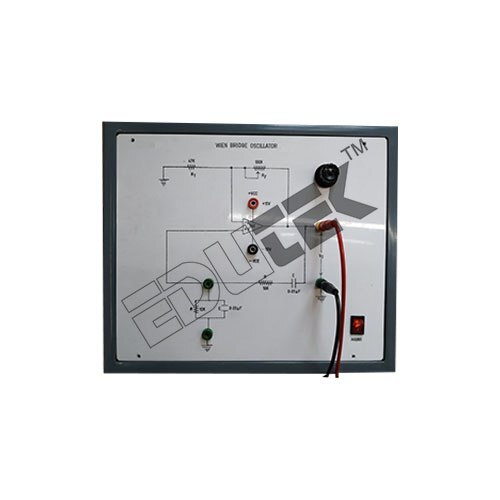
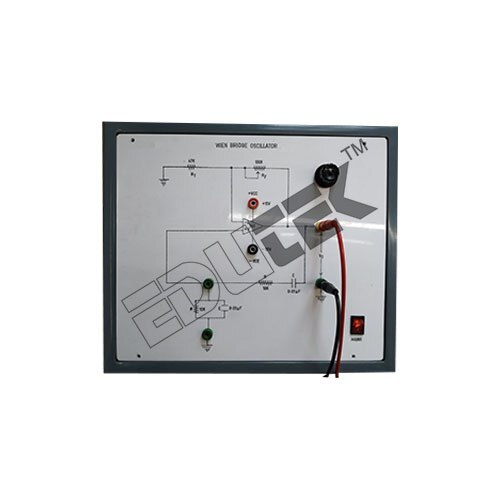
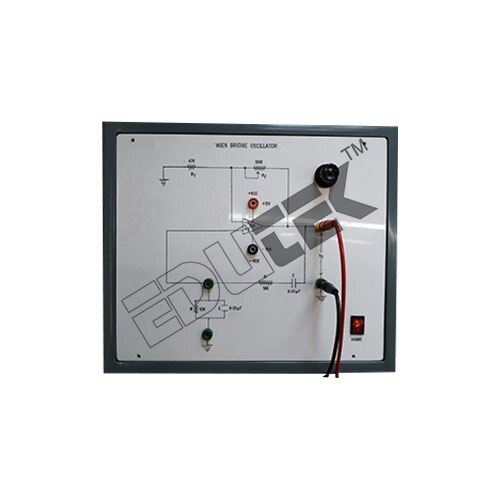
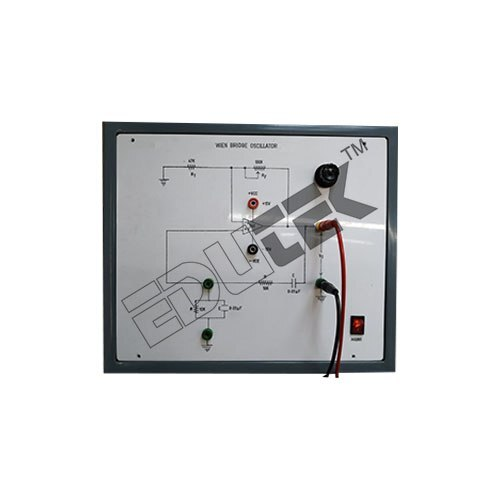
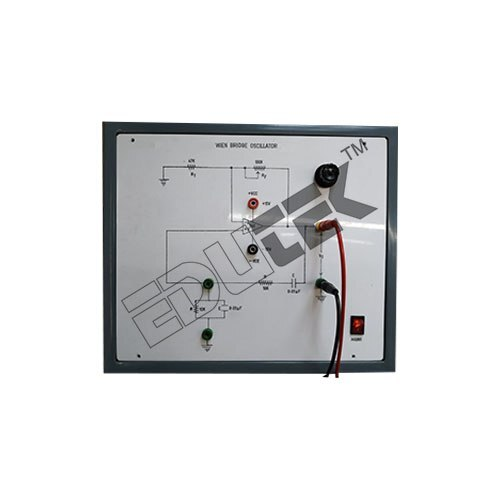
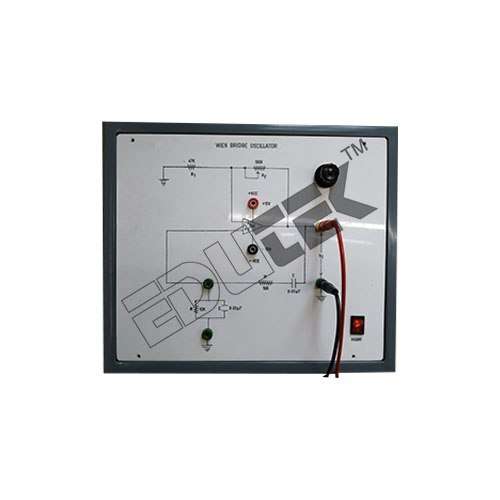
WEIN BRIDGE OSCILLATOR
To construct a Wein-Bridge Oscillator and determine the resistor ratio to develop the correct degenerative feedback.
To insert a simple automatic gain control (AGC) and observe the effect, it has on oscillator operation.
To vary these values of resistance and capacitance in the leading network and to observe the resultant frequency changes.
Precision Sine Wave GenerationThe Wien Bridge Oscillator uses a high-quality operational amplifier-based circuit to produce pure sine waves with less than 1% harmonic distortion. This precise signal output makes it highly suitable for electronics labs and test environments where accurate and clean waveforms are required.
User-Friendly Design and ControlsFeaturing adjustable frequency and amplitude via intuitive panel controls, users can fine-tune the output to their requirements. The oscillator offers clearly marked scales, multiple test points, and analog display for monitoring, all within an ergonomic ABS shock-resistant enclosure for convenient handling.
Safety and Robust ConstructionEquipped with built-in fuse protection and housed in a shock-proof ABS case, the instrument ensures safe operation and long-term durability. Its portable design and stable enclosure make it suitable for various laboratory and educational uses, delivering reliability wherever precision waveforms are essential.
FAQ's of WEIN BRIDGE OSCILLATOR:
Q: How do I adjust the output frequency and amplitude of the Wein Bridge Oscillator?
A: You can adjust both the frequency (from 1 Hz to 100 kHz) and amplitude (up to 5 V pp nominal) directly using the panel control knobs. The analog display and clearly marked scales help you set precise values for your required application.
Q: What type of output waveform does this oscillator generate?
A: The Wien Bridge Oscillator generates a pure sine wave output with low harmonic distortion, making it ideal for accurate testing and measurement tasks in electronics laboratories.
Q: When should I use multiple test points provided on the device?
A: Multiple test points are useful when you need to monitor or sample different stages of the output or circuit. This allows for detailed analysis and fine-tuning during experiments, ensuring optimal performance.
Q: Where can this oscillator be used most effectively?
A: This device is best suited for use in educational institutions, research laboratories, and electronics development environments, where precision sine wave sources are needed for experimentation, calibration, and testing.
Q: What is the process for recalibrating the oscillator?
A: Although the device is factory calibrated, you can perform user calibration by adjusting the relevant trimmers and panel controls, following the calibration instructions in the user manual for optimal accuracy.
Q: How does the ABS shock-proof case benefit me?
A: The robust ABS enclosure protects the instrument from physical shocks and damage during transport or regular use, while the carrying handle adds portability, making it a practical choice for busy laboratory settings.




 Send Inquiry

 Send Inquiry


