About Pipe Networks
PIPE NETWORKS
An important task in the construction of pipelines is to determine the pressure and flow rate in complex piping systems. In practice, the calculation of the total pressure losses serves as a foundation for the design of suitable drive units for heating and air conditioning systems, drinking water supply systems and parts of wastewater systems. Knowledge of pressure losses is also used to optimise operation.
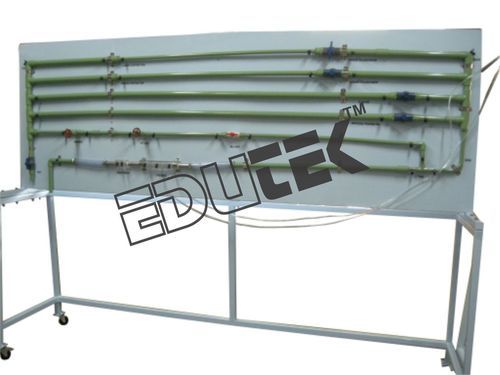
Enables the construction and investigation of various pipe networks, such as parallel and series connections of pipes, their branching and merging, and the study of individual pipes. In analogy to Kirchhoffs laws of electricity, it is possible to conduct nodal analysis.
The five pre-installed pipe sections on the top of the trainer are connected to pipe networks using the piping elements. Tank, pipes, piping elements and valves and fittings are made entirely of plastic. The individual pipe sections are shut off by ball valves. During the experiments, the pressure losses in various pipes and piping elements are recorded and evaluated.
Two manometers for different measuring ranges are included to measure differential pressure. The flow rate is measured volumetrically.
The trainer has its own water supply. The closed water circuit includes a supply tank with submersible pump. The well-structured instructional material sets out the fundamentals and provides a step-by-step guide through the experiments.
Learning Objectives / Experiments
- Recording the calibration curve for pipe sections:
- Pressure loss over flow rate
- Pipe sections connected in parallel
- Pipe sections connected in series
- Combined series and parallel connection
- Investigation of a closed circular pipeline
- Differential pressure measurement
- Pressure losses at various piping elements
Specification:
- Investigation of different pipe networks
- Five pre-installed pipe sections with different diameters
- Panel for piping elements
- Construction of pipe networks from pipe sections and various piping elements
- Calibration of pipe sections
- Parallel and series connection of pipe sections
- Construction of a closed circular pipeline
- Differential pressure measurement with twin tube manometers and differential pressure manometer
- Flow rate measurement with measuring tank (can be shut off), stopwatch and level indicator
Technical Data:
- Pump
- Power consumption: 250W
- Max. flow rate: 9m/h
- Max. head: 7,6m
- Pipe network, max. flow rate: 4,8m/h
- Pipe sections, length 700mm each
- 1x: 25x1,9mm
- 2x: 20x1,5mm
- 2x: 16x1,2mm
Twin tube manometers:
- Tank for water: 180L
- Tank for flow rate measurement
- Small measuring range: 10L
- Large measuring range: 60L
- Stopwatch: 1/100s
Measuring ranges:
- Differential pressure: 1x 0...1bar
- Differential pressure with tube manometers:
- 2x 0...100mbar
Dimensions and Weight:
- LxWxH: 1650x835x1645mm
- Weight: approx. 128kg
Our laboratory PIPE NETWORKS are developed to deliver exceptional efficiency and complete accuracy for a wide range of experiments. With a design focused on 100% measurement precision, you can trust each test outcome, ensuring reliable data for educational or research purposes.
Built for Laboratory ExcellenceWeighing 128 kg and sized at 1650x835x1645 mm, these PIPE NETWORKS offer a robust structure for consistent laboratory usage. Their versatility and durability make them a preferred choice for institutions requiring long-term, error-free operation.
Proudly Manufactured in IndiaAs a leading exporter, manufacturer, and supplier from India, we adhere to rigorous quality standards to deliver products that uphold our reputation in both domestic and international markets. Our PIPE NETWORKS exemplify technological sophistication tailored for laboratory demands.
FAQs of Pipe Networks:
Q: How does the PIPE NETWORKS system ensure 100% accuracy in laboratory experiments?
A: The PIPE NETWORKS are designed with advanced flow measurement and calibration mechanisms. This enables precise monitoring and evaluation of fluid movement, guaranteeing consistent 100% accuracy every time the system is used in laboratory applications.
Q: What are the primary benefits of using your PIPE NETWORKS in a laboratory setting?
A: Key benefits include highly efficient performance, robust construction, and absolute measurement accuracy, making the system ideal for practical experiments, research, and teaching. Its durable design supports repeated use, minimizing maintenance and enhancing educational value.
Q: Where can these PIPE NETWORKS be utilized outside of laboratory environments?
A: While primarily intended for laboratory use, these systems can also be applied in pilot projects, research facilities, and quality control settings where precise fluid flow analysis is essential.
Q: What is the process for setting up the PIPE NETWORKS in a laboratory?
A: Installation is straightforward: position the 128 kg unit within your laboratory space according to the 1650x835x1645 mm dimensions, connect the required inlet and outlet piping, calibrate using the provided instructions, and begin experimentation.
Q: Who manufactures and supplies these PIPE NETWORKS?
A: We are an established exporter, manufacturer, and supplier based in India, dedicated to producing laboratory equipment that meets rigorous performance standards both nationally and internationally.
Q: When is it most suitable to use these PIPE NETWORKS in experiments?
A: These PIPE NETWORKS are best used when precise fluid flow analysis or demonstration of hydraulic principles is required, particularly in academic instruction, research experiments, or validation of theoretical models.










 Send Inquiry
 Send Inquiry