About MOSFET CHARACTERISTICS
Specification:
MOSFET CHARACTERISTICS
To demonstrate the operation of a typical insulated gate FET.
To examine the relationship between the gate-to source voltage (VGS) the gate drain current (ID) and the drain-to source voltage (VDS) in an N-channel depletion mode IGFET.
To measure the corresponding VGS, ID, and VDS values and graphically plot those to form a set of drain characteristics values.
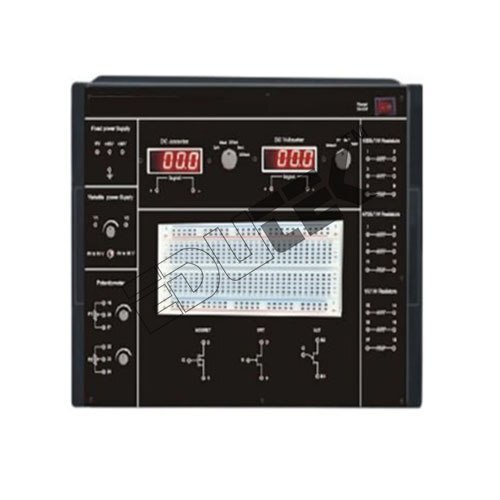
Versatile Experimental PlatformEngineered for academic use, this apparatus is ideal for demonstrating N-Channel, Enhancement mode MOSFET characteristics. It covers key experiments such as output and transfer characteristics and operational region studies, ensuring comprehensive coverage for electronics engineering curricula.
Enhanced User Safety and AccessibilityThe device features a rugged, portable casing; a fused power supply for protection; and clear labeling on the front panel to make it safe and straightforward for students. The schematic diagram printed on the panel provides immediate experimental guidance.
Efficient, Ready-to-Use DesignEliminating the need for breadboards, this apparatus offers a fixed circuit with banana socket interfaces and test points that allow for quick, reliable connections. With included patch cords and a user manual, students and instructors can set up and begin experiments quickly and confidently.
FAQ's of MOSFET CHARACTERISTICS:
Q: How does this MOSFET Characteristics Apparatus enhance learning in engineering electronics?
A: This apparatus provides a hands-on platform for students to directly observe and investigate N-Channel MOSFET properties, such as output and transfer characteristics. Clear labeling, a front-panel schematic, and variable gate voltage control promote active learning and reinforce key concepts in electronic devices.
Q: What accessories are included with the MOSFET Characteristics Apparatus?
A: The unit comes supplied with essential patch cords for immediate connections and a comprehensive user manual. These accessories facilitate quick setup, guide experimental procedures, and support safer, more effective laboratory sessions.
Q: When should I use this apparatus during electronics studies?
A: This demonstration device is most beneficial during laboratory sessions on MOSFETs within electronics courses. It is designed for practical study of device operation regions, characteristic curves, and behavior under varying voltages, aligning closely with engineering curricula.
Q: Where can this product be effectively utilized?
A: The apparatus is best suited for electronics engineering labs in universities, polytechnic institutes, and technical colleges. Its portable, desktop design makes it a convenient choice for both classroom demonstrations and individual laboratory experiments.
Q: What is the process for operating the MOSFET demonstration unit?
A: Connect the included patch cords and external 12V DC power supply to the designated banana sockets. Use the variable potentiometer to adjust gate voltage. Follow the procedures outlined in the user manual and observe output or transfer characteristics via test points, as guided by the front-panel schematic.
Q: How does the fixed-circuit design benefit users compared to breadboard-based setups?
A: By using a fixed-circuit configuration, the apparatus eliminates wiring errors and instability common with breadboards. This ensures reliable experiment outcomes, saving time and fostering student confidence during practical exercises.
Q: What are the main benefits of clear labeling and a printed schematics panel?
A: Clear on-panel labeling and a printed schematic diagram help users quickly identify test points and component locations, reducing confusion and making the experimental process both safer and more efficient for students.





 Send Inquiry

 Send Inquiry


