About Mobile Phase Filtration Assembly
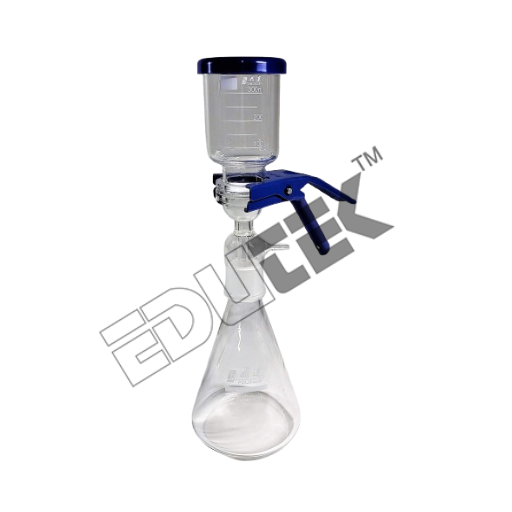
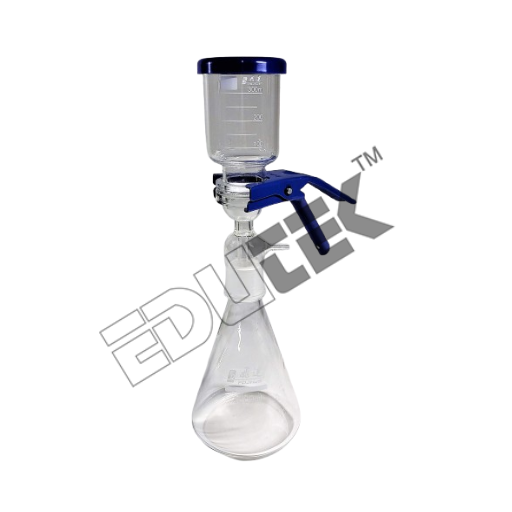
MOBILE PHASE FILTRATION ASSEMBLY (MILLIPORE)
- Glass filter holder assembly with funnel,
- Fritted base,
- Stopper,
- Clamp, 47 mm
- Fritting inlet: funnel, Dia 7.6, height 22.9
- Fritting outlet: No.8 perforated silicon stopper mouths in standard 1 and 4 liters filtering flasks;
- Funnel Capacity: 300 ml
- Material: Borosilicate glass funnel and base,
- Silicon stopper
- Sterilization: UV Sterilize or autoclave without filter in place
- Filter Dia. 47 mm
- Seal material: PTFE
- Pressure: Vacuum, 1 ltr
- Buckner flask;
- Millipore vacuum pump
- Chemical duty pump: 220-230 V AC/50Hz
Versatile Filtration Membrane CompatibilityThis assembly supports a range of filtration membranes including PTFE, Nylon, cellulose nitrate, and others, making it suitable for diverse laboratory filtration requirements. The compatibility allows users to select membranes based on specific chemical properties or filtration accuracy needs, providing flexibility for varying sample types and solvent systems in routine and advanced analyses.
Robust Build and User-Friendly DesignCrafted from borosilicate glass and stainless steel (SS304/SS316), this assembly is built for durability and chemical resistance. Its transparent glass funnel facilitates easy monitoring, while a heavy-duty, anti-slip base ensures stability during operation. The leak-proof design and manual control make assembly, use, and maintenance straightforward, promoting efficient, safe filtration.
Autoclavable and High Temperature ResistanceEngineered to withstand sterilization cycles, this filtration assembly is autoclavable up to 121C and endures temperatures up to 180C safely. Its resistance to thermal stress makes it ideal for repeated laboratory use, maintaining structural integrity and performance even in demanding environments where cleanliness and sterility are essential.
FAQs of Mobile Phase Filtration Assembly:
Q: How do I set up and assemble the Mobile Phase Filtration Assembly for laboratory use?
A: To set up, attach the filtration membrane (PTFE, Nylon, cellulose nitrate, or other compatible types) to the filter holder, secure the funnel(s) and connect the assembly to a standard laboratory vacuum pump via the provided fitting. Ensure all silicone/O-ring seals are in place for a leak-proof operation. The anti-slip base should be placed on a stable surface for safe manual operation.
Q: What solvents and mobile phases can be filtered using this assembly?
A: This assembly is designed to filter a wide range of solvents and mobile phases used in HPLC and GC analyses. Its chemically resistant componentsborosilicate glass, stainless steel, and PTFEallow filtration of both organic and aqueous solutions without risk of contamination or chemical attack.
Q: When is it necessary to autoclave the filtration assembly?
A: Autoclaving is recommended before initial use, between different applications, or when sterility is required for analytical accuracy. The assembly tolerates autoclave conditions up to 121C, ensuring laboratory-standard hygiene without compromising its structural integrity.
Q: Where is this filtration assembly typically used?
A: It is commonly used in analytical laboratories, research institutions, pharma labs, academic facilities, and industrial QC labs across India and internationally. Its design meets global lab practice standards, making it suitable for both routine and specialized laboratory setups.
Q: What is the process for changing filtration membranes and cleaning the assembly?
A: To change the membrane, disassemble the filter holder, remove and replace the membrane, then reassemble. For cleaning, disassemble all parts, wash with appropriate laboratory detergents, rinse, and dry. All components are easy to assemble and disassemble, ensuring efficient workflow and maintenance.
Q: How does using this filtration assembly benefit laboratory operations?
A: The assembly offers high filtration accuracy (<0.45 micron), chemical resistance, and ease of use. Its manual operation ensures reliability without power dependence, while leak-proof design, robust materials, and customizable configuration enhance safety, productivity, and adaptability to diverse lab needs.





 Send Inquiry
 Send Inquiry

