About Losses In Pipe Bends
LOSSES IN PIPE BENDS
In addition to pressure losses due to pipe friction, pipes through which water flows experience pressure losses at changes in pipe direction. In practice, various changes in pipe direction with different geometries are used in pipe networks.
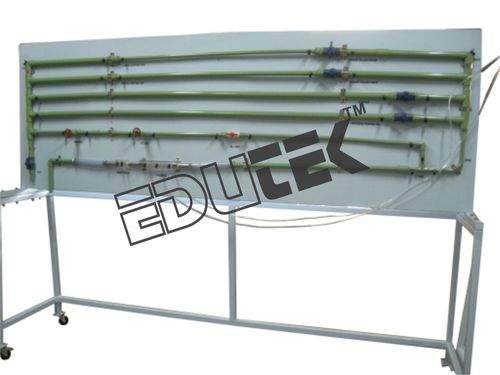
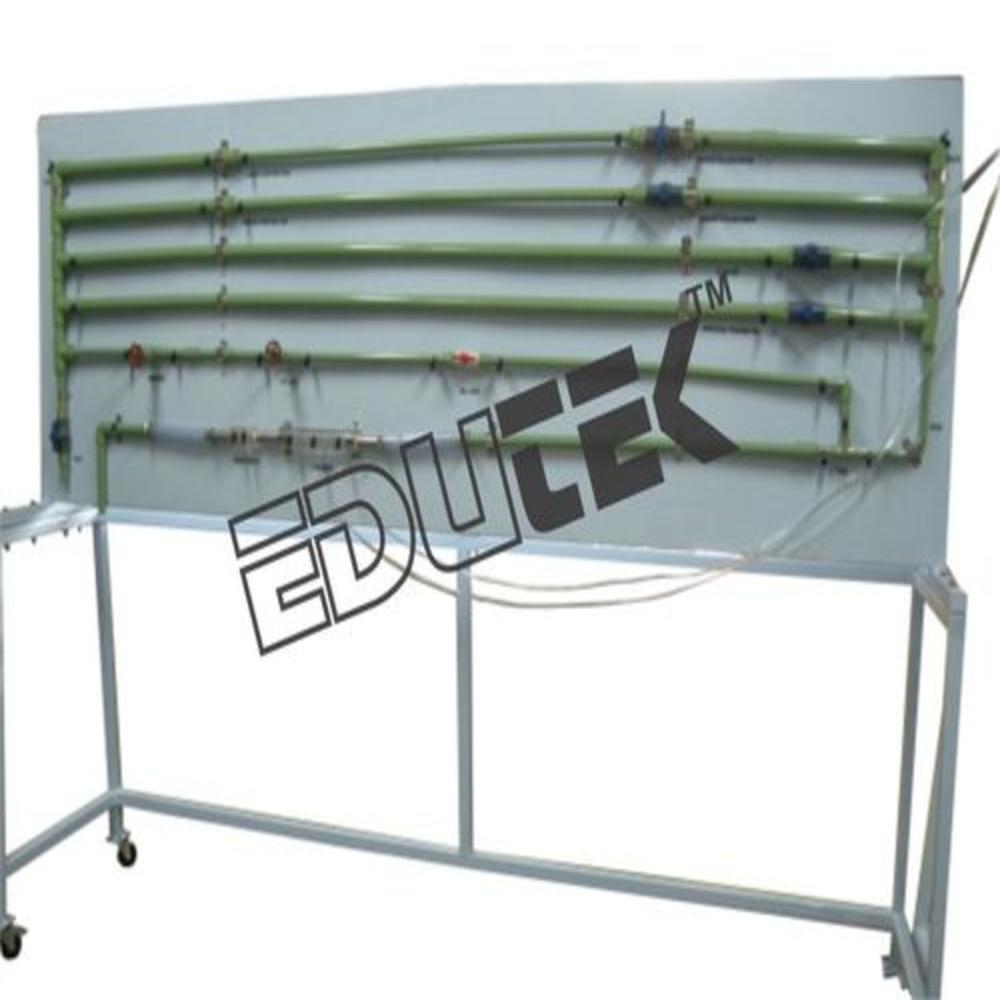
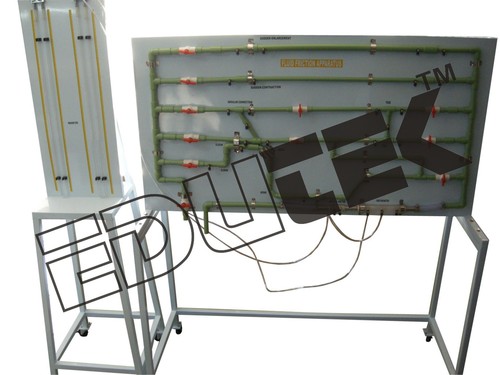
Used to investigate how different changes in pipe direction made from different materials affect the pipe flow. The pipe elements used are commercially standard components in heating and sanitary engineering. The clear panel is mounted on a sturdy, movable frame.
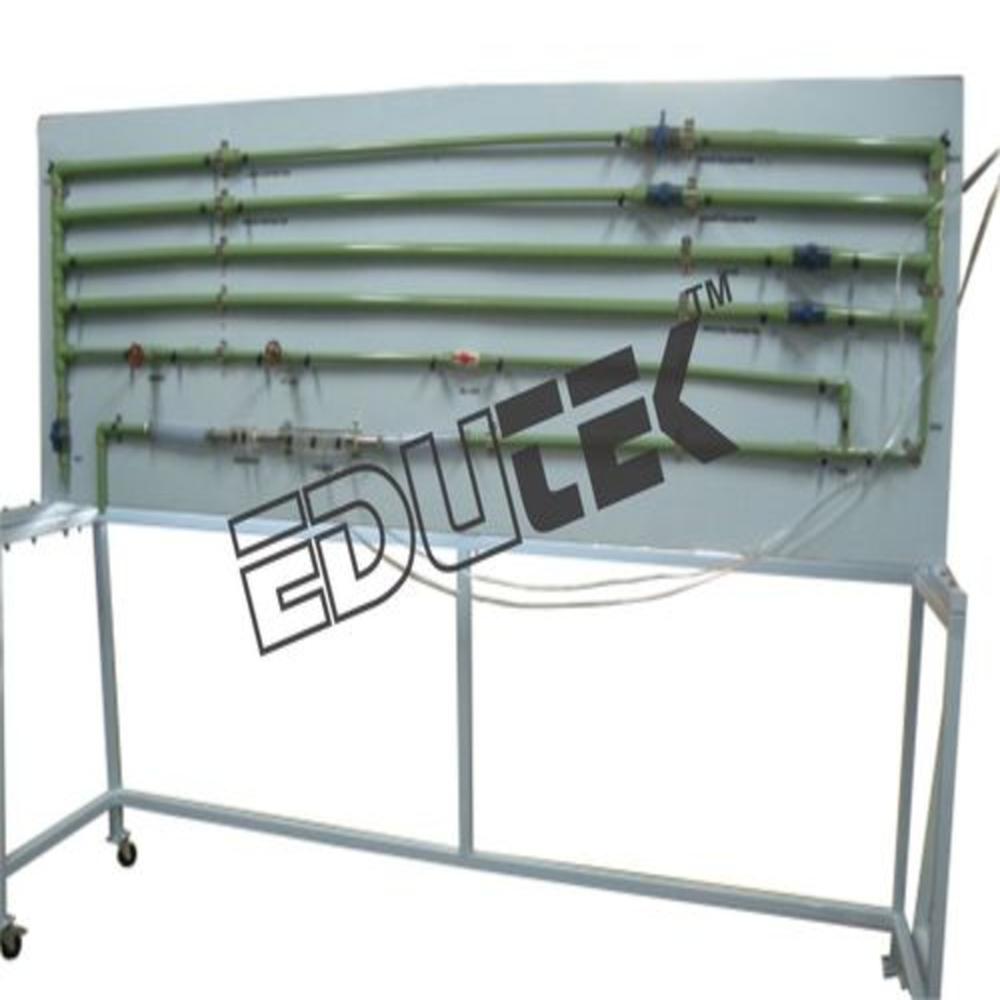
The trainer consists of four pipe elements with ten deflections each with the same pipe length. Two measuring sections have different radii and are made of different materials. A hose connects the desired measuring section. The flow is adjusted using valves in the inflow and return and read on a rotameter.
The pressure measuring points in the pipe system are designed as annular chambers and are located between the beginning and end of the measuring sections, ensuring a precise pressure measurement. The sensors are connected in pairs to a differential pressure meter and the respective differential pressure read on the display.
The well-structured instructional material sets out the fundamentals and provides a step-by-step guide through the experiments.
Learning Objectives / Experiments
- Flow measurement
- Differential pressure measurement
- Effect of flow and surface roughness
- Effect of the flow velocity
- Effect of changes in pipe direction
Specification
- Investigation of the pressure loss at pipe elements with different changes in pipe direction and materials
- Pipe elements are commercially standard components in heating and sanitary engineering
- Clear panel mounted on a sturdy, movable frame
- Simply selection of the measuring sections via hose connection with quick-release couplings
- Flow can be adjusted via valves
- Flow measurement using rotameter
- Differential pressure measurement via differential pressure meter with display
Technical Data
- Measuring sections: 2300mm
- Pipe section 1: steel, diameter: ", 90 pipe angle
- Pipe section 2: steel, diameter: ", 90 pipe bend
- Pipe section 3: copper, diameter: 18x1mm, 90 pipe angle
- Pipe section 4: copper, diameter: 18x1mm, 90 pipe bend
- Differential pressure meter
Measuring ranges
- Flow rate: 150...1600L/h
- Differential pressure: -350mbar...350mbar
Dimensions and Weight
- LxWxH: 1650x700x1850mm
- Weight: approx. 100kg
This Losses In Pipe Bends equipment is meticulously engineered for laboratory settings, offering 100% accurate results. Its design captures the effects of pipe curvature on fluid flow, providing essential insights for hydraulic studies. The robust frame makes it suitable for repeated academic or industrial use.
Features Designed for EfficiencyEngineered with precision in mind, this apparatus boasts highly efficient performance. The well-calibrated system ensures that each measurement reflects real-world scenarios, helping users simulate and analyze potential fluid losses with ease and reliability.
Manufactured and Exported from IndiaProudly produced by experienced manufacturers in India, this lab device adheres to international standards and is exported globally. It is supplied with comprehensive documentation and after-sales support, making it a preferred choice for institutions worldwide.
FAQs of Losses In Pipe Bends:
Q: How does the Losses In Pipe Bends apparatus work in laboratory environments?
A: The apparatus measures the head loss that occurs when fluid passes through bends in a pipe. Students or researchers can vary flow rates and record differential pressures across pipe bends, allowing precise and repeatable studies in laboratory settings.
Q: What benefits does this equipment offer for educational purposes?
A: This unit provides a clear demonstration of real-world fluid dynamic concepts, enabling users to directly observe and quantify the impact of pipe bends on flow. Its high accuracy ensures reliable results essential for effective learning and research.
Q: When should you use the Losses In Pipe Bends apparatus?
A: It is most effectively used during experiments on fluid mechanics related to pipe systems, specifically when studying energy losses due to direction changes in piping. It is ideal for classroom demonstrations, student labs, and research projects.
Q: Where is this apparatus manufactured and available?
A: The Losses In Pipe Bends apparatus is manufactured in India by recognized exporters and suppliers, and is readily available for shipment to laboratories, universities, and research centers worldwide.
Q: What is the process of measuring losses using this equipment?
A: The procedure involves circulating fluid through the pipe bends, adjusting flow rates, and measuring input and output pressures. The differential readings represent energy loss, which can then be analyzed according to established fluid mechanics principles.
Q: How accurate is the Losses In Pipe Bends testing apparatus?
A: This equipment is designed to deliver 100% accuracy in head loss measurement, ensuring all experimental data aligns with theoretical valuesmaking it reliable for both practical instruction and scientific investigation.




 Send Inquiry
 Send Inquiry

