About Kjeldhal Apparatus
KJELDHAL APPARATUS
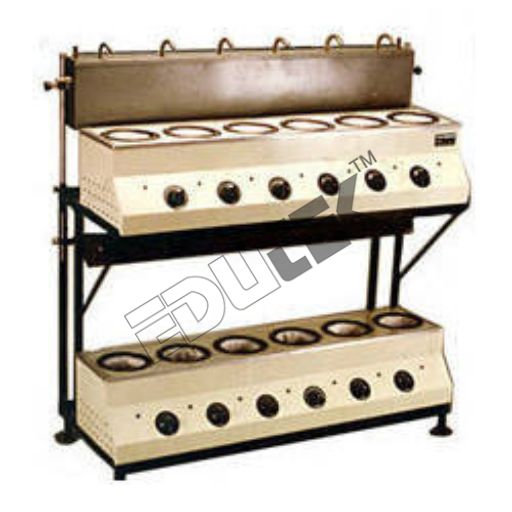
Provided with two sets of mantle type heating platforms-one for digestion and other for distillation. Complete with condenser rack, lead fume duct and a pair of hangers, on a mild steel sheet tubular stand. Both units supplied with individual energy regulators. It works on 220V AC 50Hz.
- Automatically intelligent cleaning system
- Manual/auto double-mode switch
- Precision 0.5%
Precision in Nitrogen AnalysisThe manual Kjeldahl Apparatus is engineered for efficient nitrogen estimation in diverse laboratory settings, including chemical, agricultural, and pharmaceutical environments. With high accuracy and a robust build, it provides consistent results through uniform heating using nichrome elements. Its intuitive manual controls make it suitable for both routine and research applications.
Durable and Thoughtful ConstructionMade with borosilicate glass tubes and a powder-coated mild steel stand, the apparatus resists corrosion and can withstand repeated intensive use. The rectangular stand accommodates up to six tubes, each capable of holding 500 ml, and is fitted with effective asbestos insulation for safety and energy efficiency.
Comprehensive Safety and Ease of UseSafety features such as a thermal cut-off switch and earth protection minimize operational risks. The integrated fume duct safely removes hazardous vapors, while easy tube assembly and compatibility with standard laboratory glassware enable streamlined experiment setup and operation.
FAQs of Kjeldhal Apparatus:
Q: How is the Kjeldahl Apparatus used in determining nitrogen content in samples?
A: The Kjeldahl Apparatus is employed through a sequence of digestion, distillation, and titration steps. A sample is placed in the borosilicate glass tube, digested using concentrated acids and heat from the nichrome wire elements, then distilled, and finally titrated to quantify nitrogen content. The process is manual, allowing precise control at each stage.
Q: What types of laboratories often utilize this equipment?
A: This apparatus is ideal for chemical, agricultural, and pharmaceutical laboratories where nitrogen determination in organic and inorganic substances is a common requirement. Its durable construction and versatile design also make it suitable for research and quality control labs.
Q: When should the thermal cut-off and earth protection features be checked or maintained?
A: It is recommended to inspect the thermal cut-off and earth protection features regularly, ideally during routine equipment maintenance or before extended use. Ensuring these safety systems are functional helps prevent overheating and electrical hazards during operation.
Q: Where are the fume extraction features located and why are they important?
A: The apparatus integrates a fume duct within the stand structure, designed to direct hazardous vapors away from users. This is essential for laboratory safety, as it minimizes exposure to potentially harmful gases generated during the digestion process.
Q: What is the process for cleaning and assembling the Kjeldahl Apparatus?
A: After use, let the apparatus cool, then disassemble the glass tubes and wash them thoroughly with appropriate cleaning agents. The modular clamps allow for easy removal and reassembly, and the corrosion-resistant materials ensure longevity even after frequent cleaning.
Q: What benefits does the use of borosilicate glass provide in this apparatus?
A: Borosilicate glass offers high thermal resistance up to 350C, exceptional chemical durability, and mechanical strength. This ensures that the tubes remain intact during high-temperature reactions and repeated cycles, guaranteeing reliable performance and user safety.




 Send Inquiry
 Send Inquiry

