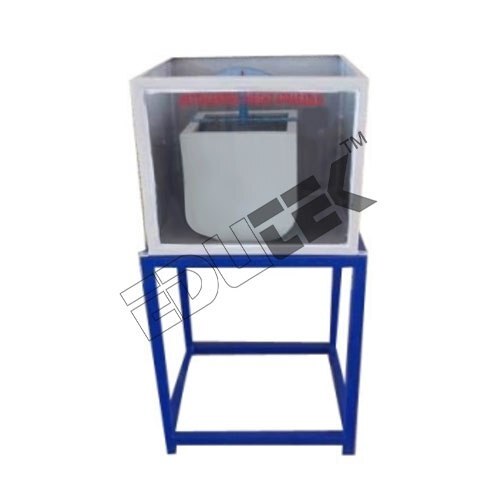
About Hydrodynamics Kit
HYDRODYNAMICS KIT
- Consist of 3 modules for view and study:
- Orifice tank
- Impact of jets
- Hydraulic ram
The three modules should be:
- Mounted on the Hydraulics Bench
- To use its water feeding
- To use its regulation system
Common base shall be:
- Composed of a rectangular body in transparent plexiglass.
- Enclosed between two plates of anodized aluminum and Predisposed to receive the three modules.
- Dimensions: 280x150x72h mm.
The plexiglass rectangular module should allow:
- Housed the water feeding through 20mm barb.
- Positioned inside a bayonet coupling to allow feeding the
- Three modules
The group should be:
- Mounted on a lightweight support frame made of anodized aluminum.
- Rectangular shape.
- Dimension: 19X19X2 mm.
The group should carry at its top a small bag:
- Transparent plexiglass, outside diameter 40mm.
- Thickness 2.5 mm and height 84mm.
- With variable displacement.
- Through a stainless steel cylinder.
- And a manually adjustable valve.
In the bottom plate there should be:
- A hole for free discharge during the jet impact experience.
- While during the other experiences it will be closed by a cap.
The orifice tank shall consist:
- Transparent plexiglass tube of external diameter 100 mm, thickness 5 mm and 700 mm high.
- Must be mounted on the common base group.
- Attached by means of three straps of stainless steel and An aluminum top flange.
- Two orifices in plexiglass, 8 and 5 mm diameter.
- Mounted on the cylinder wall.
- The water feeding should be obtained by means of A PVC tube.
- Which has in the lower extremity a bayonet coupling for
- The connection to the base group.
- At its top several sprinkler holes avoiding excessive turbulence.
- A suitable deflector of the profile trajectory of the jet should be used with the horizontal position of the orifice.
- It comprises a brass rod provided with nine equally spaced holes in which are mounted as nine stainless steel rod 240 mm long.
- Impact of jets with the following characteristics:
- The water feeding should be obtained through a PVC tube with bayonet coupling at the top of which are mounted the draining off nozzles 8 and 5 mm, that can be easily replaced.
- A transparent plexiglas screen, shall protecting pipe and nozzle. The water supply hose barb group must be connected to the pump of the Hydraulic Bench. The water, leaving the nozzle, should be deflected by the reaction profiles and drawn through the large hole placed in the bottom plate of the base group.
- The upper group shall consists of a balance which, through a system of weight fixed and mobile, allows: the leveling of the unit the determination of the forces exercised by the jet on the profiles (fins) of different forms.
The three reaction profiles in anodized aluminum, must have respectively the form:- Flat.
- Concave.
- Tilted to 45.
- Each must be anchored to the arm by means of a screw.
- The Hydraulic ram shall be composed of:
- Push button valve provided with a plurality of different value weights.
- Bag capacity variable transparent plexiglass, outside diameter 40 mm, thickness 2.5 mm and height 84 mm.
- With variable displacement.
- Through a stainless steel cylinder.
- And a manually adjustable valve.
- Check valve on the bag output.
- Water feeding group consisting of a floor stand with adjustable height equipped with a suitable tank to create a gap between the free surface and the bottom of the vessel in the base group.
- Placed alongside the Hydraulic bench.
- Number of flexible pipes allow the union between the different elements.
- Water supply: from the hydraulic bench.
The Hydrodynamics Kit delivers maximum functionality within laboratory environments, supporting experiments related to fluid motion and properties. Engineered for accuracy and ease of use, it comes with user-friendly components designed to streamline laboratory procedures for instructors and students.
Compact and Durable DesignWith its manageable size of 280x150x72 mm, the kit is well-suited for labs where space is limited. The robust construction ensures durability under frequent laboratory usage and maintains performance consistency even with continuous handling.
FAQs of Hydrodynamics Kit:
Q: How is the Hydrodynamics Kit typically used in laboratory settings?
A: The Hydrodynamics Kit is used to conduct experiments pertaining to fluid mechanics, allowing students and researchers to study the behavior of fluids under various conditions.
Q: What benefits does the 100% accuracy feature provide?
A: The 100% accuracy ensures that experimental results are reliable and repeatable, which is essential for drawing valid scientific conclusions and facilitating high-quality research or educational demonstrations.
Q: When is the Hydrodynamics Kit most beneficial for students or researchers?
A: The kit is particularly advantageous during studies or experiments that require precise measurement of fluid properties, such as velocity, pressure, and flow patterns, contributing to deeper understanding of hydrodynamic principles.
Q: Where is this Hydrodynamics Kit manufactured and supplied from?
A: This kit is manufactured, exported, and supplied by reputable firms based in India, known for producing high-quality laboratory equipment.
Q: What is the process for setting up the Hydrodynamics Kit?
A: Setting up the Hydrodynamics Kit involves assembling the components as per the supplied instructions, ensuring proper calibration, and then configuring the apparatus according to the specific experimental requirements.
Q: What warranty does the Hydrodynamics Kit include?
A: The Hydrodynamics Kit comes with a one-year warranty, covering any manufacturing defects or performance issues during normal laboratory usage.
Q: How does the compact size of 280x150x72 mm impact laboratory usage?
A: The compact dimensions ensure the kit fits easily into various lab setups, making it convenient for use in smaller spaces without compromising on experiment quality or effectiveness.




 Send Inquiry
 Send Inquiry