About Hydraulic Bench
Hydraulic Bench
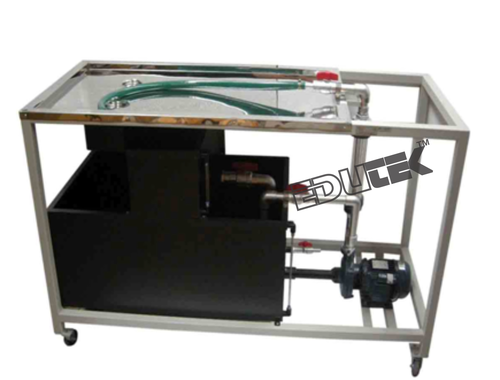
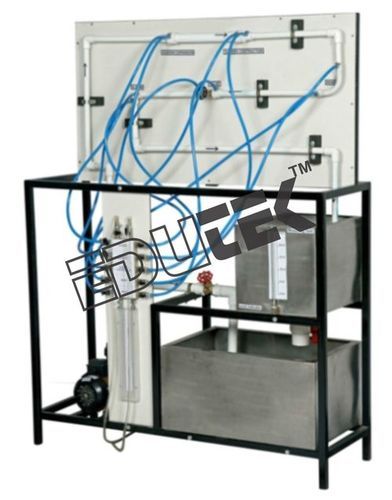
The Hydraulic Bench is of volumetric type and has been designed to provide continuous and controlled supply of water to conduct various experiments using auxiliary modules in typical Fluid Mechanics and Hydraulics Laboratory. The unit is an ideal service unit for conducting student projects. Once filled, no external water supply is required. Water is recycled between the Experiment Module, Measuring Tank and the Storage Tank by the Centrifugal Pump. Several experiments in Fluid Mechanics and Hydraulics require continuous and controlled supply of water. The Basic Hydraulic Bench provides a controlled recirculation water supply to conduct experiments.
The Basic Hydraulic Bench is a very important module and is recommended for all Fluid Mechanics and Hydraulics Laboratories in Educational Institutions. It is a basic module for flow related experiments using auxiliary modules.
A list of common experiments that can be conducted using the Basic Hydraulic Bench is given below:
1. Impact of a Jet2. Flow over Weirs3. Bernoulli Theorem Demonstration4. Orifice Discharge5. Energy Loss in Bends6. Osborne Reynolds Demonstration7. Energy Loss in Pipes8. Hydrostatic Pressure9. Flow Visualization in Channels10. Dead Weight Calibrator11. Metacentric Height12. Series & Parallel Pumps13. Centrifugal Pump Characteristics14. Free and Forced Vortices15. Water Hammer16. Pelton Turbine17. Orifice & Free Jet Flow18. Flow Meter Demonstration19. Cavitations Phenomenon Demonstration20. Laminar Flow Demonstration21. Radial Flow Turbine22. Venturi, Bernouli and Cavitation 23. Pipe Friction Apparatus 24. Equipment for the Study of Porous Beds in Venturi Tubes 25. Flow Channel 1m Length 26. Depression Measurement System (Vacuum Gauge) 27. Axial Flow Turbine 28. Pump Impeller Display Panel
- Self contained and fully portable mobile unit with welded frame.
- Light weight body made of reinforced fiber glass and corrosion resistant materials.
- Closed water circuit consisting of Measuring Tank, Storage Tank and the Centrifugal Pump.
- Control valve to regulate the pump and adjust the flow rate.
- Work space on Bench Top has integrated flow channel for flow measurements using
- Weirs and is fitted with stepped edge to ensure safe and easy mounting of experiment modules.
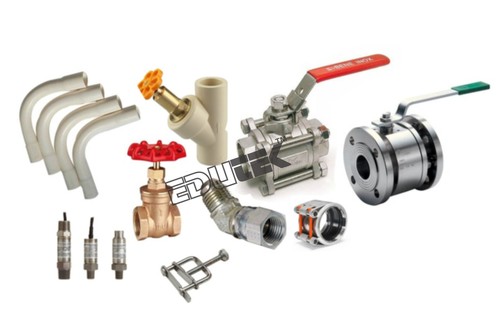
- 6. Suitable pipe connectors are provided in the Bench Top to enable easy change of experiment modules.
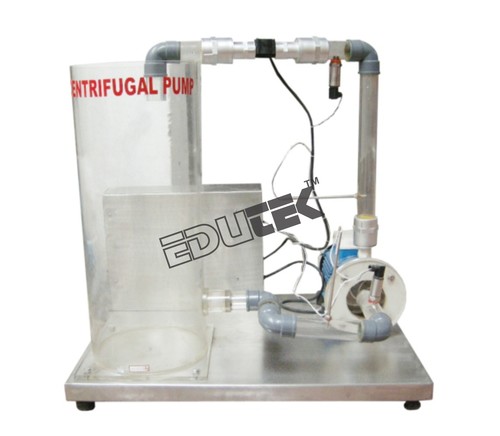
- Graduated and stepped Measuring Tank for both low and high volume flow rates. Level Indicators for water level are provided in the Open Channel and Measuring Tank.
- Variable area Flow Meter (10-75 liters per minute) is also provided to measure flow rate independently.
- Stilling baffles are provided to reduce turbulence.
- Sight tube with scale provided to indicate instantaneous water level.
- Bulls eye level is provided to ensure proper position of the Bench and accurate reading of levels.
- Remote Actuator provided to operate the Dump Valve at the base of Measuring Tank
- Over Flow provided in Measuring Tank to avoid flooding.
- Separate Storage Tank Outlet facility provided to enable the Bench to be used in any hydraulic circuit.
- Push button starter provided for the centrifugal pump.
- Power supply includes over-load and under-voltage protection.
Precision Control & MeasurementThe hydraulic bench integrates a by-pass valve for precise flow control. An analog flow meter offers measurements within 1% accuracy across a range of 0.510 L/min, making it highly reliable for a spectrum of laboratory fluid mechanics investigations.
Convenient Operation & MaintenanceDesigned for practicality, the bench features quick release fittings, a removable cleaning panel, and a quick lock drain facility. The integrated water reservoir simplifies operation and reduces set-up time, ensuring seamless transitions between experiments.
Robust & Portable DesignWith epoxy-coated mild steel framework, stainless steel and acrylic components, and sturdy caster wheels, the hydraulic bench demonstrates long-term durability, corrosion resistance, and excellent mobility for dynamic academic environments.
FAQs of Hydraulic Bench:
Q: How is the hydraulic bench maintained between experiments?
A: Routine maintenance involves draining water using the quick-lock facility, wiping surfaces with a non-abrasive cloth, and using the removable cleaning panel for thorough access to the tank and internal components. Regular cleaning prevents residue buildup and maintains hygiene.
Q: What experiments can be performed using this hydraulic bench?
A: The bench is specifically designed for fluid mechanics laboratory experiments, such as measuring flow rates, determining pump performance, and observing hydraulic phenomena. Its modular quick release connections allow compatibility with a variety of experiment modules.
Q: When should the overload protection feature be utilized?
A: The built-in overload protection operates automatically to safeguard the motor during power surges or excessive load conditions. No manual intervention is required, but it ensures the safety of both equipment and user whenever such anomalies occur.
Q: Where can the hydraulic bench be installed for optimal performance?
A: It is best placed in a level, well-ventilated laboratory environment close to a power source (220240V AC). Its portable, caster-mounted design allows for flexible positioning within teaching or research areas.
Q: What benefits does the corrosion resistant construction provide?
A: Corrosion resistance, ensured by 304 grade stainless steel and powder coated mild steel, extends the operational life of the bench, reduces maintenance, and sustains consistent performance even in humid laboratory conditions.
Q: How does the quick release fitting system enhance experiment setup?
A: Quick release fittings enable fast, tool-free attachment and removal of experiment modules. This promotes efficiency and flexibility, so users can change or reconfigure apparatus without significant downtime.
Q: What is the advantage of the analog flow meter and fine adjustment control?
A: The analog flow meter offers real-time, highly accurate readings within 1% of the full scale, while the fine adjustment by-pass valve allows meticulous flow regulation, supporting precise data collection and experimental integrity.





 Send Inquiry
 Send Inquiry

