About FUNNEL, BUECHNER, POLYPROPYLENE
FUNNEL, BUECHNER, POLYPROPYLENE
Lightweight and durable.Bottom and top can be separated for easierc leaning
| Funnel Top | Stem Top | Cap Volume | Height Filter Paper |
| i.d(mm) | o.d.×length(mm) | (ml) | (mm)Size(mm) |
| 11×65 | 146 | 186 | 146 70 |
| 22×93 | 213 | 919 | 213 110 |
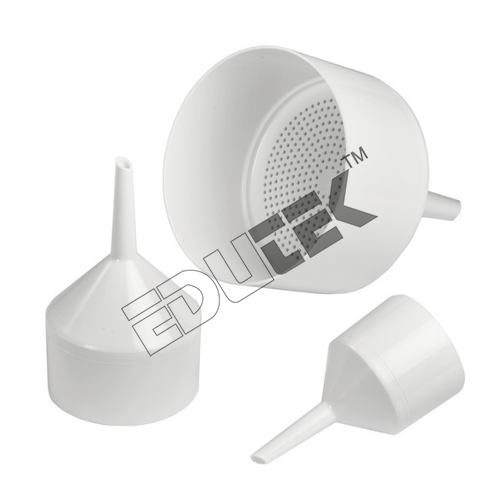
High-Performance FiltrationDesigned explicitly for laboratory filtration tasks, this Buechner funnel enables precise and efficient separation of solids from liquids. Its robust perforated plate ensures even distribution during vacuum filtration, optimizing throughput while maintaining clarity in results. The autoclavable polypropylene construction maintains purity throughout the process.
Built for Durability and SafetyManufactured from premium polypropylene, the funnel is lightweight but highly resistant to acids, bases, and high temperatures, making it ideal for rigorous laboratory environments. Its autoclavable characteristic allows repeated sterilization without deformation, ensuring ongoing safety and reliability.
Versatile Laboratory ApplicationsAvailable in multiple diameters and capacities, the Buechner funnel adapts to a wide range of lab protocols. Its compatibility with vacuum filtration processes makes it suitable for microbiology, analytical chemistry, and pharmaceutical testing, ensuring researchers have dependable filtration at hand.
FAQs of FUNNEL, BUECHNER, POLYPROPYLENE:
Q: How is the Buechner funnel used in laboratory filtration?
A: The Buechner funnel is typically used with a vacuum filtration setup to separate solids from liquids. Filter paper is placed over the perforated plate, the mixture is poured in, and a vacuum is applied to draw liquid through the filter for efficient separation.
Q: What makes this Buechner funnel suitable for vacuum filtration?
A: Its robust polypropylene material, flat perforated plate, and cylindrical shape ensure stable operation under vacuum pressure. The design facilitates consistent filtration without collapsing or reacting with chemicals.
Q: When should I choose a polypropylene funnel over glass for lab filtration?
A: Opt for polypropylene when chemical resistance, lightweight handling, and high durability are required. Additionally, this funnel can be autoclaved repeatedly without risk of glass breakage, making it especially practical for busy laboratories.
Q: Where can I find information on available sizes and capacities?
A: A size chart containing diameter and capacity options (from 60ml to 2000ml) is available for reference. For more details, consult the supplier or manufacturers catalog.
Q: What is the process for cleaning and sterilizing this funnel?
A: After use, the funnel can be cleaned with standard laboratory detergents and rinsed thoroughly. For sterilization, it can be safely autoclaved at temperatures up to 120C, retaining its integrity over repeated cycles.
Q: What are the benefits of using a polypropylene Buechner funnel?
A: Benefits include excellent chemical and temperature resistance, lightweight handling, easy cleaning, and repeated autoclaving. These features ensure reliable, safe, and cost-effective filtration in various laboratory applications.