About Crushing Strength Apparatus
CRUSHING STRENGTH APPARATUS
-
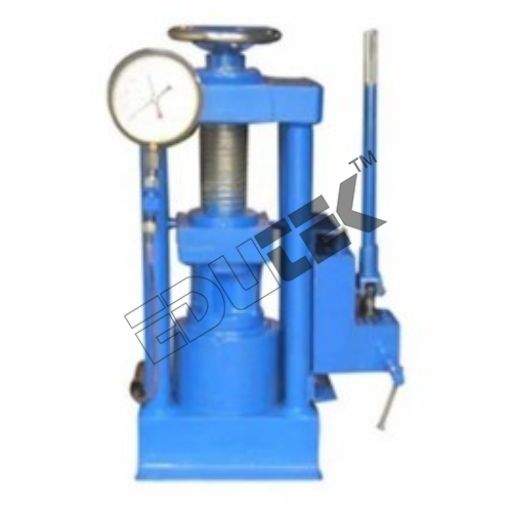
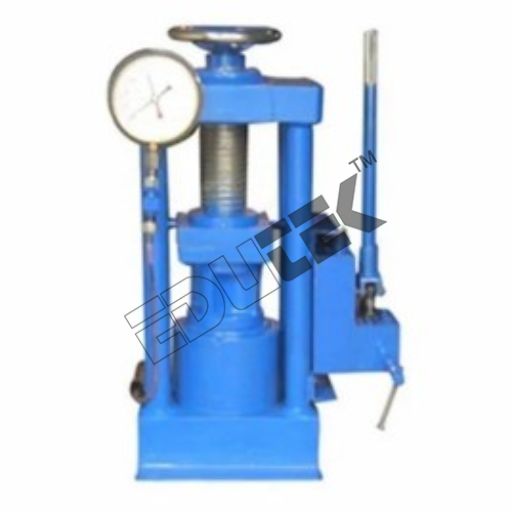
In these load frames C channels are used, they are welded at the top as well as bottom and with stand high loads. A hydraulic jack is fitted at center of the base of the load frame, over which can be fitted lower platen and spacer block with the help of centering pin. A lead screw passes through the top of the frame. To the lower end of this lead screw is fixed the upper platen with spherical seat for self alignment. The platens are accurately machined, hardened and polished. The lower platen grooves to correctly place the specimen.
- Vol: 5lb
- Stroke 5.9" (150 mm)
- Travel Rate 3 mm/wheel turn (approximately)
Reliable and Versatile Strength TestingThis apparatus is engineered for strength testing of solid specimens such as tablets or materials in pharmaceuticals, cement, and chemical industries. Its adjustable sample holder, heavy-duty build, and compliance with IS and ASTM standards ensure durability, adaptability, and precision in testing applications.
User-Friendly Manual OperationFeaturing a straightforward screw-type loading mechanism operated by a hand wheel, the apparatus offers manual control for precise testing. An analog dial gauge (with optional digital display) allows for easy and accurate measurement readings, supported by factory calibration and an available calibration certificate.
Comprehensive and Durable ConstructionConstructed from powder-coated mild steel and cast iron, this tester stands up to rigorous industrial use. With dimensions of approximately 250mm x 150mm x 280mm and a weight of around 30kg, it combines portability with ruggedness, making it ideal for various laboratory and production environments.
FAQs of Crushing Strength Apparatus:
Q: How does the Crushing Strength Apparatus measure strength of solid specimens?
A: The apparatus uses a manual screw-type loading mechanism to apply a compressive force to the sample, while a Bourdon tube analog dial gauge (or optional digital indicator) measures the applied pressure until the specimen fails, providing accurate strength values up to 500 kg/cm.
Q: What industries benefit most from using this Crushing Strength Apparatus?
A: Pharmaceutical, cement, and chemical industries, as well as research laboratories that require reliable measurement of tablet or material compressive strength, benefit greatly from its precision, compliance with standards, and robust build.
Q: Where should the Crushing Strength Apparatus be placed for operation?
A: Its best to use the apparatus in controlled laboratory settings or quality control areas with ambient temperatures up to 40C, ensuring a stable bench or workspace for reliable and repeatable testing results.
Q: When is calibration or re-calibration necessary for this equipment?
A: Each apparatus is factory calibrated before shipping and a calibration certificate is available upon request. Periodic re-calibration is recommended according to industry or laboratory standards to maintain measurement accuracy.
Q: What is the process involved in operating the Crushing Strength Tester?
A: To use the tester, place the specimen in the adjustable holder, gradually apply load using the hand wheel, and observe the pressure gauge until failure occurs. The maximum dial reading reflects the crushing strength of the specimen.
Q: Why choose a model with optional digital load indication?
A: A digital load indication offers enhanced readability and recording of results compared to the standard analog dial, supporting users who require electronic data capture or greater precision in reading measurements.
Q: What accessories and documentation come with the Crushing Strength Apparatus?
A: The apparatus includes adjustable and replaceable sample holders and an instruction manual, with a calibration certificate available upon request to support compliance and operational accuracy.






 Send Inquiry
 Send Inquiry

